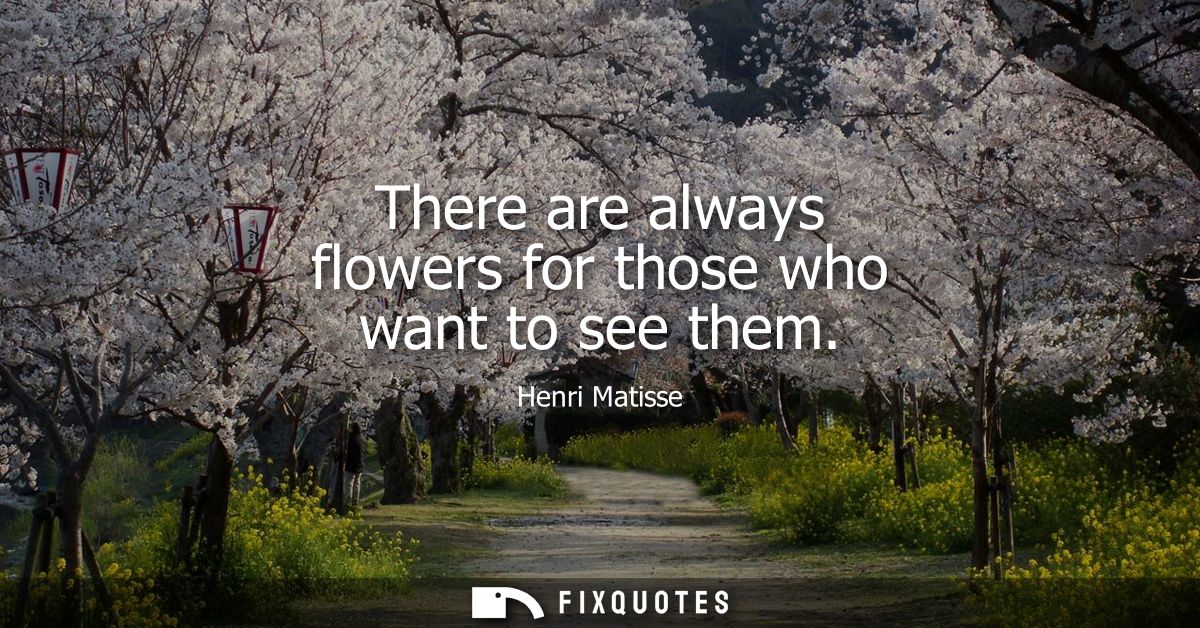
"There are always flowers for those who want to see them"
About this Quote
Matisse’s line is a small manifesto disguised as a gentle reminder. “There are always flowers” doesn’t claim the world is consistently kind; it claims that beauty is an available medium, like paint, and the viewer’s attention is the brush. The sentence turns aesthetics into an active verb. Flowers aren’t merely present; they’re granted to “those who want to see them,” a phrase that makes perception sound like desire, discipline, even defiance.
That framing matters in Matisse’s context. He worked through war, illness, and the churn of modernity, insisting on color and pleasure when seriousness was the fashionable posture of the age. His late cut-outs, made when he was physically limited, are practically an argument for this quote: if the body narrows your world, you widen your seeing. The subtext isn’t naive optimism; it’s an artist’s strategy for survival. Attention becomes a tool for reclaiming agency when circumstances can’t be controlled.
The line also smuggles in a democratic provocation. Flowers are not museums, not passports, not elite education. They’re the everyday, the overlooked, the thing you pass on the way to “important” life. Matisse suggests that the scarcity isn’t beauty itself but our willingness to register it. In a culture that trains us to look for threats, status, and productivity, “wanting to see” reads like a quiet refusal: the choice to prize sensuous experience, to practice noticing, to let joy count as a serious act.
That framing matters in Matisse’s context. He worked through war, illness, and the churn of modernity, insisting on color and pleasure when seriousness was the fashionable posture of the age. His late cut-outs, made when he was physically limited, are practically an argument for this quote: if the body narrows your world, you widen your seeing. The subtext isn’t naive optimism; it’s an artist’s strategy for survival. Attention becomes a tool for reclaiming agency when circumstances can’t be controlled.
The line also smuggles in a democratic provocation. Flowers are not museums, not passports, not elite education. They’re the everyday, the overlooked, the thing you pass on the way to “important” life. Matisse suggests that the scarcity isn’t beauty itself but our willingness to register it. In a culture that trains us to look for threats, status, and productivity, “wanting to see” reads like a quiet refusal: the choice to prize sensuous experience, to practice noticing, to let joy count as a serious act.
Quote Details
| Topic | Optimism |
|---|---|
| Source | Verified source: Jazz (Henri Matisse, 1947)
Evidence: Il y a des fleurs partout pour qui veut bien les voir. (Page 134 (French text page numbering shown in the source image)). The commonly-circulated English quote (“There are always flowers for those who want to see them”) appears to be a translation/paraphrase of Matisse’s original French line in his artist’s book *Jazz* (Paris: Tériade, 1947). The Harvard Art Museums record provides an image of the *Jazz* text page numbered 134 containing this sentence in Matisse’s handwriting, which is strong primary evidence for the wording and its appearance in the 1947 publication. Note that the English version often replaces “partout” (“everywhere”) with “always,” so the popular English phrasing is not a strictly literal translation of the French original. Other candidates (1) Brain Teaser Cryptogram Puzzle (2022) compilation95.0% ... Henri Frederic Amiel 114. The mind is its own place, and in itself can make a Heaven of Hell, a Hell of Heaven ..... |
| Cite |
Citation Formats
APA Style (7th ed.)
Matisse, Henri. (2026, February 8). There are always flowers for those who want to see them. FixQuotes. https://fixquotes.com/quotes/there-are-always-flowers-for-those-who-want-to-121017/
Chicago Style
Matisse, Henri. "There are always flowers for those who want to see them." FixQuotes. February 8, 2026. https://fixquotes.com/quotes/there-are-always-flowers-for-those-who-want-to-121017/.
MLA Style (9th ed.)
"There are always flowers for those who want to see them." FixQuotes, 8 Feb. 2026, https://fixquotes.com/quotes/there-are-always-flowers-for-those-who-want-to-121017/. Accessed 12 Feb. 2026.
More Quotes by Henri
Add to List