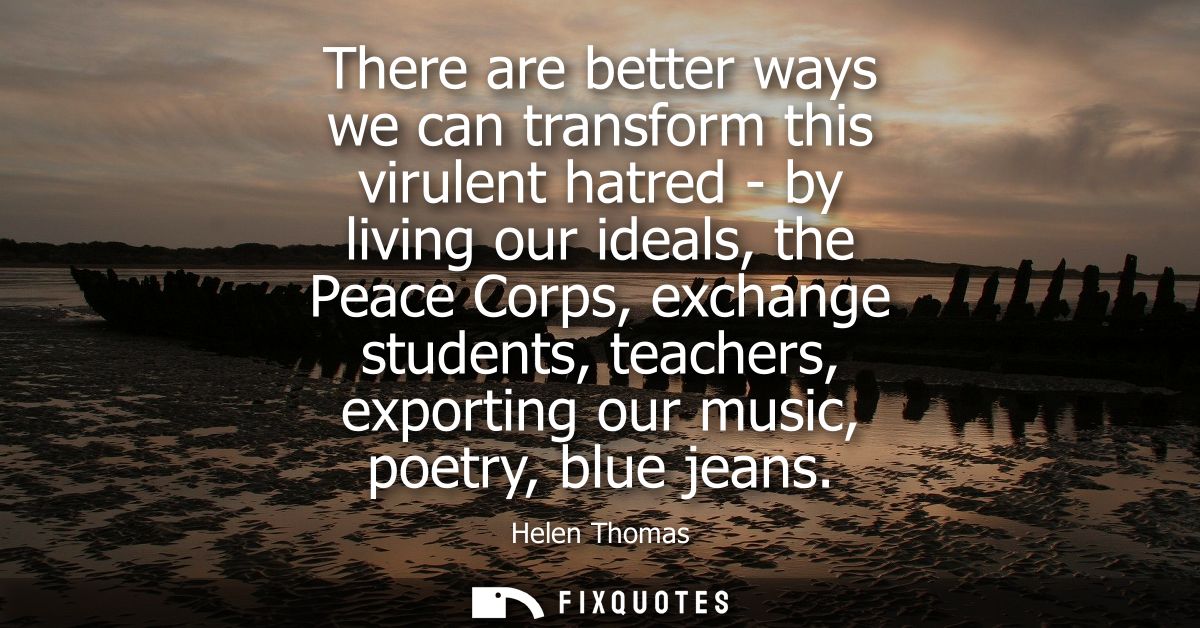
"There are better ways we can transform this virulent hatred - by living our ideals, the Peace Corps, exchange students, teachers, exporting our music, poetry, blue jeans"
About this Quote
Thomas's phrasing works because it treats culture as infrastructure. "Living our ideals" comes first, setting a moral baseline before the exports begin. Then the items tumble out in a sequence that moves from civic service (Peace Corps) to human contact (exchange students) to institutions that reproduce a society (teachers) to the messy seductions of popular culture ("music, poetry, blue jeans"). It's a rhetorical braid: conscience, connection, cool. The blue jeans kicker is pointedly quotidian, suggesting that influence often travels through the ordinary and the aspirational, not the official.
Context matters: Thomas spent decades inside the machinery of American power, watching how governments justify violence as necessity while underestimating the blowback. Her word choice, "transform", implies hatred is not a fixed identity but a condition with causes and levers. It's also a subtle rebuke to the reflex of answering rage with force. You don't "win" a relationship with a drone. You might, however, complicate the story people are told about you by showing up in their classrooms, their host families, their playlists, their streets.
Quote Details
| Topic | Peace |
|---|---|
| Source | Help us find the source |
| Cite |
Citation Formats
APA Style (7th ed.)
Thomas, Helen. (2026, January 17). There are better ways we can transform this virulent hatred - by living our ideals, the Peace Corps, exchange students, teachers, exporting our music, poetry, blue jeans. FixQuotes. https://fixquotes.com/quotes/there-are-better-ways-we-can-transform-this-79730/
Chicago Style
Thomas, Helen. "There are better ways we can transform this virulent hatred - by living our ideals, the Peace Corps, exchange students, teachers, exporting our music, poetry, blue jeans." FixQuotes. January 17, 2026. https://fixquotes.com/quotes/there-are-better-ways-we-can-transform-this-79730/.
MLA Style (9th ed.)
"There are better ways we can transform this virulent hatred - by living our ideals, the Peace Corps, exchange students, teachers, exporting our music, poetry, blue jeans." FixQuotes, 17 Jan. 2026, https://fixquotes.com/quotes/there-are-better-ways-we-can-transform-this-79730/. Accessed 12 Feb. 2026.