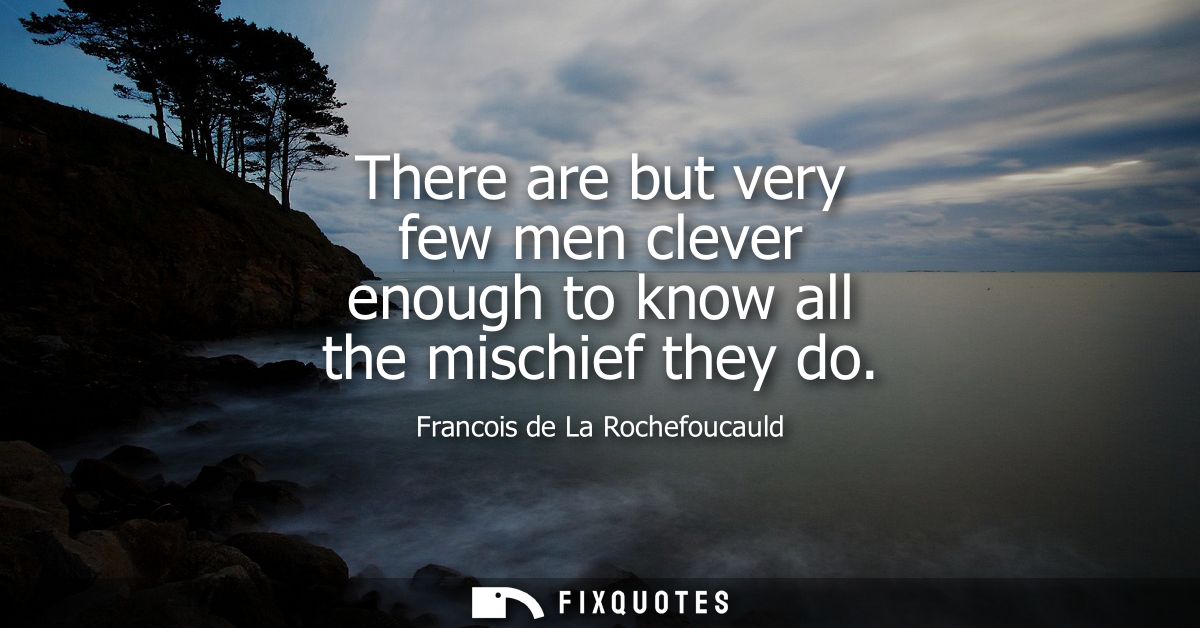
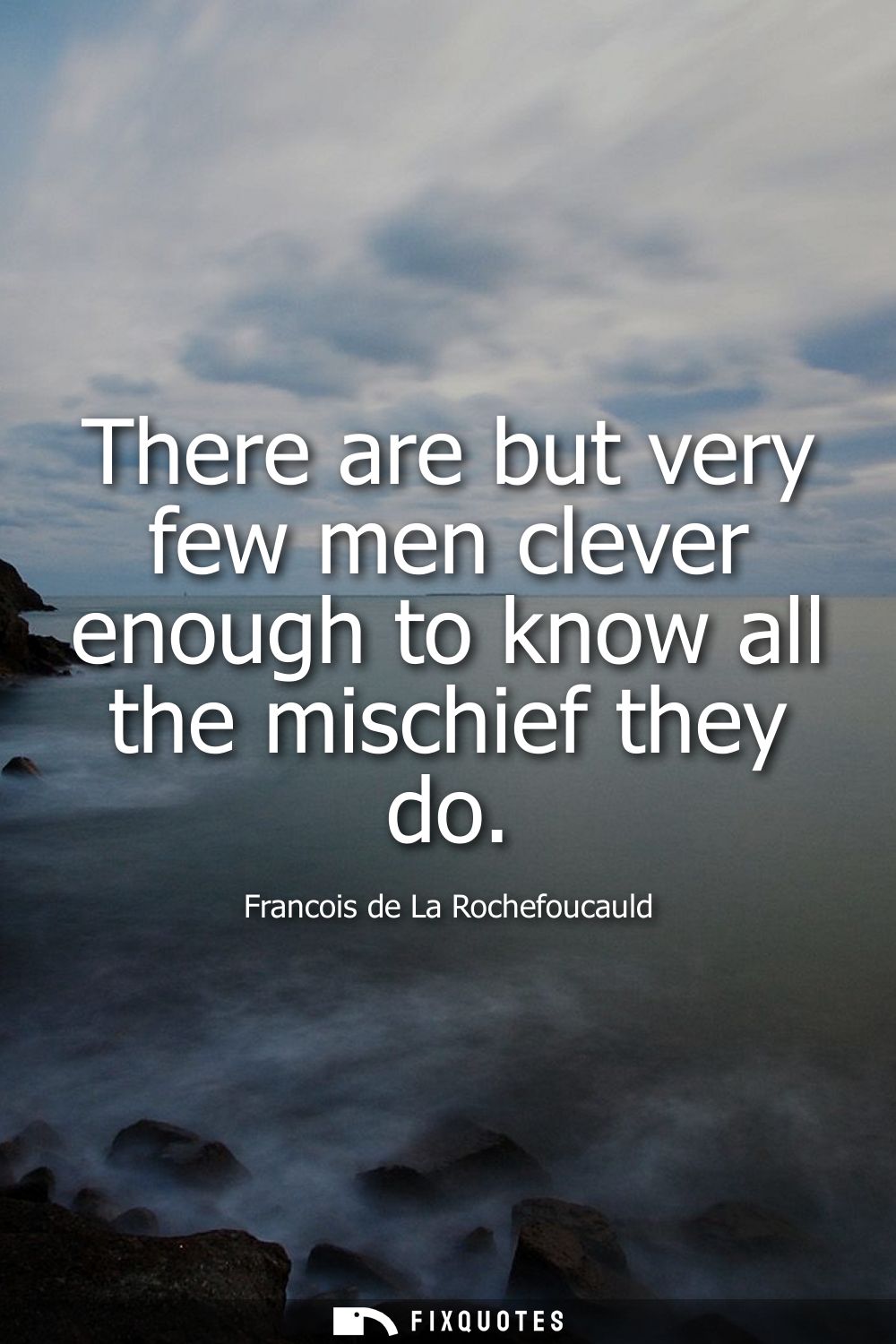
"There are but very few men clever enough to know all the mischief they do"
About this Quote
A perfect La Rochefoucauld needle: it flatters the reader’s intelligence while quietly stripping everyone else of theirs. On the surface, it’s a jab at incompetence. Underneath, it’s more corrosive: most harm isn’t committed by comic-book villains who understand their impact and proceed anyway. It’s produced by people who are too self-satisfied, too distracted, or too morally lazy to notice what their choices set in motion.
The line works because it weaponizes “clever enough” as a moral category. Cleverness isn’t praise here; it’s the rare, bleak capacity to see the full blast radius of your behavior. That twist is very Rochefoucauld: virtue and vice are often just vanity in better clothes, and self-knowledge is scarce. The subtext is that we routinely confuse good intentions with good outcomes, then use ignorance as a kind of alibi. If you can’t “know all the mischief,” you can always claim you didn’t mean it.
Context sharpens the cynicism. Writing in 17th-century France, in the orbit of court politics and salon life, La Rochefoucauld watched reputations rise and fall on insinuation, patronage, and small acts with large consequences. His maxims are built for that ecosystem: a world where people injure each other through etiquette, ambition, and “reasonable” self-interest more than through open malice.
The sting is contemporary because it anticipates modern systems talk without the comforting jargon. Most damage is structural, indirect, dispersed. Few people are clever enough to trace the chain from choice to consequence, which means mischief thrives in the gap between action and accountability.
The line works because it weaponizes “clever enough” as a moral category. Cleverness isn’t praise here; it’s the rare, bleak capacity to see the full blast radius of your behavior. That twist is very Rochefoucauld: virtue and vice are often just vanity in better clothes, and self-knowledge is scarce. The subtext is that we routinely confuse good intentions with good outcomes, then use ignorance as a kind of alibi. If you can’t “know all the mischief,” you can always claim you didn’t mean it.
Context sharpens the cynicism. Writing in 17th-century France, in the orbit of court politics and salon life, La Rochefoucauld watched reputations rise and fall on insinuation, patronage, and small acts with large consequences. His maxims are built for that ecosystem: a world where people injure each other through etiquette, ambition, and “reasonable” self-interest more than through open malice.
The sting is contemporary because it anticipates modern systems talk without the comforting jargon. Most damage is structural, indirect, dispersed. Few people are clever enough to trace the chain from choice to consequence, which means mischief thrives in the gap between action and accountability.
Quote Details
| Topic | Ethics & Morality |
|---|
More Quotes by Francois
Add to List