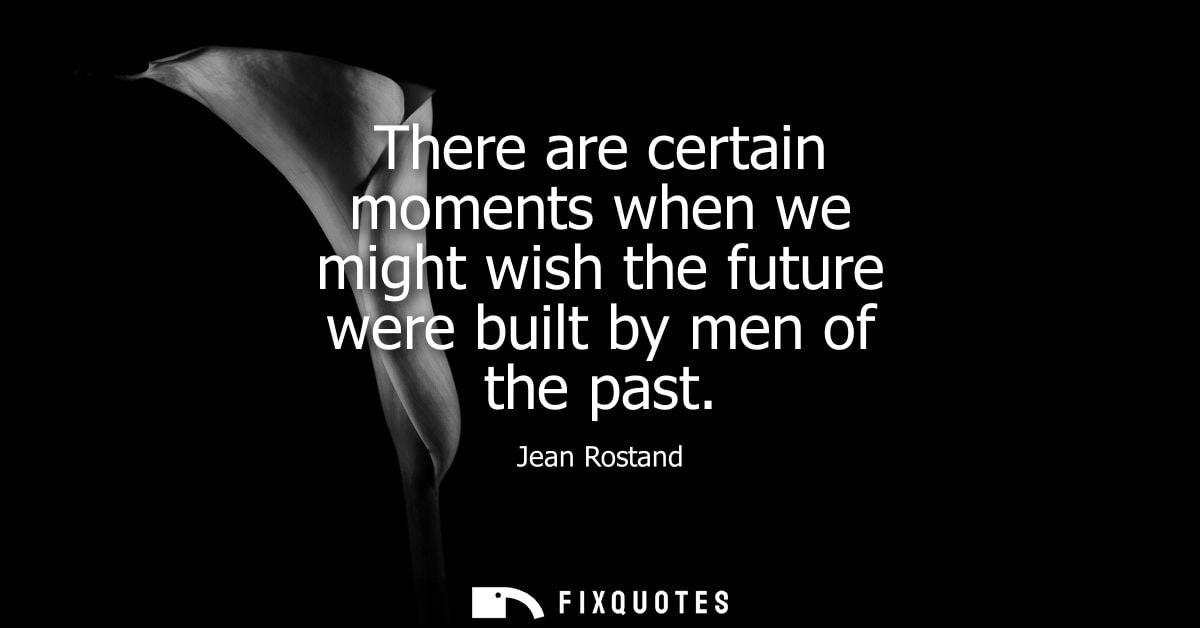
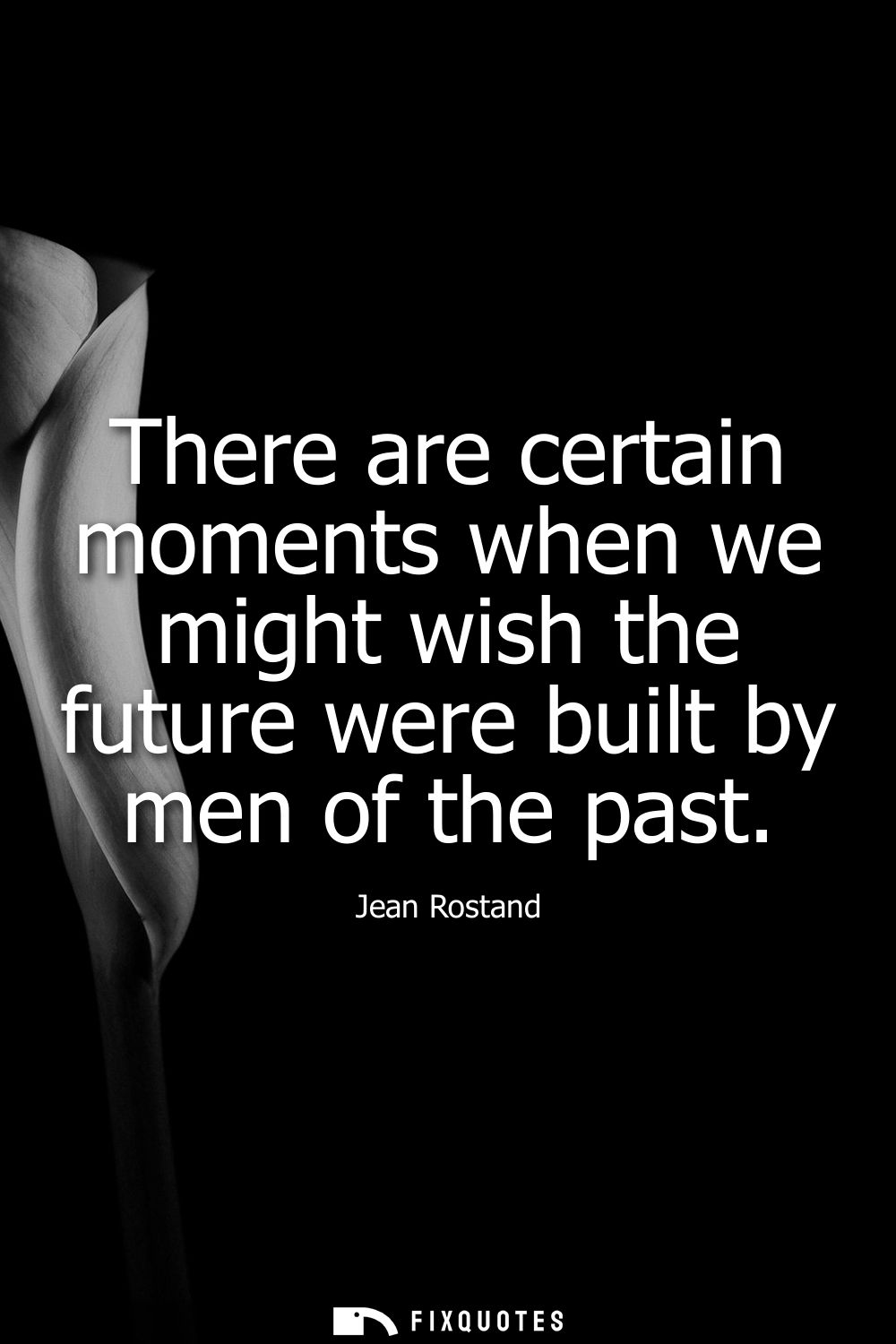
"There are certain moments when we might wish the future were built by men of the past"
About this Quote
The provocation sits in that final pivot: “built by men of the past.” Rostand isn’t canonizing earlier generations so much as invoking them as a missing constraint. “Men of the past” reads as a stand-in for slower tempos, thicker social friction, and a greater sense that actions had visible consequences. Modernity, by contrast, gives us tools that are abstract, scalable, and hard to un-invent. When you can change life at the cellular level, or annihilate cities at the push of a button, the old virtues of hesitation and limits stop looking quaint and start looking like guardrails.
Context matters: Rostand lived through two world wars, the rise of industrialized killing, and the early decades of genetics and bioethics debates. For a biologist-philosopher, the nightmare isn’t science itself; it’s science yoked to ambition, nationalism, or market incentives. The subtext is a grim compliment to earlier eras: they lacked our power, and that ignorance sometimes doubled as safety.
Quote Details
| Topic | Nostalgia |
|---|---|
| Source | Help us find the source |
| Cite |
Citation Formats
APA Style (7th ed.)
Rostand, Jean. (2026, January 18). There are certain moments when we might wish the future were built by men of the past. FixQuotes. https://fixquotes.com/quotes/there-are-certain-moments-when-we-might-wish-the-11596/
Chicago Style
Rostand, Jean. "There are certain moments when we might wish the future were built by men of the past." FixQuotes. January 18, 2026. https://fixquotes.com/quotes/there-are-certain-moments-when-we-might-wish-the-11596/.
MLA Style (9th ed.)
"There are certain moments when we might wish the future were built by men of the past." FixQuotes, 18 Jan. 2026, https://fixquotes.com/quotes/there-are-certain-moments-when-we-might-wish-the-11596/. Accessed 4 Apr. 2026.