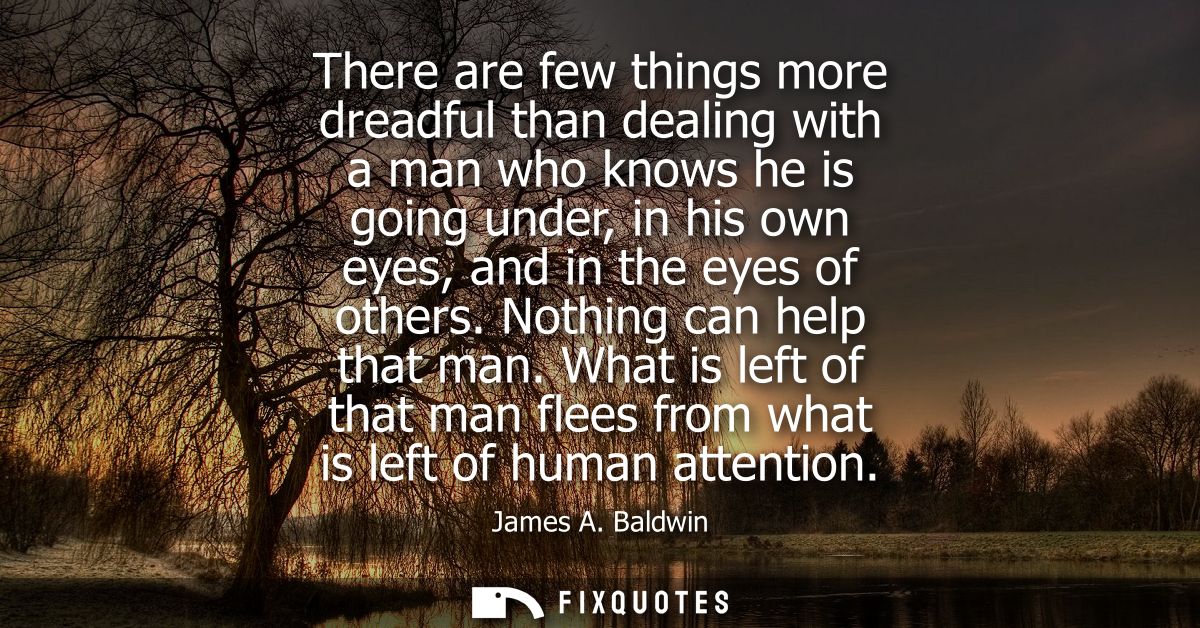
"There are few things more dreadful than dealing with a man who knows he is going under, in his own eyes, and in the eyes of others. Nothing can help that man. What is left of that man flees from what is left of human attention"
About this Quote
The subtext is Baldwin’s core preoccupation: what human attention does, and what its withdrawal destroys. “In his own eyes, and in the eyes of others” is the trapdoor. Once self-contempt and public contempt synchronize, assistance becomes suspicious, even humiliating. The person can’t receive help because receiving it would require believing in a future the world has already foreclosed. So “what is left” - a phrase that keeps stripping the subject down - doesn’t fight back; it flees. Not from danger, but from being seen. Attention, for Baldwin, is not mere observation; it’s a moral relationship. Lose it, and you’re not just lonely, you’re socially dead.
Contextually, the line sits comfortably in Baldwin’s mid-century America: a culture eager to brand people - Black men especially - as doomed, criminal, “already gone.” He’s describing the human wreckage left by stigma, and the chilling way it spreads: even decent people recoil, because to look too closely is to confront their own complicity.
Quote Details
| Topic | Loneliness |
|---|---|
| Source | Help us find the source |
| Cite |
Citation Formats
APA Style (7th ed.)
Baldwin, James A. (2026, January 18). There are few things more dreadful than dealing with a man who knows he is going under, in his own eyes, and in the eyes of others. Nothing can help that man. What is left of that man flees from what is left of human attention. FixQuotes. https://fixquotes.com/quotes/there-are-few-things-more-dreadful-than-dealing-23760/
Chicago Style
Baldwin, James A. "There are few things more dreadful than dealing with a man who knows he is going under, in his own eyes, and in the eyes of others. Nothing can help that man. What is left of that man flees from what is left of human attention." FixQuotes. January 18, 2026. https://fixquotes.com/quotes/there-are-few-things-more-dreadful-than-dealing-23760/.
MLA Style (9th ed.)
"There are few things more dreadful than dealing with a man who knows he is going under, in his own eyes, and in the eyes of others. Nothing can help that man. What is left of that man flees from what is left of human attention." FixQuotes, 18 Jan. 2026, https://fixquotes.com/quotes/there-are-few-things-more-dreadful-than-dealing-23760/. Accessed 27 Mar. 2026.