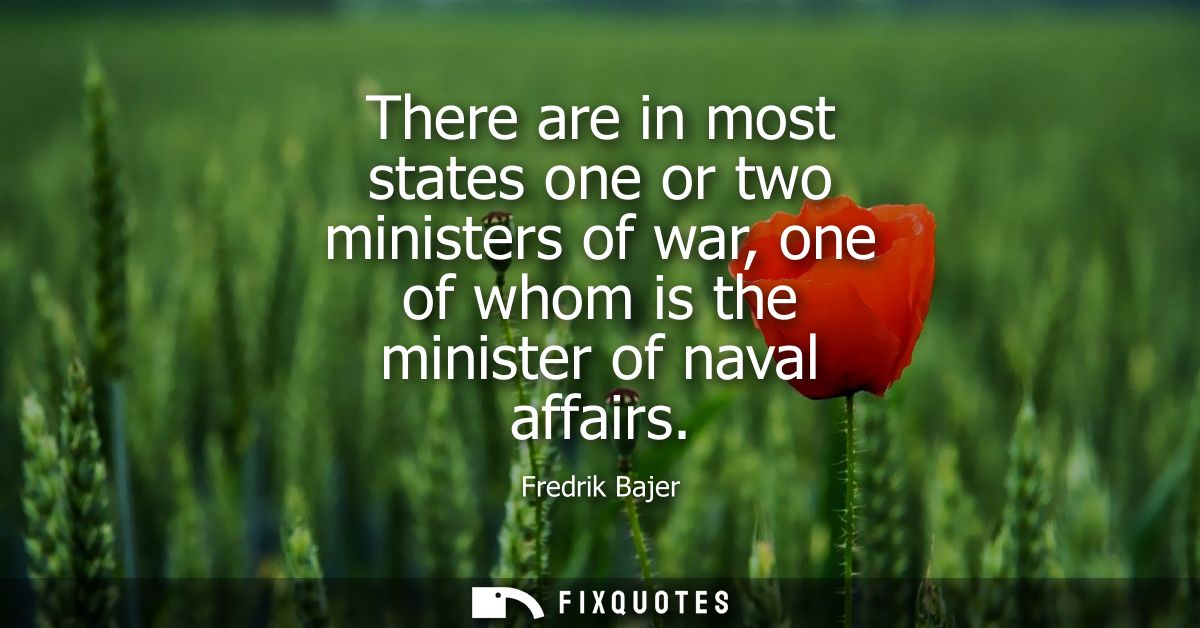
"There are in most states one or two ministers of war, one of whom is the minister of naval affairs"
About this Quote
The phrasing also exposes an absurd asymmetry. States are expected to maintain permanent war portfolios, yet peace rarely gets equivalent institutional dignity. There’s no “minister of peace” in the common cabinet lineup; peace is treated as the default, war as the planned project. Bajer flips that expectation: if war requires ministers, then war is not a last resort but an organized ambition.
Context matters. Bajer, a Danish writer and leading peace advocate (and later a Nobel Peace Prize laureate), wrote in an era when European powers were professionalizing militaries, expanding navies, and turning arms into prestige. His tone is deliberately unheated because the reality is already damning. By describing militarism as office furniture, he invites readers to see how violence persists not only through ideology, but through paperwork, budgets, and the comforting permanence of a job title.
Quote Details
| Topic | War |
|---|---|
| Source | Help us find the source |
| Cite |
Citation Formats
APA Style (7th ed.)
Bajer, Fredrik. (2026, January 17). There are in most states one or two ministers of war, one of whom is the minister of naval affairs. FixQuotes. https://fixquotes.com/quotes/there-are-in-most-states-one-or-two-ministers-of-61392/
Chicago Style
Bajer, Fredrik. "There are in most states one or two ministers of war, one of whom is the minister of naval affairs." FixQuotes. January 17, 2026. https://fixquotes.com/quotes/there-are-in-most-states-one-or-two-ministers-of-61392/.
MLA Style (9th ed.)
"There are in most states one or two ministers of war, one of whom is the minister of naval affairs." FixQuotes, 17 Jan. 2026, https://fixquotes.com/quotes/there-are-in-most-states-one-or-two-ministers-of-61392/. Accessed 22 Mar. 2026.