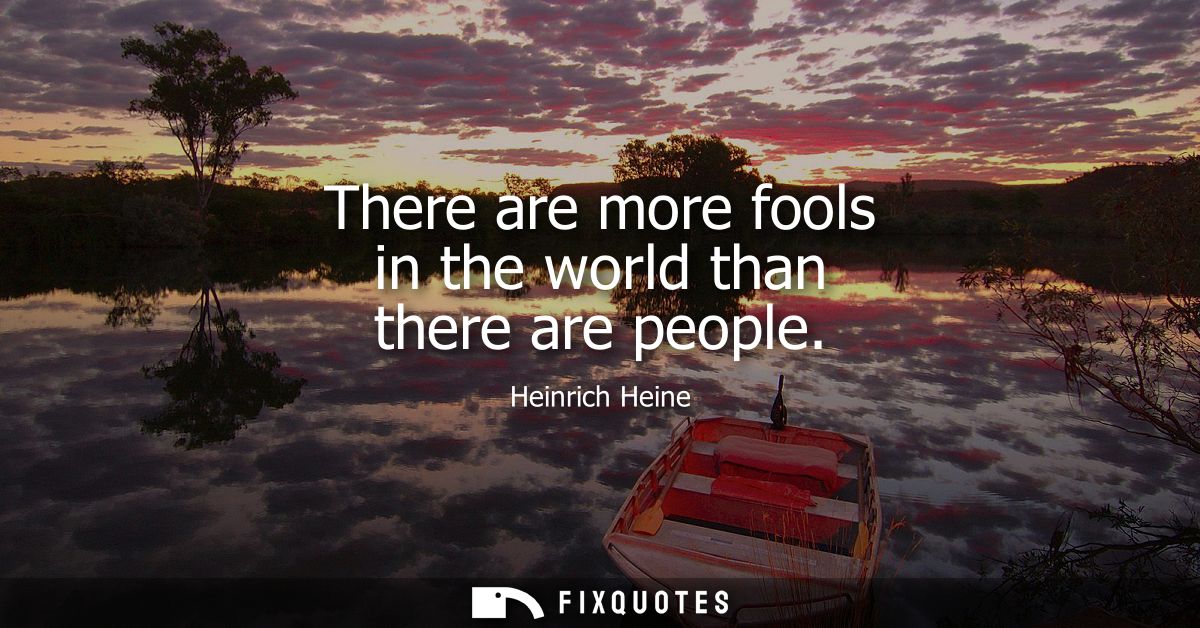
"There are more fools in the world than there are people"
About this Quote
Heine’s line is a neat little rigged trap: it sounds like a glib insult, then it quietly detonates a worldview. “More fools… than… people” isn’t a statistic; it’s a moral paradox. He’s implying that “personhood” is not guaranteed by having a pulse. In modern terms, he’s splitting the human into two categories: those who think, and those who merely participate. The joke is that the second group can outnumber the first without increasing the population at all.
That’s the subtext that gives the aphorism its bite. Heine isn’t just scorning ignorance; he’s mocking the way societies launder stupidity into legitimacy. A fool is not simply uninformed. A fool is someone who consents to cliché, who prefers the comfort of herd opinion to the inconvenience of judgment. The line’s brilliance is its economy: it flatters the reader’s desire to feel lucid while also hinting that anyone can slide from “people” to “fools” the moment they stop questioning.
Context matters. Heine lived through the long hangover of the French Revolution, the rise of bourgeois respectability, and the tightening grip of censorship in the German states. His work often skewered nationalism, piety, and the sanctimony of “serious” public life. Read against that backdrop, the quote feels less like misanthropy and more like a survival tool: a poet’s shorthand for navigating a world where crowds demand slogans and authorities demand obedience. It’s cynicism sharpened into a compass.
That’s the subtext that gives the aphorism its bite. Heine isn’t just scorning ignorance; he’s mocking the way societies launder stupidity into legitimacy. A fool is not simply uninformed. A fool is someone who consents to cliché, who prefers the comfort of herd opinion to the inconvenience of judgment. The line’s brilliance is its economy: it flatters the reader’s desire to feel lucid while also hinting that anyone can slide from “people” to “fools” the moment they stop questioning.
Context matters. Heine lived through the long hangover of the French Revolution, the rise of bourgeois respectability, and the tightening grip of censorship in the German states. His work often skewered nationalism, piety, and the sanctimony of “serious” public life. Read against that backdrop, the quote feels less like misanthropy and more like a survival tool: a poet’s shorthand for navigating a world where crowds demand slogans and authorities demand obedience. It’s cynicism sharpened into a compass.
Quote Details
| Topic | Witty One-Liners |
|---|---|
| Source | Help us find the source |
| Cite |
Citation Formats
APA Style (7th ed.)
Heine, Heinrich. (2026, January 15). There are more fools in the world than there are people. FixQuotes. https://fixquotes.com/quotes/there-are-more-fools-in-the-world-than-there-are-33238/
Chicago Style
Heine, Heinrich. "There are more fools in the world than there are people." FixQuotes. January 15, 2026. https://fixquotes.com/quotes/there-are-more-fools-in-the-world-than-there-are-33238/.
MLA Style (9th ed.)
"There are more fools in the world than there are people." FixQuotes, 15 Jan. 2026, https://fixquotes.com/quotes/there-are-more-fools-in-the-world-than-there-are-33238/. Accessed 5 Apr. 2026.
More Quotes by Heinrich
Add to List