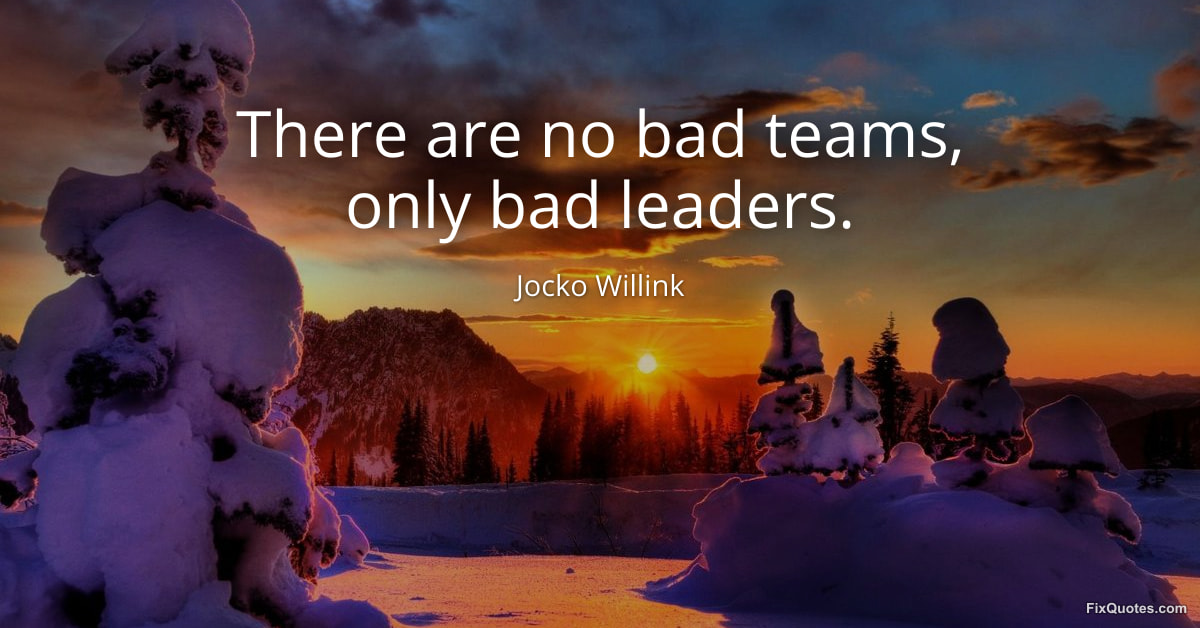
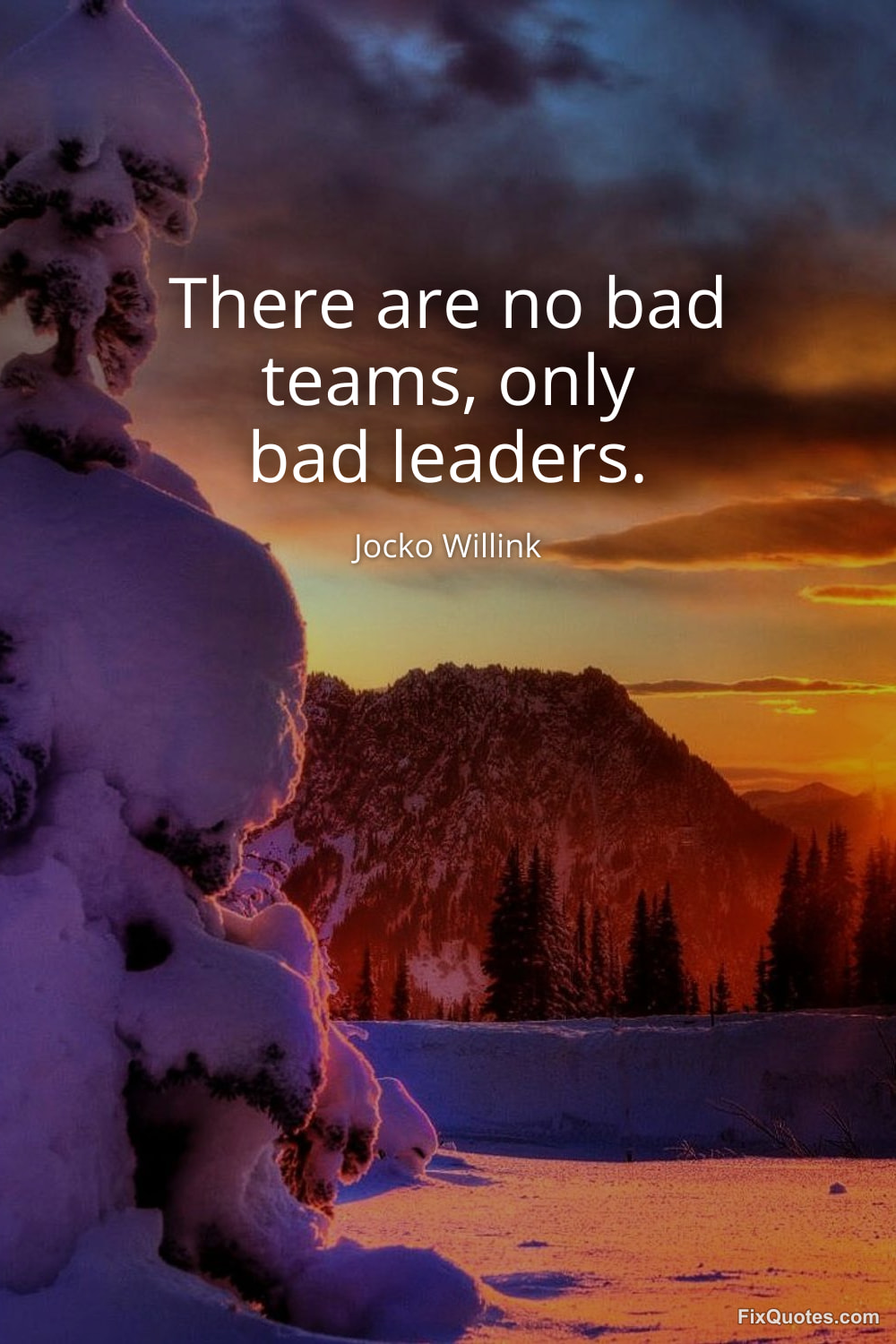
"There are no bad teams, only bad leaders"
About this Quote
Accountability gets weaponized here, and that is exactly the point. “There are no bad teams, only bad leaders” is a provocation disguised as a morale poster: it yanks failure upward, away from the comforting story that “the people” or “the culture” were the problem. Coming from Jocko Willink, a Navy SEAL-turned-management brand, the line carries battlefield DNA. In combat, blaming the “team” is useless; the leader is the system. The sentence is built like an order: short, absolute, non-negotiable.
Its intent is motivational, but the subtext is disciplinary. If outcomes are your fault, then improvement is your job. That’s empowering for subordinates (you don’t have to wait for better coworkers), but it’s also a warning to leaders who hide behind process, HR language, or “talent gaps.” Willink’s whole ethos of “extreme ownership” lives inside that word “only,” which leaves no escape hatch.
The rhetorical trick is the binary. “No bad teams” is an exaggeration that forces a decision: either you accept responsibility or you’re making excuses. As cultural advice, it flatters a certain modern appetite for control in a chaotic workplace. As a leadership doctrine, it’s also controversial: it downplays structural realities (understaffing, incentives, politics) and individual agency (there are, in fact, chronically toxic performers). The line works because it’s less a sociological claim than a commandment. It doesn’t describe the world; it attempts to remake the leader’s posture inside it.
Its intent is motivational, but the subtext is disciplinary. If outcomes are your fault, then improvement is your job. That’s empowering for subordinates (you don’t have to wait for better coworkers), but it’s also a warning to leaders who hide behind process, HR language, or “talent gaps.” Willink’s whole ethos of “extreme ownership” lives inside that word “only,” which leaves no escape hatch.
The rhetorical trick is the binary. “No bad teams” is an exaggeration that forces a decision: either you accept responsibility or you’re making excuses. As cultural advice, it flatters a certain modern appetite for control in a chaotic workplace. As a leadership doctrine, it’s also controversial: it downplays structural realities (understaffing, incentives, politics) and individual agency (there are, in fact, chronically toxic performers). The line works because it’s less a sociological claim than a commandment. It doesn’t describe the world; it attempts to remake the leader’s posture inside it.
Quote Details
| Topic | Leadership |
|---|---|
| Source | Book: Extreme Ownership: How U.S. Navy SEALs Lead and Win (2015) |
| Cite |
Citation Formats
APA Style (7th ed.)
Willink, Jocko. (2026, January 24). There are no bad teams, only bad leaders. FixQuotes. https://fixquotes.com/quotes/there-are-no-bad-teams-only-bad-leaders-184091/
Chicago Style
Willink, Jocko. "There are no bad teams, only bad leaders." FixQuotes. January 24, 2026. https://fixquotes.com/quotes/there-are-no-bad-teams-only-bad-leaders-184091/.
MLA Style (9th ed.)
"There are no bad teams, only bad leaders." FixQuotes, 24 Jan. 2026, https://fixquotes.com/quotes/there-are-no-bad-teams-only-bad-leaders-184091/. Accessed 13 Feb. 2026.
More Quotes by Jocko
Add to List