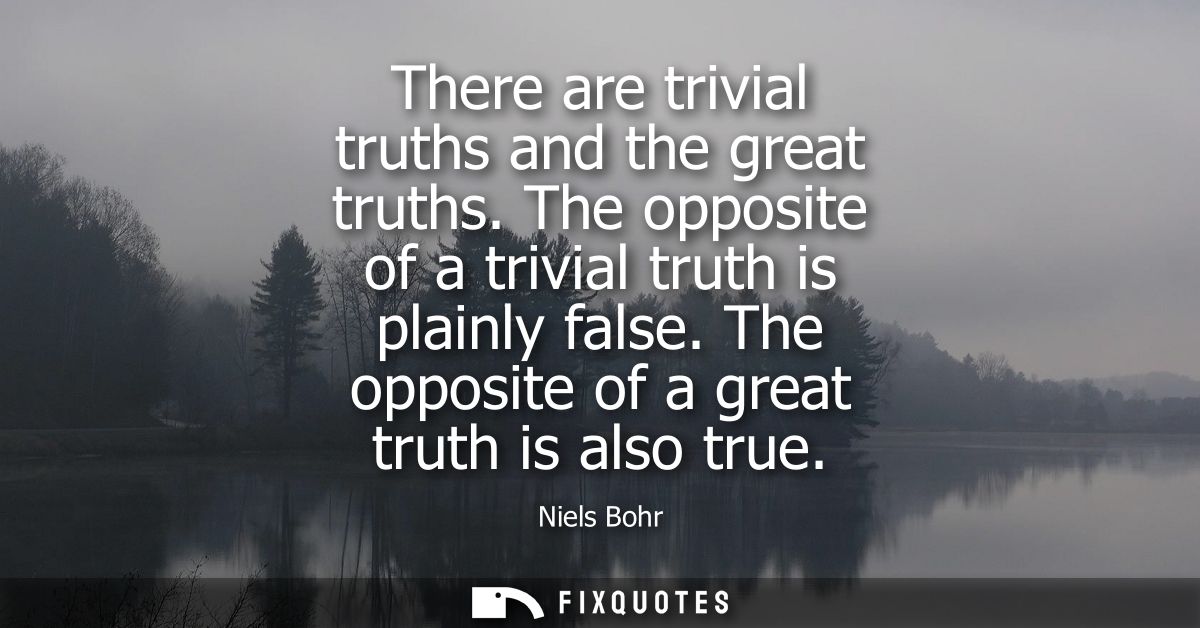
"There are trivial truths and the great truths. The opposite of a trivial truth is plainly false. The opposite of a great truth is also true"
About this Quote
The subtext is Copenhagen-era humility dressed as aphorism. Early 20th-century physics had just detonated the common-sense picture of the world: light behaving as wave and particle, measurement changing what is measured, causality becoming statistical. Bohr spent his career insisting that these weren't just technical glitches but clues about how knowledge works. Complementarity is the quiet engine behind this line: two descriptions can be mutually exclusive in practice yet jointly necessary to tell the truth.
The intent is also rhetorical. Bohr gives scientists and non-scientists permission to hold tension without calling it hypocrisy. "Great truths" feel paradoxical because our language evolved for apples and arrows, not electrons and probability amplitudes. Read culturally, it's an antidote to debate culture's addiction to dunks: when the subject is power, identity, markets, climate, medicine, the most honest statements often come paired with their own apparent contradiction. The opposite can be true because the world is multi-layered, and our categories are the crude part.
Quote Details
| Topic | Truth |
|---|---|
| Source | Help us find the source |
| Cite |
Citation Formats
APA Style (7th ed.)
Bohr, Niels. (2026, January 15). There are trivial truths and the great truths. The opposite of a trivial truth is plainly false. The opposite of a great truth is also true. FixQuotes. https://fixquotes.com/quotes/there-are-trivial-truths-and-the-great-truths-the-25389/
Chicago Style
Bohr, Niels. "There are trivial truths and the great truths. The opposite of a trivial truth is plainly false. The opposite of a great truth is also true." FixQuotes. January 15, 2026. https://fixquotes.com/quotes/there-are-trivial-truths-and-the-great-truths-the-25389/.
MLA Style (9th ed.)
"There are trivial truths and the great truths. The opposite of a trivial truth is plainly false. The opposite of a great truth is also true." FixQuotes, 15 Jan. 2026, https://fixquotes.com/quotes/there-are-trivial-truths-and-the-great-truths-the-25389/. Accessed 14 Mar. 2026.