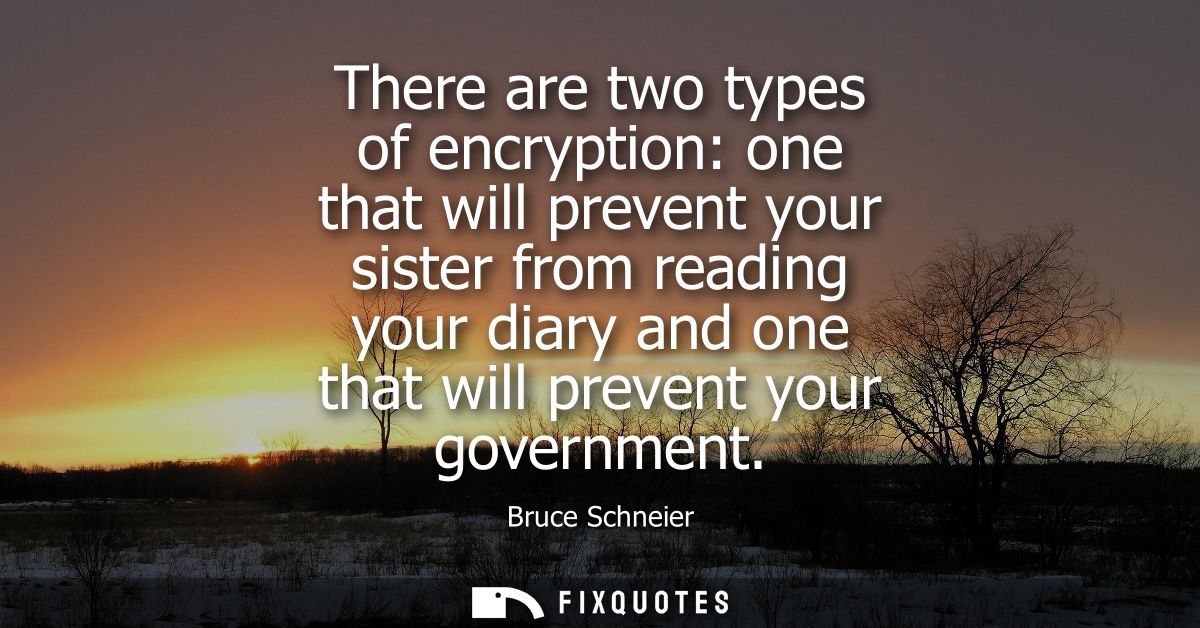
"There are two types of encryption: one that will prevent your sister from reading your diary and one that will prevent your government"
About this Quote
The subtext is a rebuke to a common rhetorical dodge in tech policy: treating “privacy” as a matter of personal embarrassment rather than power. If your threat model is just your sister, you can settle for convenience and weak protections. If your threat model includes the government, you’re forced to confront surveillance, compelled access, and the temptation to build “exceptional” backdoors that magically work only for the good guys. Schneier’s cynicism is technical: a system that can be broken on command will be broken off command.
Context matters: Schneier has spent decades arguing that security isn’t a product you buy, it’s an adversarial relationship you manage. This quip compresses that worldview into a single dichotomy: encryption isn’t one thing, and the difference between “good enough” and “actually secure” is measured in who gets to demand entry.
Quote Details
| Topic | Privacy & Cybersecurity |
|---|---|
| Source | Unverified source: Applied Cryptography: Protocols, Algorithms, and Source C... (Bruce Schneier, 1994)ISBN: 0471597562
Evidence: There are two kinds of cryptography in this world: cryptography that will stop your kid sister from reading your files, and cryptography that will stop major governments from reading your files. This book is about the latter. (Preface (opening paragraph; often printed as p. 1 in previews, varies ... Other candidates (1) Espionage & Encryption Super Pack (Lance Henderson, 2023) compilation95.7% ... There are two types of encryption: one that will prevent your sister from reading your diary and one that will pr... |
| Cite |
Citation Formats
APA Style (7th ed.)
Schneier, Bruce. (2026, February 21). There are two types of encryption: one that will prevent your sister from reading your diary and one that will prevent your government. FixQuotes. https://fixquotes.com/quotes/there-are-two-types-of-encryption-one-that-will-136156/
Chicago Style
Schneier, Bruce. "There are two types of encryption: one that will prevent your sister from reading your diary and one that will prevent your government." FixQuotes. February 21, 2026. https://fixquotes.com/quotes/there-are-two-types-of-encryption-one-that-will-136156/.
MLA Style (9th ed.)
"There are two types of encryption: one that will prevent your sister from reading your diary and one that will prevent your government." FixQuotes, 21 Feb. 2026, https://fixquotes.com/quotes/there-are-two-types-of-encryption-one-that-will-136156/. Accessed 20 Mar. 2026.