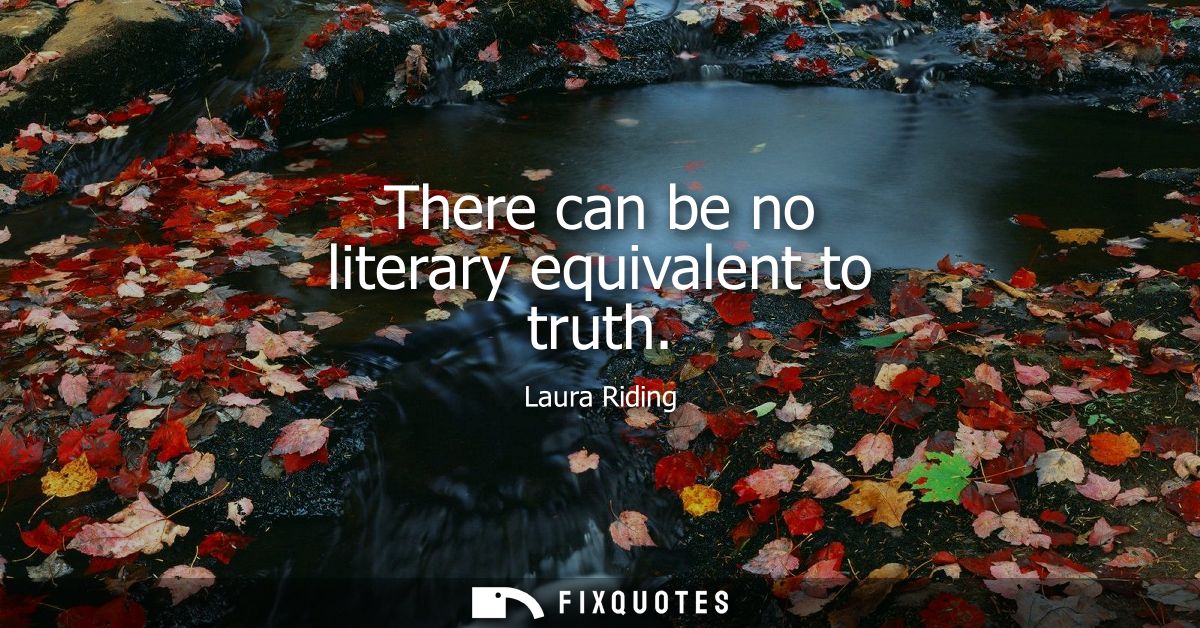
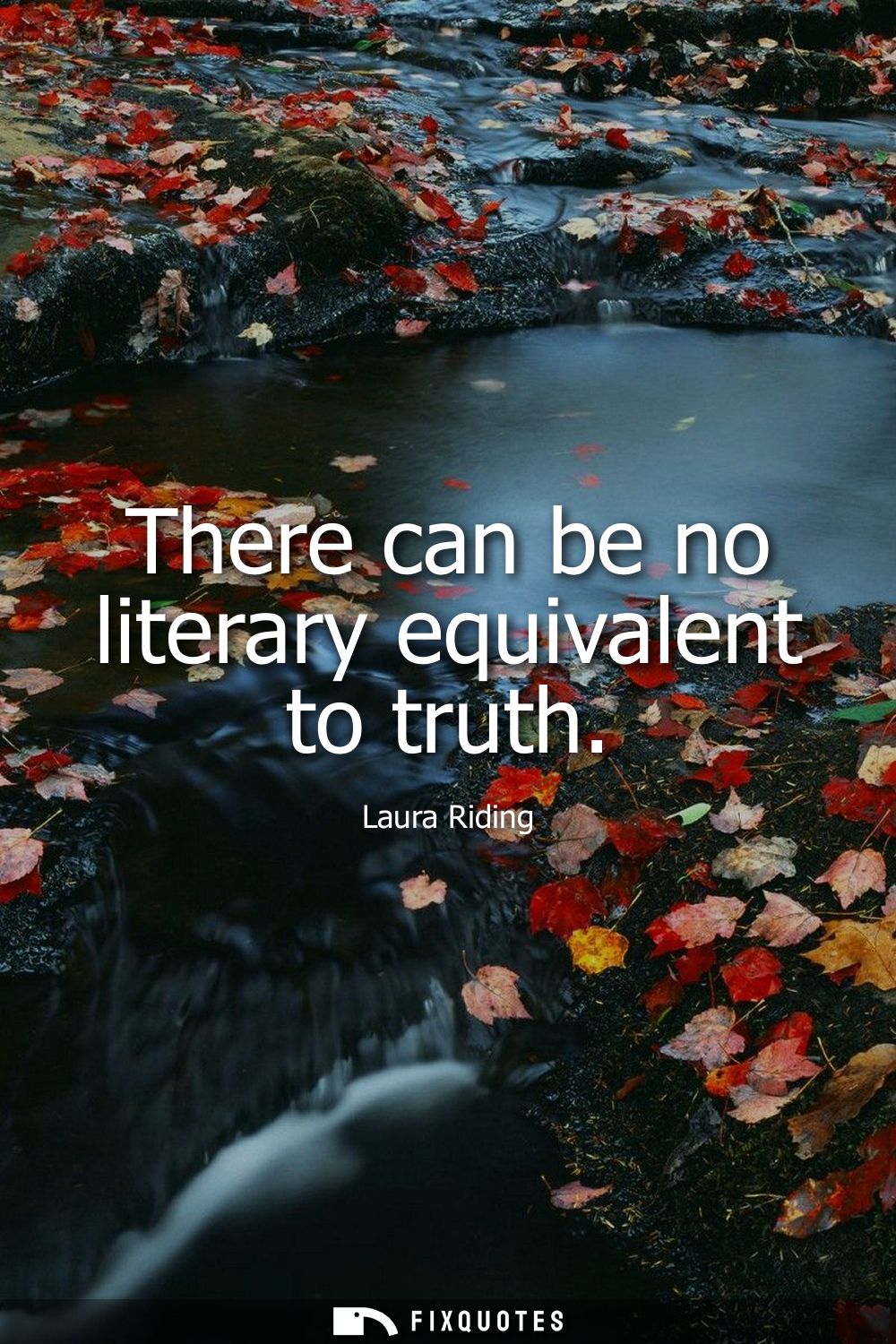
"There can be no literary equivalent to truth"
About this Quote
A poet admitting defeat is rarely surrender; it’s often a dare. Laura Riding’s line, "There can be no literary equivalent to truth", lands like a refusal to flatter language. It denies the comforting idea that if you just write well enough, the sentence will become a mirror held up to reality. Riding isn’t merely modest about literature’s limits. She’s arguing that the very act of making art - selecting, shaping, arranging - is already a deviation from truth, not because writers are liars, but because form is a kind of pressure. Style compresses experience into something portable. Truth, if it exists, isn’t portable.
The subtext is a critique of literary seduction: the way metaphor, narrative closure, and “voice” can simulate authenticity so convincingly that readers confuse aesthetic satisfaction with accuracy. A poem can feel true and still be an engineered effect. Riding’s phrasing is coldly categorical: "no" and "equivalent" shut the door on compromise. She doesn’t say literature can’t reach truth; she says it can’t produce an equivalent - no faithful exchange rate between lived reality and crafted text.
Context matters because Riding’s career was marked by a fierce ethical seriousness about language. She moved away from poetry, suspicious of its rhetorical pleasures, toward the harder project of meaning itself. Read that way, the quote becomes less a lament than a moral posture: literature may illuminate, disturb, clarify, even console - but when it claims to substitute for truth, it becomes one more beautiful counterfeit.
The subtext is a critique of literary seduction: the way metaphor, narrative closure, and “voice” can simulate authenticity so convincingly that readers confuse aesthetic satisfaction with accuracy. A poem can feel true and still be an engineered effect. Riding’s phrasing is coldly categorical: "no" and "equivalent" shut the door on compromise. She doesn’t say literature can’t reach truth; she says it can’t produce an equivalent - no faithful exchange rate between lived reality and crafted text.
Context matters because Riding’s career was marked by a fierce ethical seriousness about language. She moved away from poetry, suspicious of its rhetorical pleasures, toward the harder project of meaning itself. Read that way, the quote becomes less a lament than a moral posture: literature may illuminate, disturb, clarify, even console - but when it claims to substitute for truth, it becomes one more beautiful counterfeit.
Quote Details
| Topic | Truth |
|---|---|
| Source | Help us find the source |
| Cite |
Citation Formats
APA Style (7th ed.)
Riding, Laura. (2026, January 15). There can be no literary equivalent to truth. FixQuotes. https://fixquotes.com/quotes/there-can-be-no-literary-equivalent-to-truth-87090/
Chicago Style
Riding, Laura. "There can be no literary equivalent to truth." FixQuotes. January 15, 2026. https://fixquotes.com/quotes/there-can-be-no-literary-equivalent-to-truth-87090/.
MLA Style (9th ed.)
"There can be no literary equivalent to truth." FixQuotes, 15 Jan. 2026, https://fixquotes.com/quotes/there-can-be-no-literary-equivalent-to-truth-87090/. Accessed 12 Feb. 2026.
More Quotes by Laura
Add to List