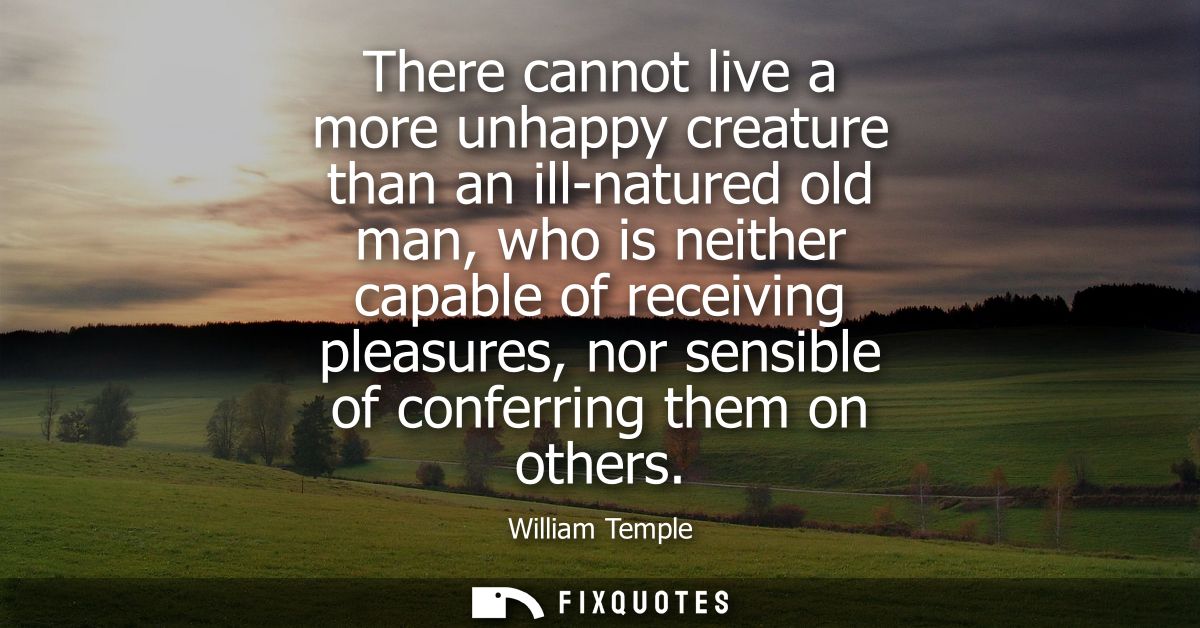
"There cannot live a more unhappy creature than an ill-natured old man, who is neither capable of receiving pleasures, nor sensible of conferring them on others"
About this Quote
Temple lands the insult with a kind of serene cruelty: unhappiness here isn’t tragic fate, it’s moral failure turned chronic. The “ill-natured old man” isn’t simply sad or lonely; he’s someone who has aged into a closed system, where irritation has become identity. Temple’s key move is to define misery as a two-way blockade. He’s “neither capable of receiving pleasures” (the world can’t get in) “nor sensible of conferring them” (he can’t reach out). Old age becomes not a plea for sympathy but a stress test for character.
The subtext is pointedly social. Pleasure isn’t framed as private entertainment; it’s relational, circulating between people. To be “sensible of conferring” pleasure suggests attentiveness, a willingness to notice what others might need. Ill-nature is portrayed as a kind of sensory impairment: the man has lost the taste for delight and the perception required for generosity. Temple is warning that bitterness doesn’t just make you unpleasant; it makes you unfit for the basic exchange that keeps community tolerable.
Contextually, this sits comfortably in an early modern moral essay tradition that treated temperament as ethics. Temple’s era prized “good humor” as a civic virtue, a lubricant for public life and household peace. The line works because it flips the expected script of aging: the problem isn’t decline in strength, but decline in grace. It’s not death that’s frightening here; it’s surviving into a self-made emotional austerity.
The subtext is pointedly social. Pleasure isn’t framed as private entertainment; it’s relational, circulating between people. To be “sensible of conferring” pleasure suggests attentiveness, a willingness to notice what others might need. Ill-nature is portrayed as a kind of sensory impairment: the man has lost the taste for delight and the perception required for generosity. Temple is warning that bitterness doesn’t just make you unpleasant; it makes you unfit for the basic exchange that keeps community tolerable.
Contextually, this sits comfortably in an early modern moral essay tradition that treated temperament as ethics. Temple’s era prized “good humor” as a civic virtue, a lubricant for public life and household peace. The line works because it flips the expected script of aging: the problem isn’t decline in strength, but decline in grace. It’s not death that’s frightening here; it’s surviving into a self-made emotional austerity.
Quote Details
| Topic | Aging |
|---|
More Quotes by William
Add to List