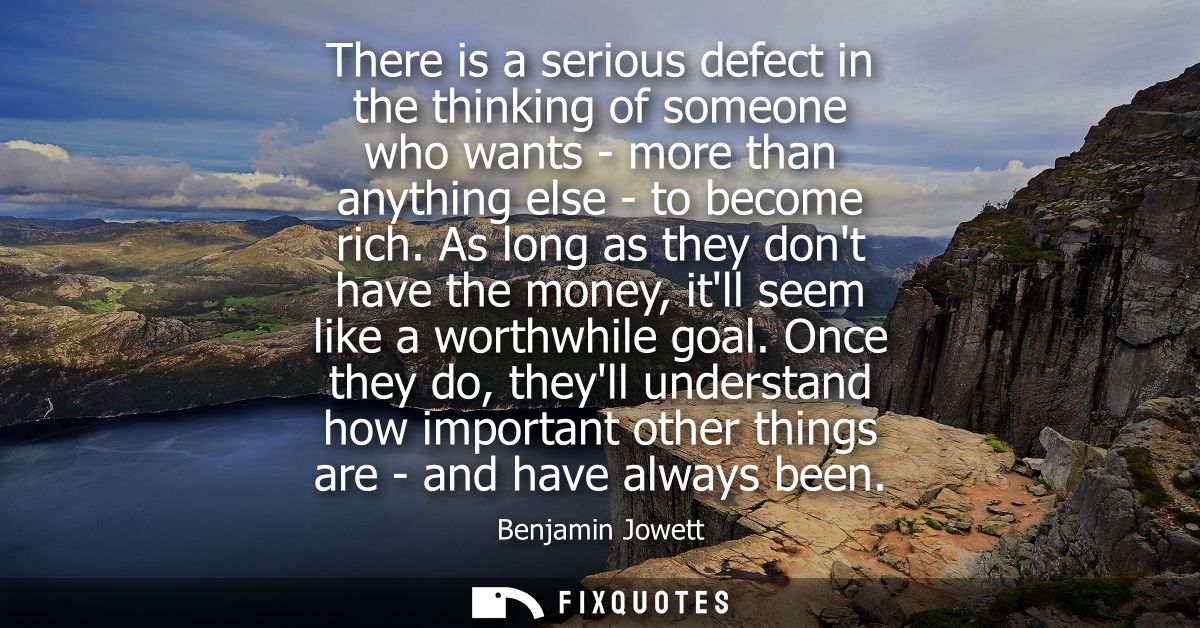
"There is a serious defect in the thinking of someone who wants - more than anything else - to become rich. As long as they don't have the money, it'll seem like a worthwhile goal. Once they do, they'll understand how important other things are - and have always been"
About this Quote
Jowett’s jab lands because it frames the hunger for wealth not as a sin, exactly, but as an error in reasoning - a category mistake dressed up as ambition. Calling it a “serious defect in the thinking” shifts the critique from morality to intellect: the would-be rich person isn’t merely greedy, they’re confused about what money is capable of delivering. The line has the calm, pastoral authority of a Victorian don who has watched generations of bright students mistake a measuring tool for a meaning-making one.
The structure is doing quiet rhetorical work. First comes the seduction: “as long as they don’t have the money, it’ll seem like a worthwhile goal.” Want is elastic; it fills the whole mental room when it’s unmet. Then comes the reversal: “once they do” - the moment acquisition demotes the fantasy. Jowett implies a brutal asymmetry: you can’t reason someone out of this obsession while they’re still imagining wealth; experience is the only refutation, and by the time it arrives, time has been spent.
The sharpest subtext is in the final clause: “and have always been.” That’s not just consolation, it’s indictment. Other things - friendship, vocation, moral seriousness, attention, faith - weren’t discovered after riches. They were quietly important all along, ignored because money promised to reorganize life into clarity. Jowett is warning that wealth doesn’t corrupt so much as reveal: it exposes the thinness of the story you told yourself while chasing it.
The structure is doing quiet rhetorical work. First comes the seduction: “as long as they don’t have the money, it’ll seem like a worthwhile goal.” Want is elastic; it fills the whole mental room when it’s unmet. Then comes the reversal: “once they do” - the moment acquisition demotes the fantasy. Jowett implies a brutal asymmetry: you can’t reason someone out of this obsession while they’re still imagining wealth; experience is the only refutation, and by the time it arrives, time has been spent.
The sharpest subtext is in the final clause: “and have always been.” That’s not just consolation, it’s indictment. Other things - friendship, vocation, moral seriousness, attention, faith - weren’t discovered after riches. They were quietly important all along, ignored because money promised to reorganize life into clarity. Jowett is warning that wealth doesn’t corrupt so much as reveal: it exposes the thinness of the story you told yourself while chasing it.
Quote Details
| Topic | Wealth |
|---|
More Quotes by Benjamin
Add to List