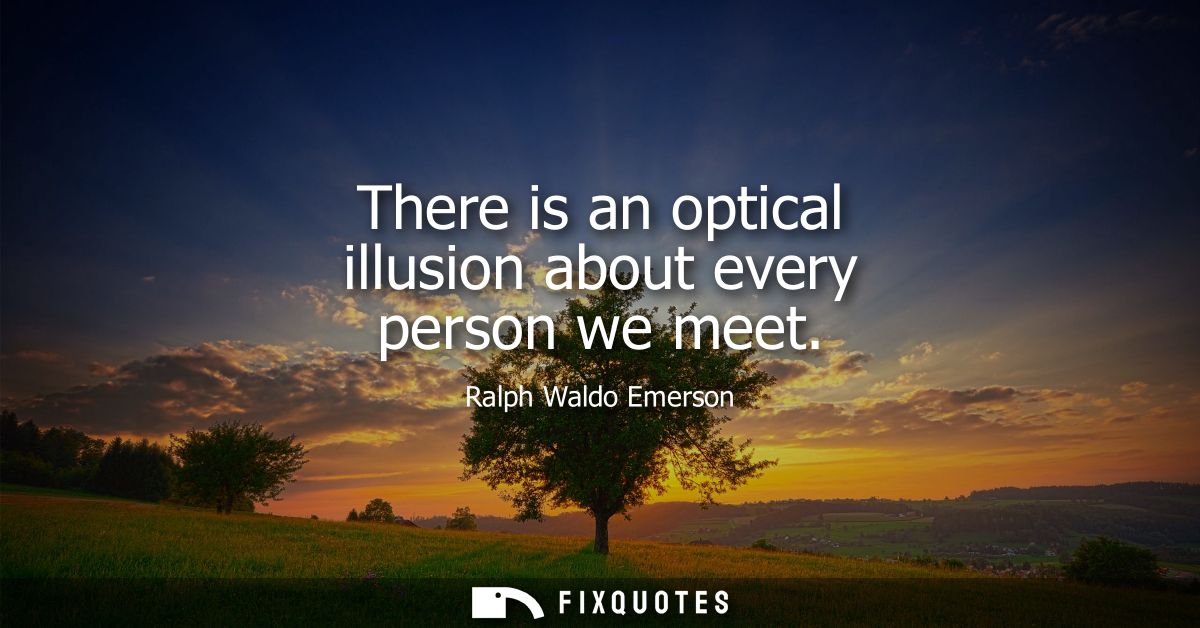
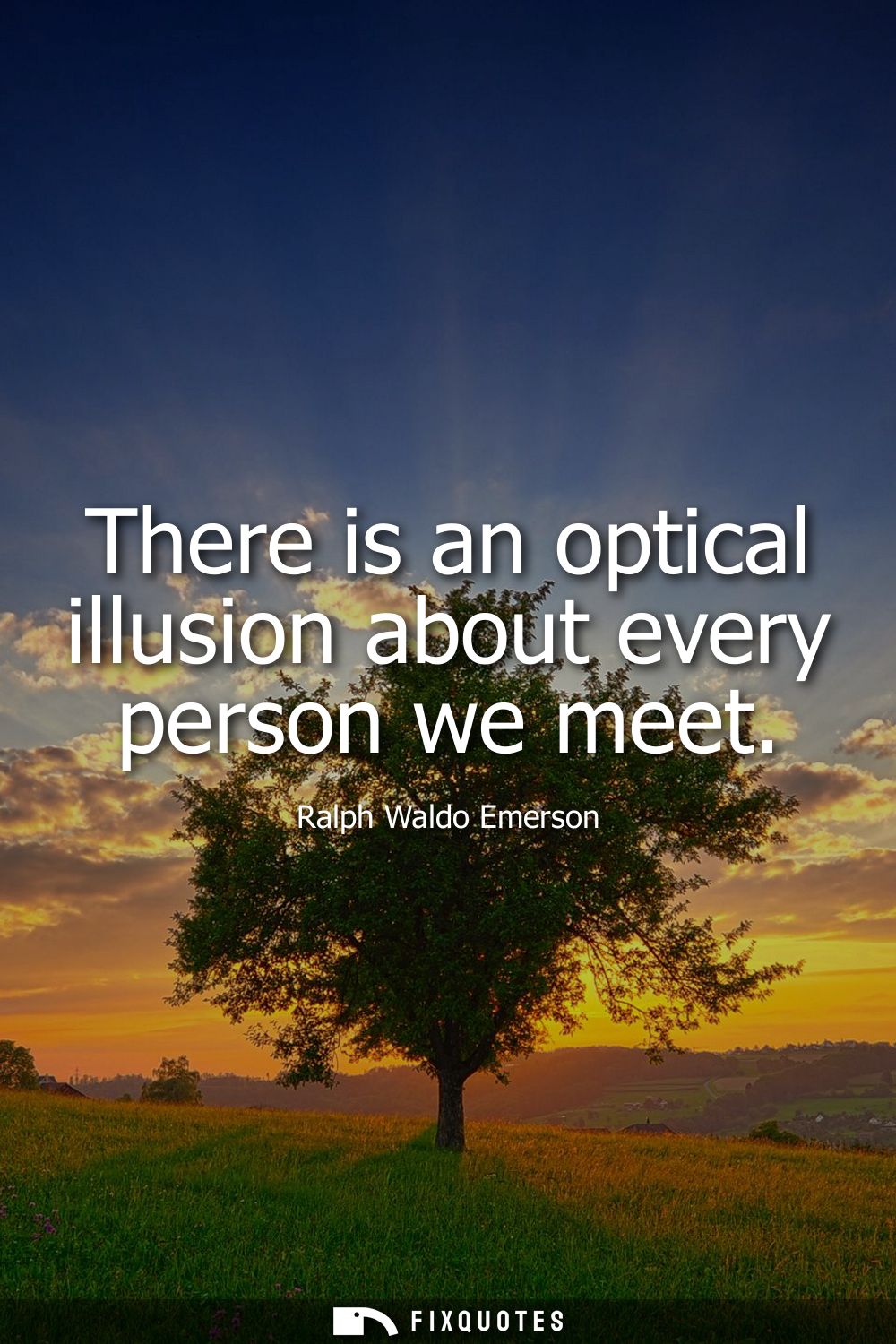
"There is an optical illusion about every person we meet"
About this Quote
Everyone arrives with a halo of guesswork. Emerson’s line is a cool, surgical reminder that “meeting” someone is never just an exchange of facts; it’s a collision between a living person and the story our minds instantly build around them. Calling it an “optical illusion” is doing sly work: it frames social perception as something physiological, automatic, even involuntary. You don’t choose an illusion; you notice it after the fact, if you’re lucky.
The intent isn’t simply to warn against prejudice, though it includes that. Emerson is pushing a deeper Transcendentalist suspicion of surfaces: the self is not fully legible from its appearances, and the world we think we see is partly a projection of the seer. In 19th-century America, with its fever for self-making, reputation, and moral legibility, this is a quiet rebuke to the culture’s confidence that character can be read like handwriting. Your first impression, your neat psychological summary, your instant moral sorting: all of it is a trick of the light.
The subtext cuts both ways. It doesn’t just accuse the observer of distortion; it suggests every person is also performing into the distortions they expect to meet. Social life becomes a hall of mirrors: we curate ourselves to fit others’ illusions, then blame them for believing what we offered.
Emerson’s brilliance is the metaphor’s humility. He doesn’t call other people liars; he calls our seeing unreliable. That’s harder to argue with, and harder to escape.
The intent isn’t simply to warn against prejudice, though it includes that. Emerson is pushing a deeper Transcendentalist suspicion of surfaces: the self is not fully legible from its appearances, and the world we think we see is partly a projection of the seer. In 19th-century America, with its fever for self-making, reputation, and moral legibility, this is a quiet rebuke to the culture’s confidence that character can be read like handwriting. Your first impression, your neat psychological summary, your instant moral sorting: all of it is a trick of the light.
The subtext cuts both ways. It doesn’t just accuse the observer of distortion; it suggests every person is also performing into the distortions they expect to meet. Social life becomes a hall of mirrors: we curate ourselves to fit others’ illusions, then blame them for believing what we offered.
Emerson’s brilliance is the metaphor’s humility. He doesn’t call other people liars; he calls our seeing unreliable. That’s harder to argue with, and harder to escape.
Quote Details
| Topic | Wisdom |
|---|---|
| Source | Help us find the source |
| Cite |
Citation Formats
APA Style (7th ed.)
Emerson, Ralph Waldo. (2026, January 17). There is an optical illusion about every person we meet. FixQuotes. https://fixquotes.com/quotes/there-is-an-optical-illusion-about-every-person-28872/
Chicago Style
Emerson, Ralph Waldo. "There is an optical illusion about every person we meet." FixQuotes. January 17, 2026. https://fixquotes.com/quotes/there-is-an-optical-illusion-about-every-person-28872/.
MLA Style (9th ed.)
"There is an optical illusion about every person we meet." FixQuotes, 17 Jan. 2026, https://fixquotes.com/quotes/there-is-an-optical-illusion-about-every-person-28872/. Accessed 7 Apr. 2026.
More Quotes by Ralph
Add to List