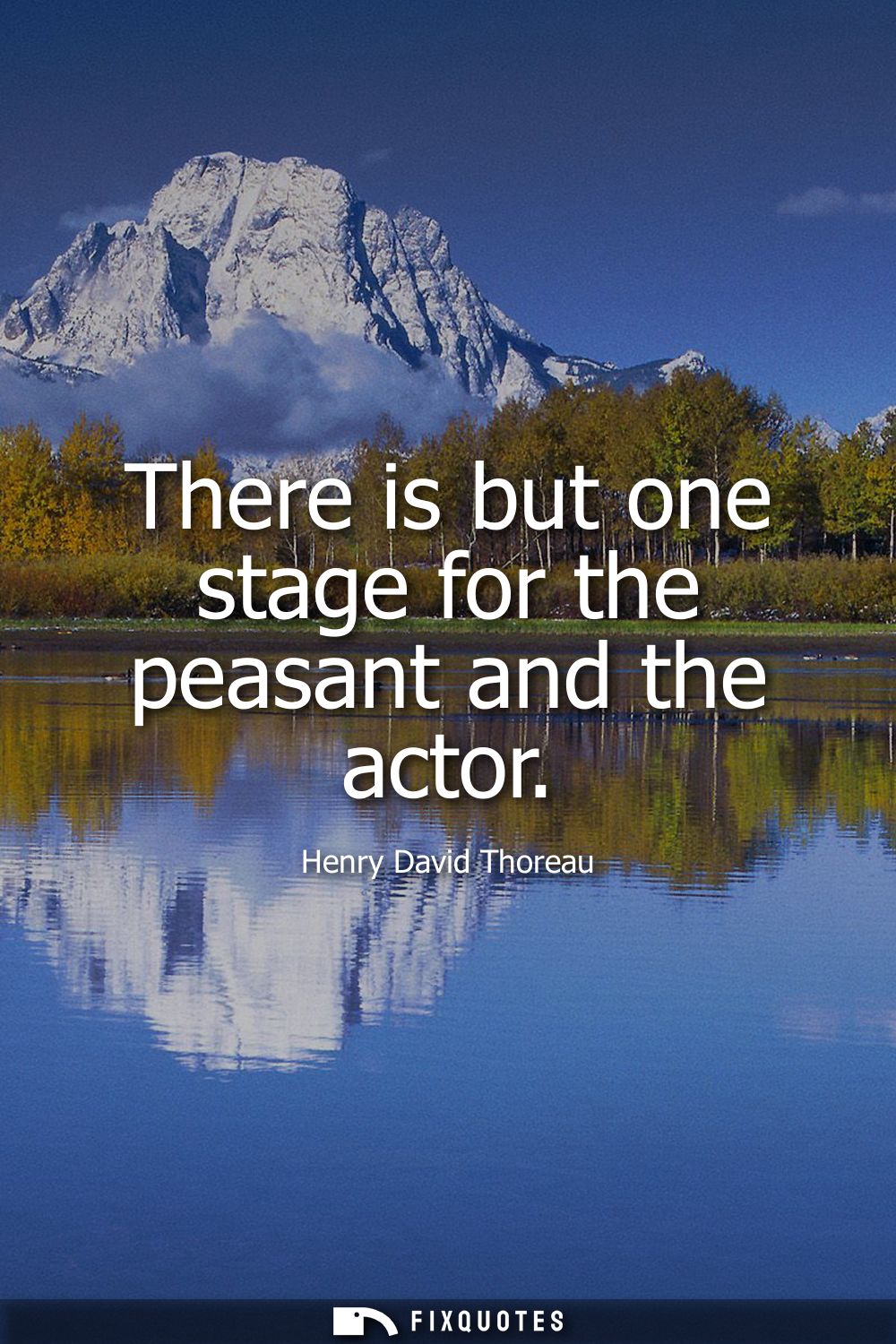
"There is but one stage for the peasant and the actor"
About this Quote
A line like this lands with Thoreau’s signature mix of moral severity and sly provocation: the “stage” isn’t a literal platform so much as the social arena where everyone is forced to perform. By pairing the peasant and the actor, Thoreau collapses what polite society treats as opposites: the supposedly “authentic” laborer and the professional faker. His point isn’t that peasants are hypocrites; it’s that public life makes actors of us all.
The intent reads as a jab at status and self-congratulation. In a culture that romanticizes the rural poor as pure and unselfconscious, Thoreau insists they’re just as implicated in spectacle, surveillance, and expectation. The peasant performs deference, toughness, piety, tradition - whatever keeps the social order running. The actor performs for wages. Different costumes, same demand: be legible to an audience.
The subtext is classic Thoreau: suspicion toward institutions that turn people into roles. Whether you’re in a field or a theater, you’re still inside someone else’s script - economic necessity, community judgment, the marketplace’s appetite for types. It’s a critique of a society that makes “honest work” into another kind of mask, then congratulates itself for not noticing.
Context matters: Thoreau wrote in an America disciplining itself into industriousness and conformity. Against the era’s faith that hard work equals virtue, he suggests something colder: the virtue is often just good stagecraft.
The intent reads as a jab at status and self-congratulation. In a culture that romanticizes the rural poor as pure and unselfconscious, Thoreau insists they’re just as implicated in spectacle, surveillance, and expectation. The peasant performs deference, toughness, piety, tradition - whatever keeps the social order running. The actor performs for wages. Different costumes, same demand: be legible to an audience.
The subtext is classic Thoreau: suspicion toward institutions that turn people into roles. Whether you’re in a field or a theater, you’re still inside someone else’s script - economic necessity, community judgment, the marketplace’s appetite for types. It’s a critique of a society that makes “honest work” into another kind of mask, then congratulates itself for not noticing.
Context matters: Thoreau wrote in an America disciplining itself into industriousness and conformity. Against the era’s faith that hard work equals virtue, he suggests something colder: the virtue is often just good stagecraft.
Quote Details
| Topic | Wisdom |
|---|---|
| Source | Help us find the source |
| Cite |
Citation Formats
APA Style (7th ed.)
Thoreau, Henry David. (2026, January 17). There is but one stage for the peasant and the actor. FixQuotes. https://fixquotes.com/quotes/there-is-but-one-stage-for-the-peasant-and-the-28779/
Chicago Style
Thoreau, Henry David. "There is but one stage for the peasant and the actor." FixQuotes. January 17, 2026. https://fixquotes.com/quotes/there-is-but-one-stage-for-the-peasant-and-the-28779/.
MLA Style (9th ed.)
"There is but one stage for the peasant and the actor." FixQuotes, 17 Jan. 2026, https://fixquotes.com/quotes/there-is-but-one-stage-for-the-peasant-and-the-28779/. Accessed 20 Mar. 2026.
More Quotes by Henry
Add to List