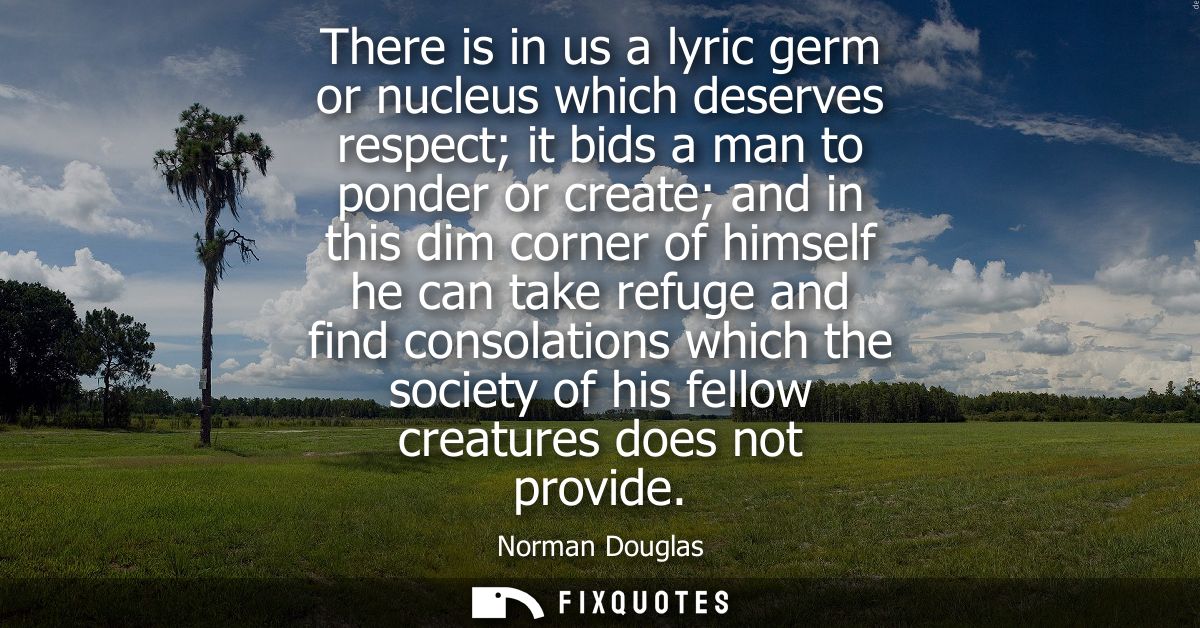
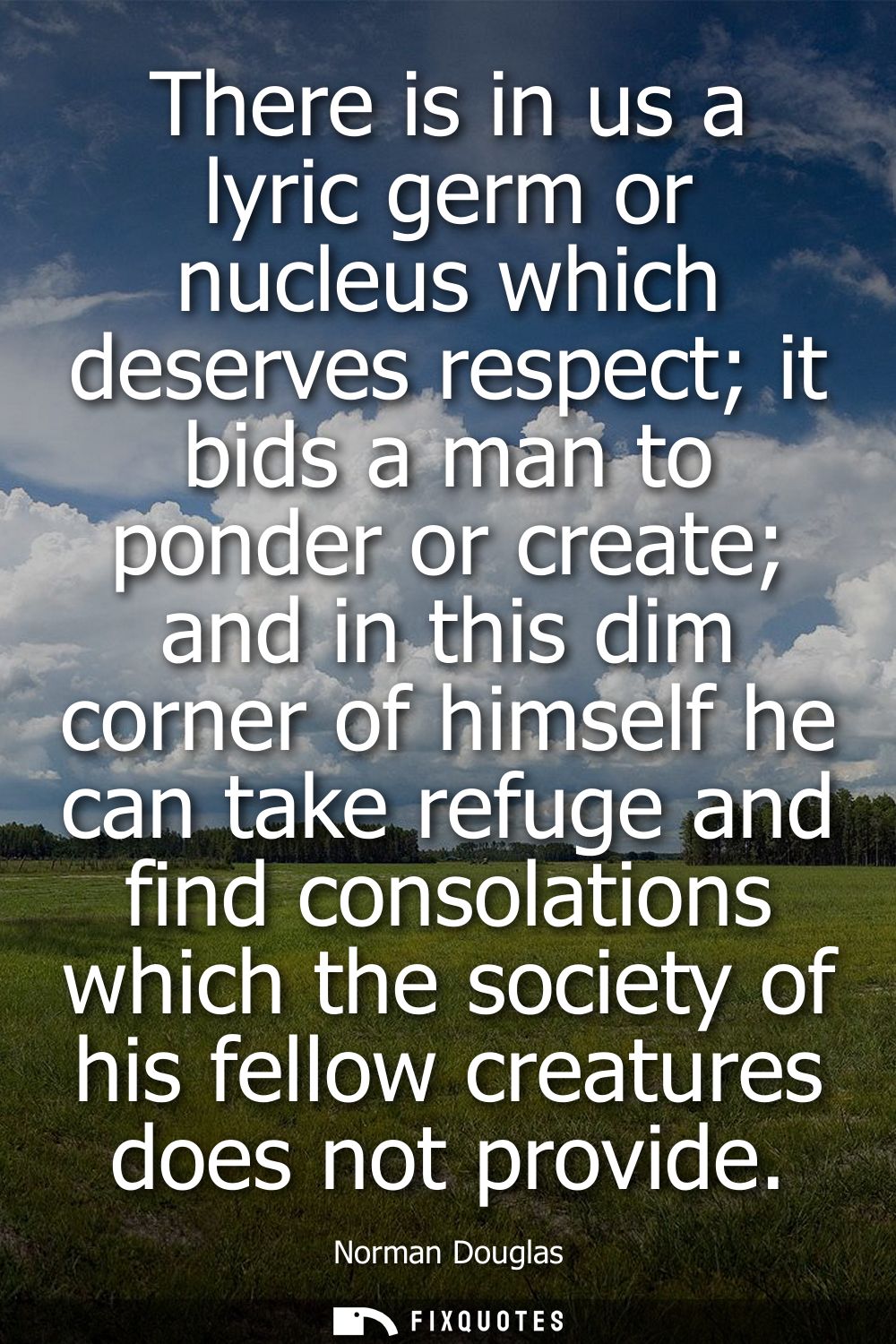
"There is in us a lyric germ or nucleus which deserves respect; it bids a man to ponder or create; and in this dim corner of himself he can take refuge and find consolations which the society of his fellow creatures does not provide"
About this Quote
The subtext is also a critique of sociability. Douglas doesn’t deny companionship; he simply insists it’s structurally limited. "The society of his fellow creatures" can entertain, affirm, distract, even love you, but it can’t supply certain consolations because those consolations depend on solitude and self-translation: turning feeling into form, confusion into thought. He positions the inner "dim corner" as a refuge, not a stage. Dimness here is protective - a place where you don’t have to perform coherence for anyone else.
Context helps: Douglas, a cosmopolitan writer shaped by fin-de-siecle skepticism and the disillusionments of early 20th-century Europe, is making an argument for the private imagination as survival technology. In an era of mass opinion, mass politics, mass everything, he sketches a counter-institution: the inner room where a person can still be more than their social role.
Quote Details
| Topic | Poetry |
|---|---|
| Source | Help us find the source |
| Cite |
Citation Formats
APA Style (7th ed.)
Douglas, Norman. (2026, January 18). There is in us a lyric germ or nucleus which deserves respect; it bids a man to ponder or create; and in this dim corner of himself he can take refuge and find consolations which the society of his fellow creatures does not provide. FixQuotes. https://fixquotes.com/quotes/there-is-in-us-a-lyric-germ-or-nucleus-which-7516/
Chicago Style
Douglas, Norman. "There is in us a lyric germ or nucleus which deserves respect; it bids a man to ponder or create; and in this dim corner of himself he can take refuge and find consolations which the society of his fellow creatures does not provide." FixQuotes. January 18, 2026. https://fixquotes.com/quotes/there-is-in-us-a-lyric-germ-or-nucleus-which-7516/.
MLA Style (9th ed.)
"There is in us a lyric germ or nucleus which deserves respect; it bids a man to ponder or create; and in this dim corner of himself he can take refuge and find consolations which the society of his fellow creatures does not provide." FixQuotes, 18 Jan. 2026, https://fixquotes.com/quotes/there-is-in-us-a-lyric-germ-or-nucleus-which-7516/. Accessed 22 Mar. 2026.