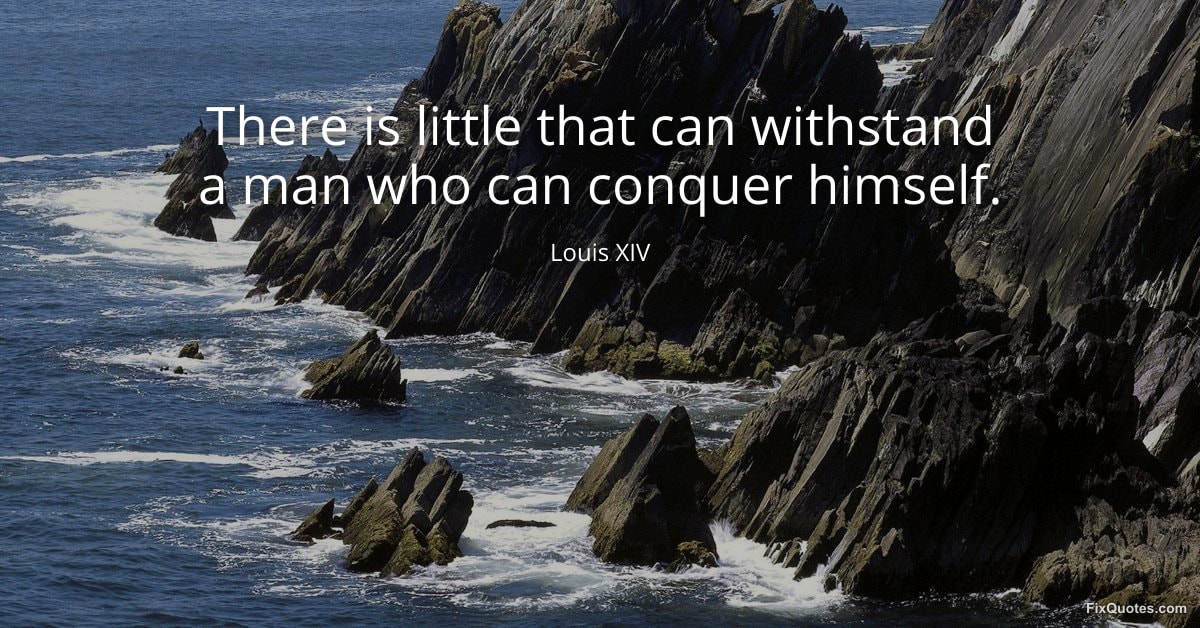
"There is little that can withstand a man who can conquer himself"
About this Quote
Self-mastery is pitched here as the king of all weapons, and coming from Louis XIV that’s not a self-help platitude so much as a doctrine of rule. The Sun King built a political universe around controlled behavior: his own body on display, his court choreographed at Versailles, his nobles turned into status-hungry satellites. In that world, the man who “can conquer himself” isn’t merely virtuous; he’s strategically unbeatable, because he can’t be baited, bought, or provoked into a mistake that others can exploit.
The phrasing is tellingly martial. “Withstand” suggests siege and pressure; “conquer” frames the self as territory to be subdued. That’s absolutism translated into psychology. Louis’s broader project was making authority look natural and inevitable, and this line smuggles in the idea that real sovereignty begins internally. If you can discipline appetite, anger, vanity, and fear, you can discipline a court, a bureaucracy, a battlefield. The subtext is almost managerial: impulses are liabilities; composure is power.
It also functions as a moral alibi for hierarchy. By implying that strength is earned through inner conquest, the quote flatters rulers and would-be rulers as uniquely qualified, converting privilege into “character.” Yet the most interesting tension is that self-conquest, in Louis’s system, is never private. It’s performative restraint, the ability to keep one’s face while everyone watches. The line reads like a maxim for surviving a palace where a raised eyebrow can be a political event.
The phrasing is tellingly martial. “Withstand” suggests siege and pressure; “conquer” frames the self as territory to be subdued. That’s absolutism translated into psychology. Louis’s broader project was making authority look natural and inevitable, and this line smuggles in the idea that real sovereignty begins internally. If you can discipline appetite, anger, vanity, and fear, you can discipline a court, a bureaucracy, a battlefield. The subtext is almost managerial: impulses are liabilities; composure is power.
It also functions as a moral alibi for hierarchy. By implying that strength is earned through inner conquest, the quote flatters rulers and would-be rulers as uniquely qualified, converting privilege into “character.” Yet the most interesting tension is that self-conquest, in Louis’s system, is never private. It’s performative restraint, the ability to keep one’s face while everyone watches. The line reads like a maxim for surviving a palace where a raised eyebrow can be a political event.
Quote Details
| Topic | Self-Discipline |
|---|---|
| Source | Help us find the source |
| Cite |
Citation Formats
APA Style (7th ed.)
XIV, Louis. (2026, January 18). There is little that can withstand a man who can conquer himself. FixQuotes. https://fixquotes.com/quotes/there-is-little-that-can-withstand-a-man-who-can-18754/
Chicago Style
XIV, Louis. "There is little that can withstand a man who can conquer himself." FixQuotes. January 18, 2026. https://fixquotes.com/quotes/there-is-little-that-can-withstand-a-man-who-can-18754/.
MLA Style (9th ed.)
"There is little that can withstand a man who can conquer himself." FixQuotes, 18 Jan. 2026, https://fixquotes.com/quotes/there-is-little-that-can-withstand-a-man-who-can-18754/. Accessed 26 Mar. 2026.
More Quotes by Louis
Add to List