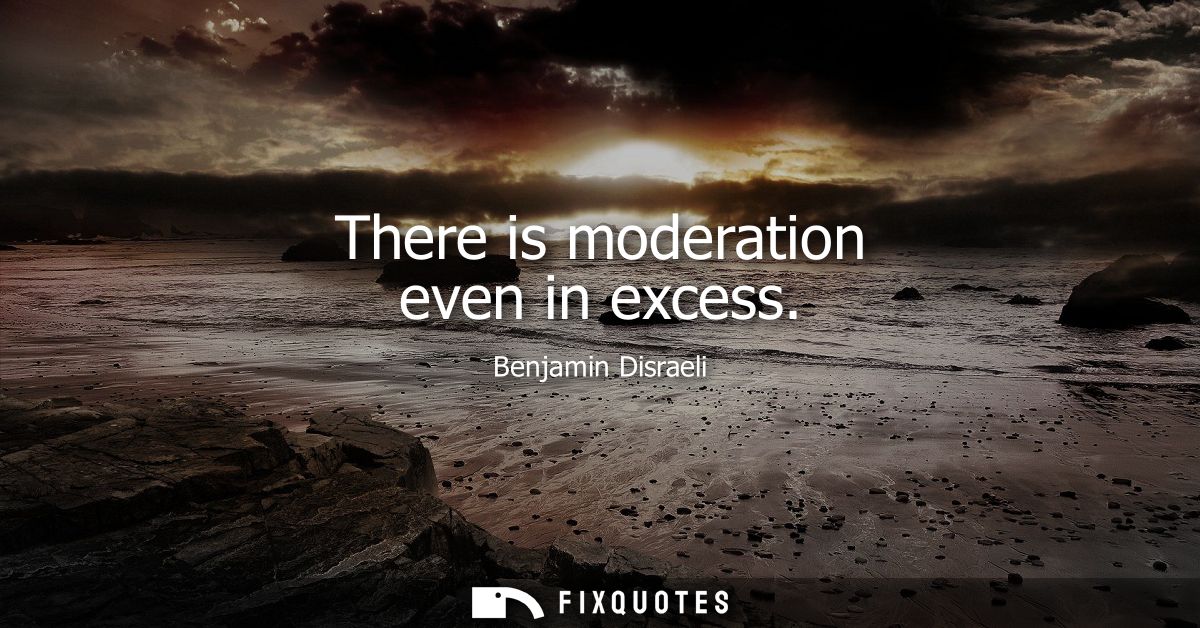
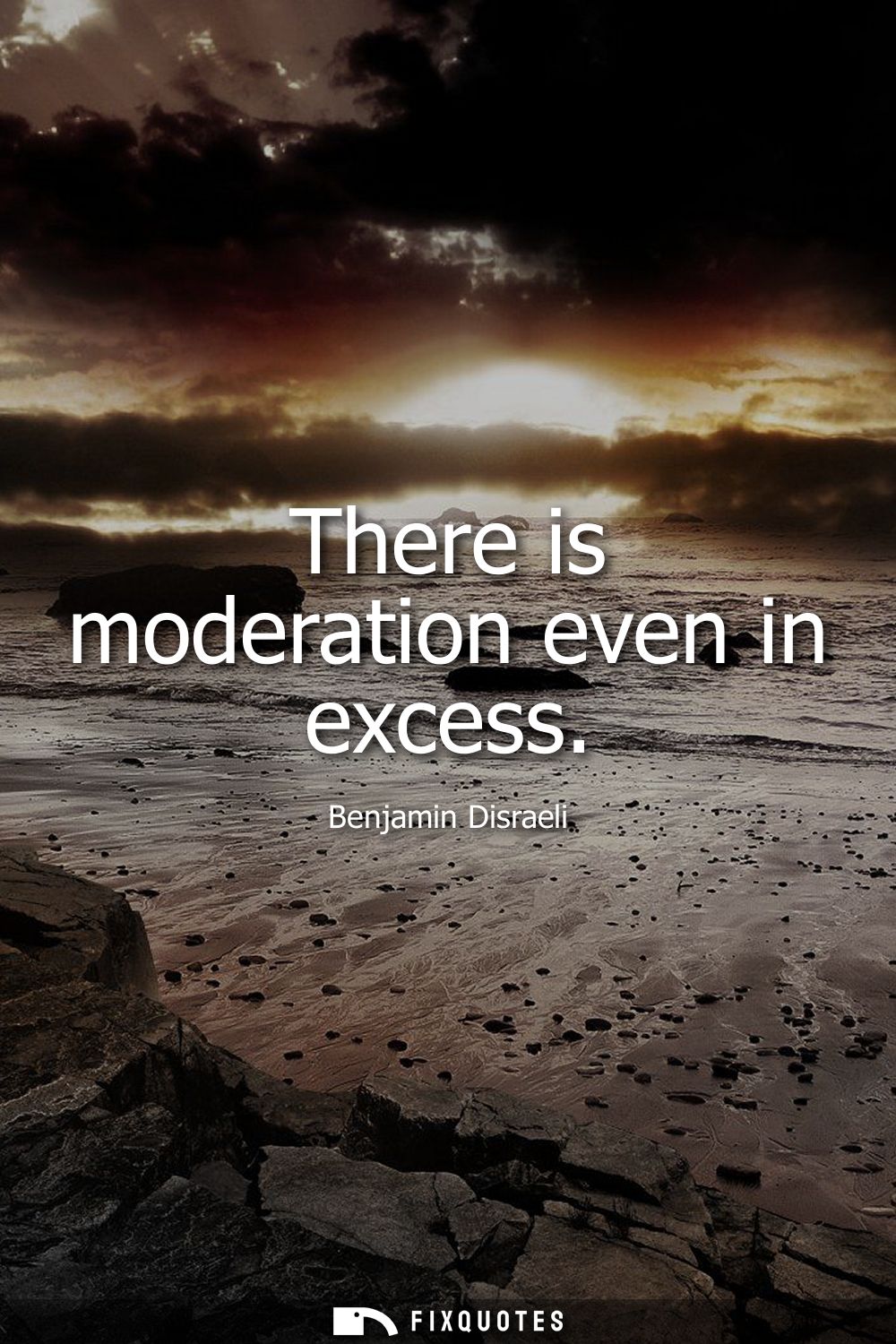
"There is moderation even in excess"
About this Quote
Disraeli’s line lands like a raised eyebrow in the middle of a moral lecture: even the wildest indulgence, he suggests, has its own internal rules. It’s a paradox designed to puncture Victorian pieties about self-control. By pairing “moderation” with “excess,” he reframes restraint not as a saintly abstinence but as a kind of craft - a calibrated performance where you can push boundaries without tumbling into chaos. The wit is political as much as personal. Disraeli, a statesman who understood appetite (for power, for spectacle, for social ascent), is implying that successful transgression requires discipline.
The subtext is that societies don’t actually run on pure virtue; they run on managed vice. People want intensity - wealth, pleasure, ambition, even outrage - but they also want the comfort of believing it’s contained. “Moderation” becomes the fig leaf that makes extravagance legible, sellable, and survivable. It’s also a sly jab at moral absolutists: the puritan who claims to be free of excess may simply be practicing a different kind of it - excess righteousness.
In Disraeli’s era, Britain was juggling imperial expansion, industrial fortunes, and the anxiety of rapid change. Public life demanded decorum while rewarding audacity. The line fits a politician who trafficked in calculated flamboyance: you can be bold, even scandalous, as long as you understand the limits of the room. It’s not a call to behave; it’s a reminder that power belongs to those who know how to overreach strategically.
The subtext is that societies don’t actually run on pure virtue; they run on managed vice. People want intensity - wealth, pleasure, ambition, even outrage - but they also want the comfort of believing it’s contained. “Moderation” becomes the fig leaf that makes extravagance legible, sellable, and survivable. It’s also a sly jab at moral absolutists: the puritan who claims to be free of excess may simply be practicing a different kind of it - excess righteousness.
In Disraeli’s era, Britain was juggling imperial expansion, industrial fortunes, and the anxiety of rapid change. Public life demanded decorum while rewarding audacity. The line fits a politician who trafficked in calculated flamboyance: you can be bold, even scandalous, as long as you understand the limits of the room. It’s not a call to behave; it’s a reminder that power belongs to those who know how to overreach strategically.
Quote Details
| Topic | Wisdom |
|---|---|
| Source | Help us find the source |
| Cite |
Citation Formats
APA Style (7th ed.)
Disraeli, Benjamin. (2026, January 18). There is moderation even in excess. FixQuotes. https://fixquotes.com/quotes/there-is-moderation-even-in-excess-4686/
Chicago Style
Disraeli, Benjamin. "There is moderation even in excess." FixQuotes. January 18, 2026. https://fixquotes.com/quotes/there-is-moderation-even-in-excess-4686/.
MLA Style (9th ed.)
"There is moderation even in excess." FixQuotes, 18 Jan. 2026, https://fixquotes.com/quotes/there-is-moderation-even-in-excess-4686/. Accessed 26 Mar. 2026.
More Quotes by Benjamin
Add to List