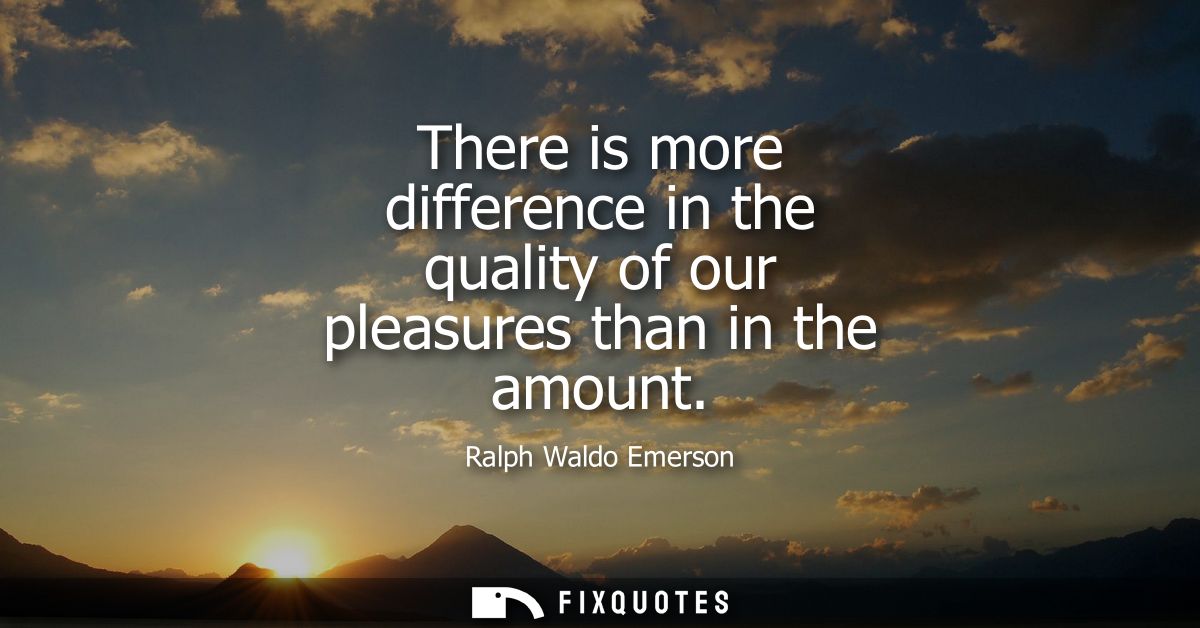
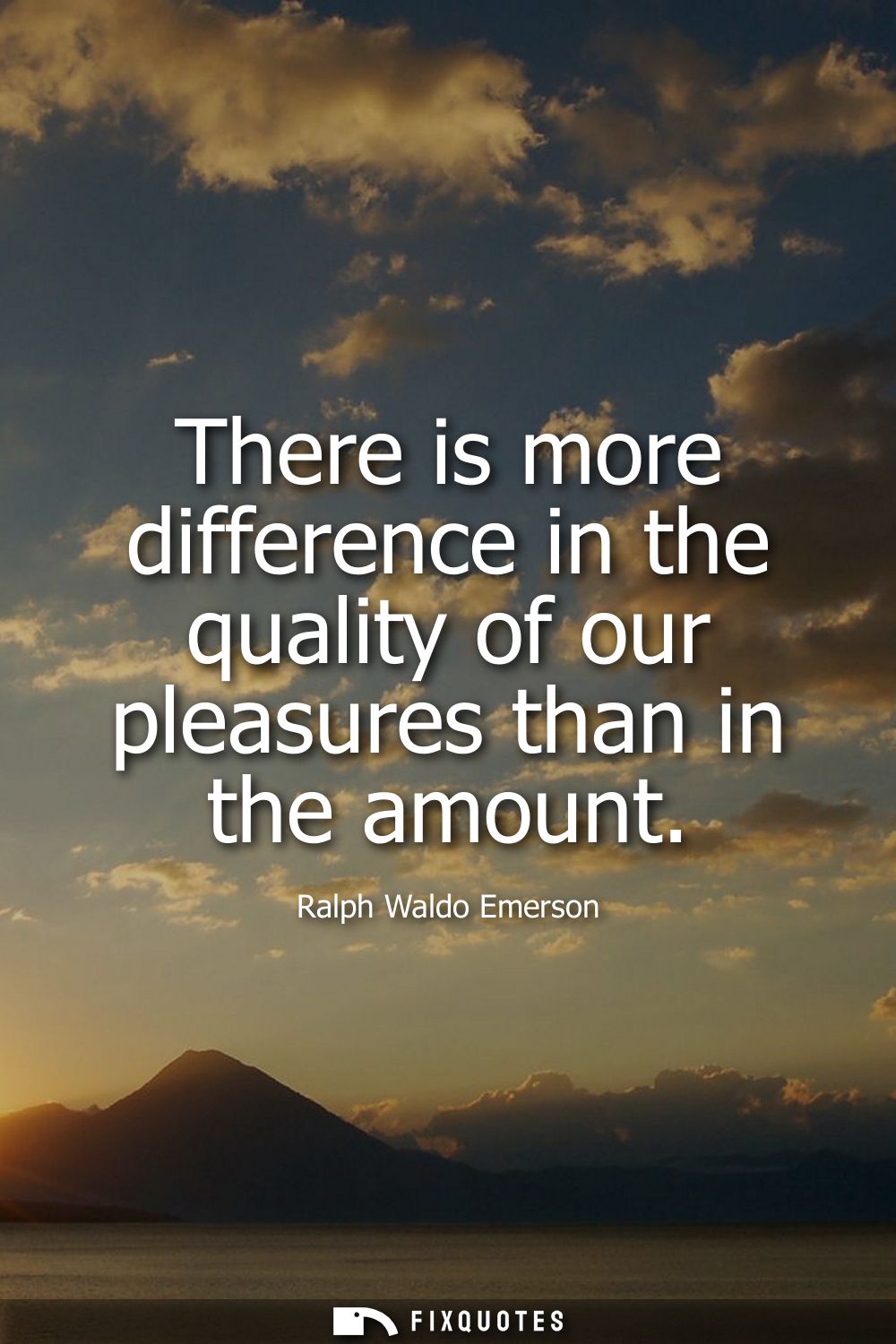
"There is more difference in the quality of our pleasures than in the amount"
About this Quote
The phrasing does a lot of work. “Quality” isn’t a tasteful synonym for “better”; it implies a moral and perceptual dimension. Emerson is pointing at the way certain pleasures refine attention and deepen agency, while others dull it. “Amount” carries the whiff of measurement, commerce, and accumulation, the logic of the ledger. By putting the two side by side, he frames hedonism as a category error: you can’t fix a shallow life by increasing the dosage.
The subtext is quintessential Emersonian self-reliance. Pleasure isn’t just something the world provides; it’s something the self learns to apprehend. A walk, a book, a hard conversation, a moment of solitude can be “more” than a crowded calendar because it changes the inner instrument doing the enjoying. That’s why the line reads like advice and indictment at once: if your pleasures feel thin, the problem may not be scarcity but a mis-educated desire.
Contextually, Emerson is writing into a 19th-century America intoxicated by expansion, industry, and rising consumer comforts. He offers an alternative status system: not conspicuous consumption, but conspicuous discernment. The provocation still lands because it reframes modern “more” culture as an aesthetic failure with ethical consequences.
Quote Details
| Topic | Wisdom |
|---|---|
| Source | Help us find the source |
| Cite |
Citation Formats
APA Style (7th ed.)
Emerson, Ralph Waldo. (2026, January 17). There is more difference in the quality of our pleasures than in the amount. FixQuotes. https://fixquotes.com/quotes/there-is-more-difference-in-the-quality-of-our-28874/
Chicago Style
Emerson, Ralph Waldo. "There is more difference in the quality of our pleasures than in the amount." FixQuotes. January 17, 2026. https://fixquotes.com/quotes/there-is-more-difference-in-the-quality-of-our-28874/.
MLA Style (9th ed.)
"There is more difference in the quality of our pleasures than in the amount." FixQuotes, 17 Jan. 2026, https://fixquotes.com/quotes/there-is-more-difference-in-the-quality-of-our-28874/. Accessed 27 Mar. 2026.