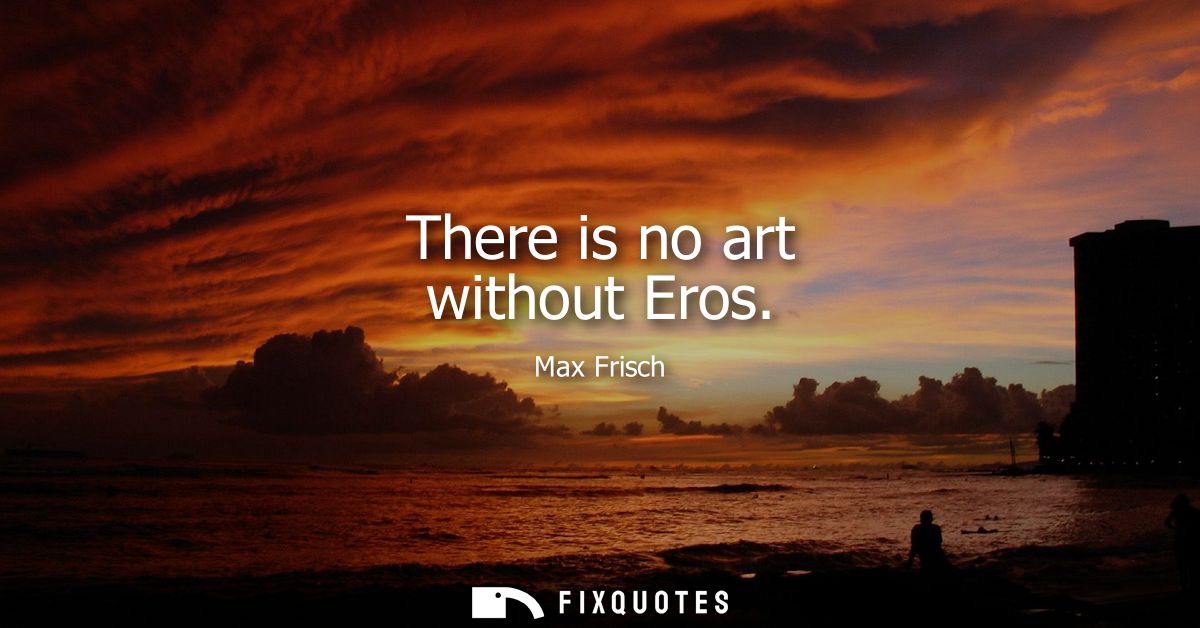
"There is no art without Eros"
About this Quote
No art without Eros is a deliberately narrowing claim: it refuses the comforting idea that creativity is a polite, detachable skill. Frisch reaches for Eros not as mere sex, but as the charged human force that makes us reach outward - appetite, curiosity, vulnerability, the itch to be seen and to see. By tying art to Eros, he implies that aesthetic production isn’t primarily about technique or good taste; it’s about desire that won’t stay quiet.
The line works because it smuggles a provocation under a clean, classical noun. Eros sounds lofty, even museum-ready, but Frisch uses it like a lit match. If art depends on Eros, then “objective” art is a contradiction: creation always carries longing, projection, and risk. You don’t make something new unless you’re pulled by something you don’t fully control. That subtext lands especially hard coming from a writer preoccupied with identity’s instability and the roles people perform to survive intimacy. In Frisch’s world, the self is a draft; Eros is the editor with a red pen.
Context matters: a 20th-century European novelist writing in the shadow of war, bourgeois respectability, and cultural institutions that love to sterilize the messy sources of inspiration. Frisch’s sentence pushes back against that sterilization. It suggests that when art pretends to be pure, it’s often just afraid - of bodies, of need, of obsession, of the embarrassing fact that the imagination is powered by wanting.
The line works because it smuggles a provocation under a clean, classical noun. Eros sounds lofty, even museum-ready, but Frisch uses it like a lit match. If art depends on Eros, then “objective” art is a contradiction: creation always carries longing, projection, and risk. You don’t make something new unless you’re pulled by something you don’t fully control. That subtext lands especially hard coming from a writer preoccupied with identity’s instability and the roles people perform to survive intimacy. In Frisch’s world, the self is a draft; Eros is the editor with a red pen.
Context matters: a 20th-century European novelist writing in the shadow of war, bourgeois respectability, and cultural institutions that love to sterilize the messy sources of inspiration. Frisch’s sentence pushes back against that sterilization. It suggests that when art pretends to be pure, it’s often just afraid - of bodies, of need, of obsession, of the embarrassing fact that the imagination is powered by wanting.
Quote Details
| Topic | Art |
|---|---|
| Source | Help us find the source |
| Cite |
Citation Formats
APA Style (7th ed.)
Frisch, Max. (2026, January 15). There is no art without Eros. FixQuotes. https://fixquotes.com/quotes/there-is-no-art-without-eros-51620/
Chicago Style
Frisch, Max. "There is no art without Eros." FixQuotes. January 15, 2026. https://fixquotes.com/quotes/there-is-no-art-without-eros-51620/.
MLA Style (9th ed.)
"There is no art without Eros." FixQuotes, 15 Jan. 2026, https://fixquotes.com/quotes/there-is-no-art-without-eros-51620/. Accessed 3 Apr. 2026.
More Quotes by Max
Add to List