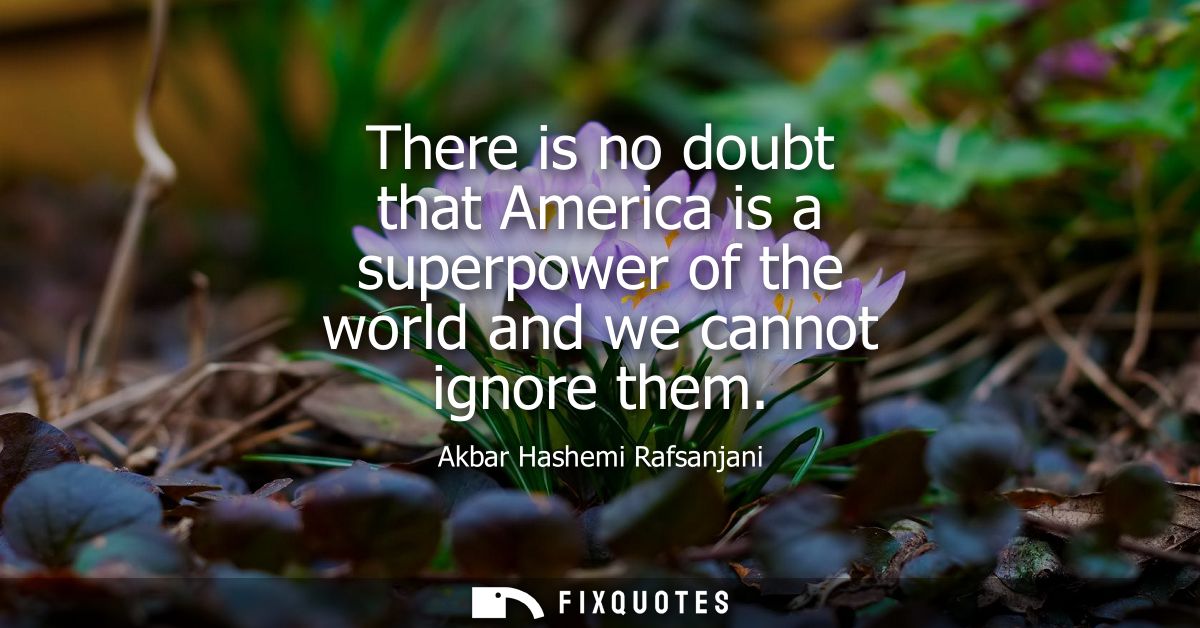
"There is no doubt that America is a superpower of the world and we cannot ignore them"
About this Quote
Rafsanjani’s line reads like a concession speech disguised as pragmatism: America is the superpower, and pretending otherwise is a luxury Iran can’t afford. The key move is the double negative. “There is no doubt” shuts down ideological argument before it starts, treating U.S. dominance not as a moral question but as a fact pattern. “We cannot ignore them” is even more pointed: it frames engagement as necessity, not admiration, and it quietly rebukes the revolutionary bravado that thrives on performative defiance.
The intent is managerial. Rafsanjani, a politician steeped in post-revolution governance and war-era scarcity, often positioned himself as the adult in the room - someone who understood that statecraft runs on leverage, tradeoffs, and the global financial system, not slogans. In that light, “ignore” is doing heavy lifting. It implies Iran has been acting as if non-recognition equals resistance, and that this posture costs real money, security, and diplomatic space.
The subtext is a domestic argument smuggled into an international observation. By acknowledging American power, he legitimizes policies that hardliners might brand as capitulation: negotiations, détente, tactical cooperation, economic normalization. It’s also a reminder of asymmetry: the U.S. can choose when to notice Iran; Iran can’t choose when to be affected by the U.S. Rafsanjani’s realism isn’t romantic - it’s a survival calculus, aimed at recalibrating pride into strategy.
The intent is managerial. Rafsanjani, a politician steeped in post-revolution governance and war-era scarcity, often positioned himself as the adult in the room - someone who understood that statecraft runs on leverage, tradeoffs, and the global financial system, not slogans. In that light, “ignore” is doing heavy lifting. It implies Iran has been acting as if non-recognition equals resistance, and that this posture costs real money, security, and diplomatic space.
The subtext is a domestic argument smuggled into an international observation. By acknowledging American power, he legitimizes policies that hardliners might brand as capitulation: negotiations, détente, tactical cooperation, economic normalization. It’s also a reminder of asymmetry: the U.S. can choose when to notice Iran; Iran can’t choose when to be affected by the U.S. Rafsanjani’s realism isn’t romantic - it’s a survival calculus, aimed at recalibrating pride into strategy.
Quote Details
| Topic | Peace |
|---|---|
| Source | Help us find the source |
More Quotes by Akbar
Add to List