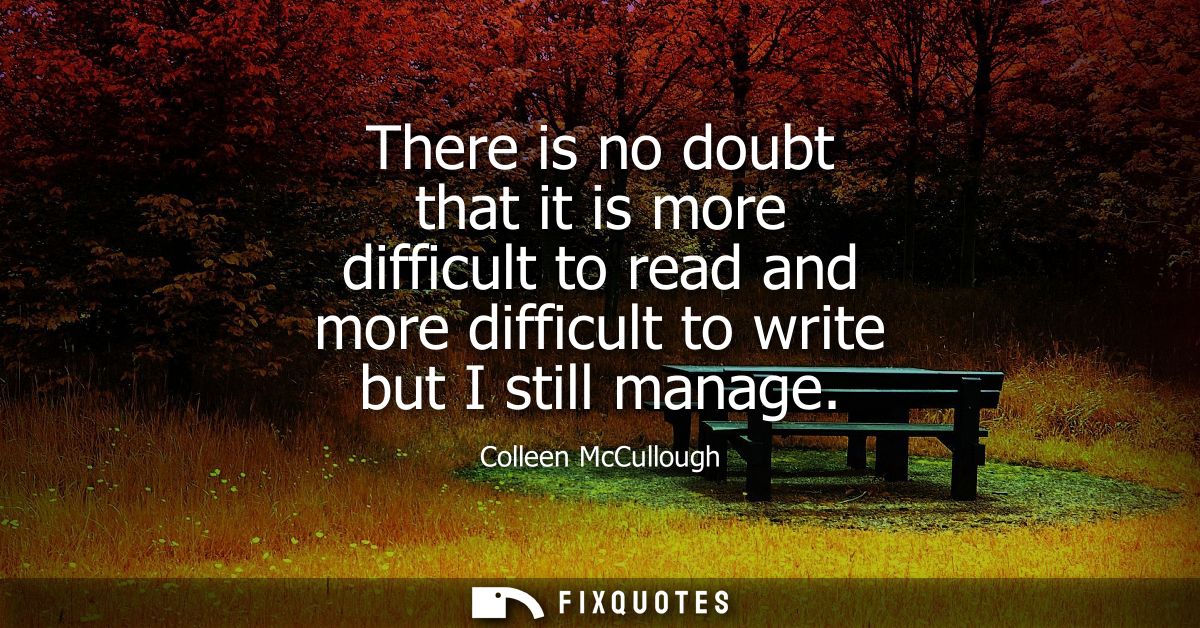
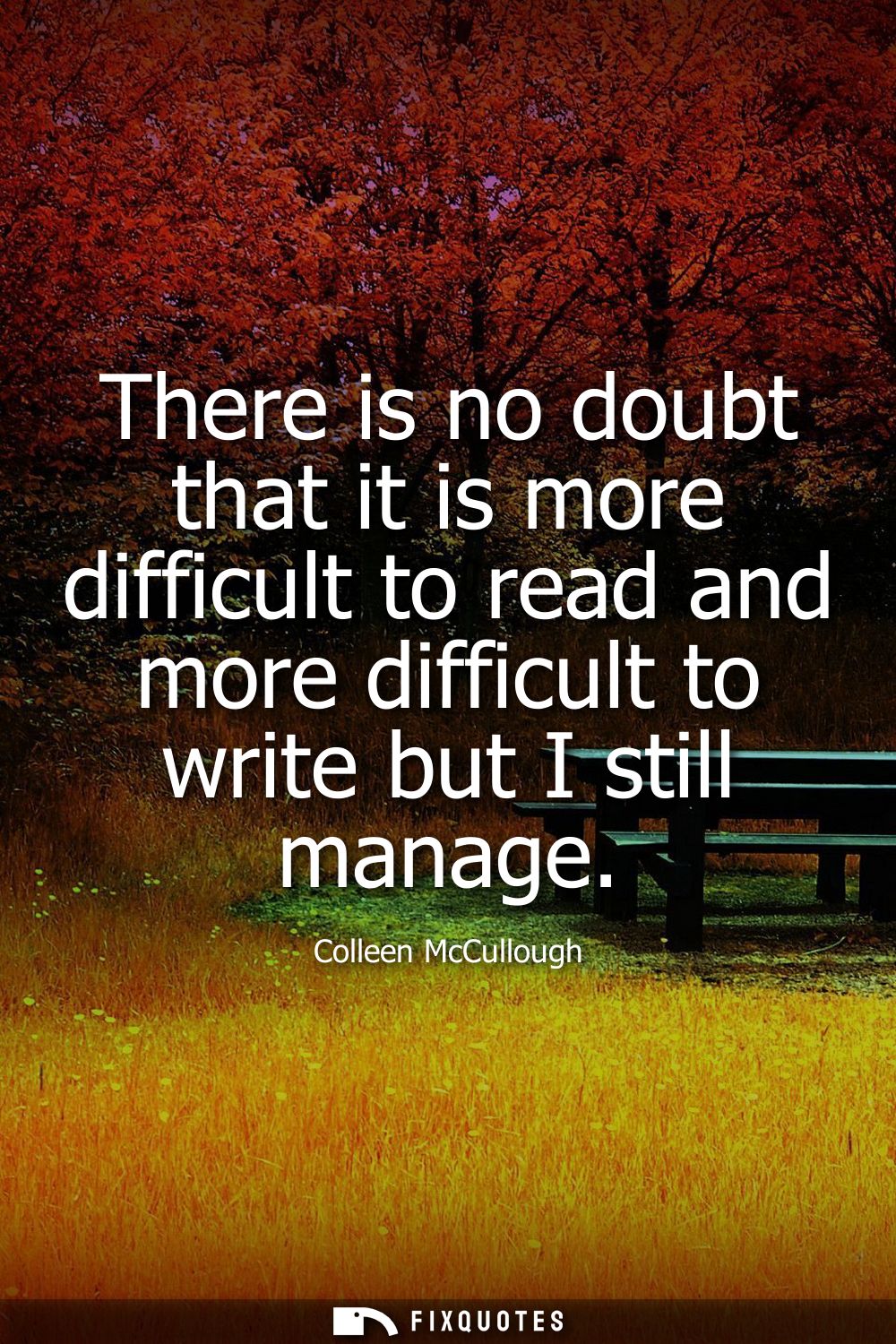
"There is no doubt that it is more difficult to read and more difficult to write but I still manage"
About this Quote
McCullough’s line lands with the dry, workmanlike confidence of someone who refuses the myth that writing is either effortless “inspiration” or glamorous suffering. She admits the double bind up front: reading is hard, writing is hard. Then she shrugs and keeps moving. That last clause, “but I still manage,” is doing the real cultural work here. It’s not a brag; it’s a declaration of professional stamina, the kind that treats difficulty as a given, not a crisis.
The subtext is a quiet rebuke to romantic narratives about authorship. McCullough wrote big, research-heavy novels that demanded immersion, discipline, and time. In that context, the statement reads like craft talk stripped to the studs: literacy isn’t passive consumption, it’s labor. Reading “more difficult” can also hint at the practical realities many writers face as they age - fatigue, health issues, the sheer cognitive load of sustained attention - without turning the speaker into a symbol. The point isn’t her hardship; it’s her refusal to let hardship become the story.
Stylistically, the sentence is plain to the edge of bluntness. No metaphor, no flourish, just a steady cadence of concession and persistence. That plainness is the ethos: the mature artist speaking from the long middle of a career, where the only real credential is continuing to show up. In an era that fetishizes hustle and “genius,” McCullough offers something rarer: competence under pressure, quietly normalized.
The subtext is a quiet rebuke to romantic narratives about authorship. McCullough wrote big, research-heavy novels that demanded immersion, discipline, and time. In that context, the statement reads like craft talk stripped to the studs: literacy isn’t passive consumption, it’s labor. Reading “more difficult” can also hint at the practical realities many writers face as they age - fatigue, health issues, the sheer cognitive load of sustained attention - without turning the speaker into a symbol. The point isn’t her hardship; it’s her refusal to let hardship become the story.
Stylistically, the sentence is plain to the edge of bluntness. No metaphor, no flourish, just a steady cadence of concession and persistence. That plainness is the ethos: the mature artist speaking from the long middle of a career, where the only real credential is continuing to show up. In an era that fetishizes hustle and “genius,” McCullough offers something rarer: competence under pressure, quietly normalized.
Quote Details
| Topic | Writing |
|---|
More Quotes by Colleen
Add to List