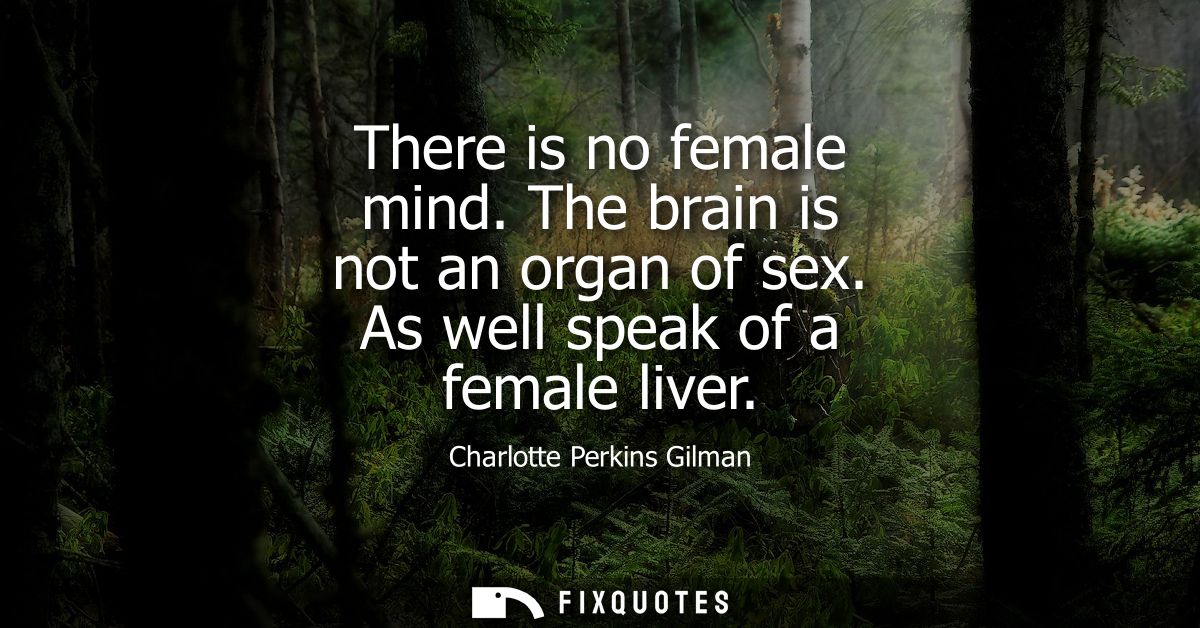
"There is no female mind. The brain is not an organ of sex. As well speak of a female liver"
About this Quote
The intent is polemical, but the subtext is tactical. Gilman isn’t merely defending women from insult; she’s attacking the entire Victorian apparatus that turned gender into destiny. The phrase “organ of sex” is a sly reversal. Nineteenth-century pseudo-science loved to locate womanhood everywhere in the body, making intellect a derivative of reproductive function. Gilman counters by stripping the brain of gendered symbolism, insisting that sex difference belongs to specific organs, not to cognition itself. It’s an argument for women’s access to education, work, and public life, but also for the right to be treated as a full human unit rather than a specialized domestic tool.
Context sharpens the provocation. Writing amid suffrage agitation and “separate spheres” ideology, Gilman anticipates a modern feminist move: treating gender as a social story we tell about bodies, not a truth those bodies inevitably dictate. Her metaphor works because it humiliates the prejudice. It doesn’t plead; it laughs, and that laughter is the leverage.
Quote Details
| Topic | Equality |
|---|---|
| Source | Verified source: Women and Economics (Charlotte Perkins Gilman, 1898)
Evidence: There is no female mind. The brain is not an organ of sex. As well speak of a female liver. (Chapter VIII (page varies by edition)). This line appears in Charlotte Perkins Gilman’s own text, Women and Economics: A Study of the Economic Relation Between Men and Women as a Factor in Social Evolution (first book publication: 1898). Many secondary references paraphrase it as “Might as well speak…,” but the wording above (“As well speak…”) is attested in the online transcription of the work. Other candidates (1) The Parasitic Mind (Gad Saad, 2020) compilation95.5% ... Charlotte Perkins Gilman infamously proclaimed , " There is no female mind . The brain is not an organ of sex . A... |
| Cite |
Citation Formats
APA Style (7th ed.)
Gilman, Charlotte Perkins. (2026, February 14). There is no female mind. The brain is not an organ of sex. As well speak of a female liver. FixQuotes. https://fixquotes.com/quotes/there-is-no-female-mind-the-brain-is-not-an-organ-99360/
Chicago Style
Gilman, Charlotte Perkins. "There is no female mind. The brain is not an organ of sex. As well speak of a female liver." FixQuotes. February 14, 2026. https://fixquotes.com/quotes/there-is-no-female-mind-the-brain-is-not-an-organ-99360/.
MLA Style (9th ed.)
"There is no female mind. The brain is not an organ of sex. As well speak of a female liver." FixQuotes, 14 Feb. 2026, https://fixquotes.com/quotes/there-is-no-female-mind-the-brain-is-not-an-organ-99360/. Accessed 5 Apr. 2026.