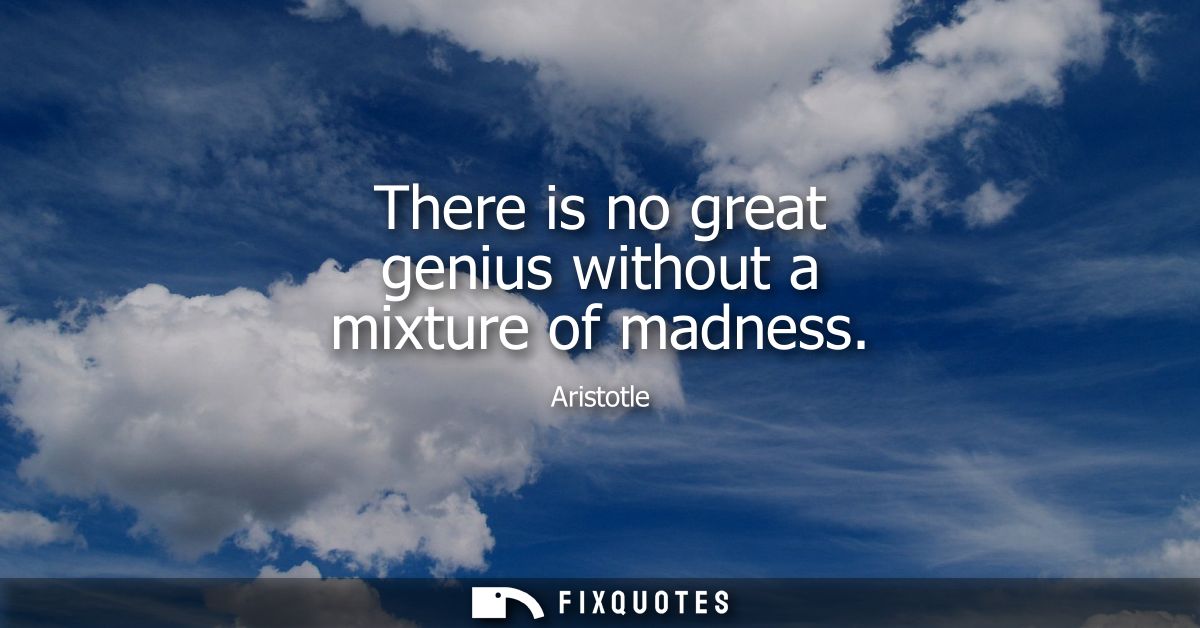
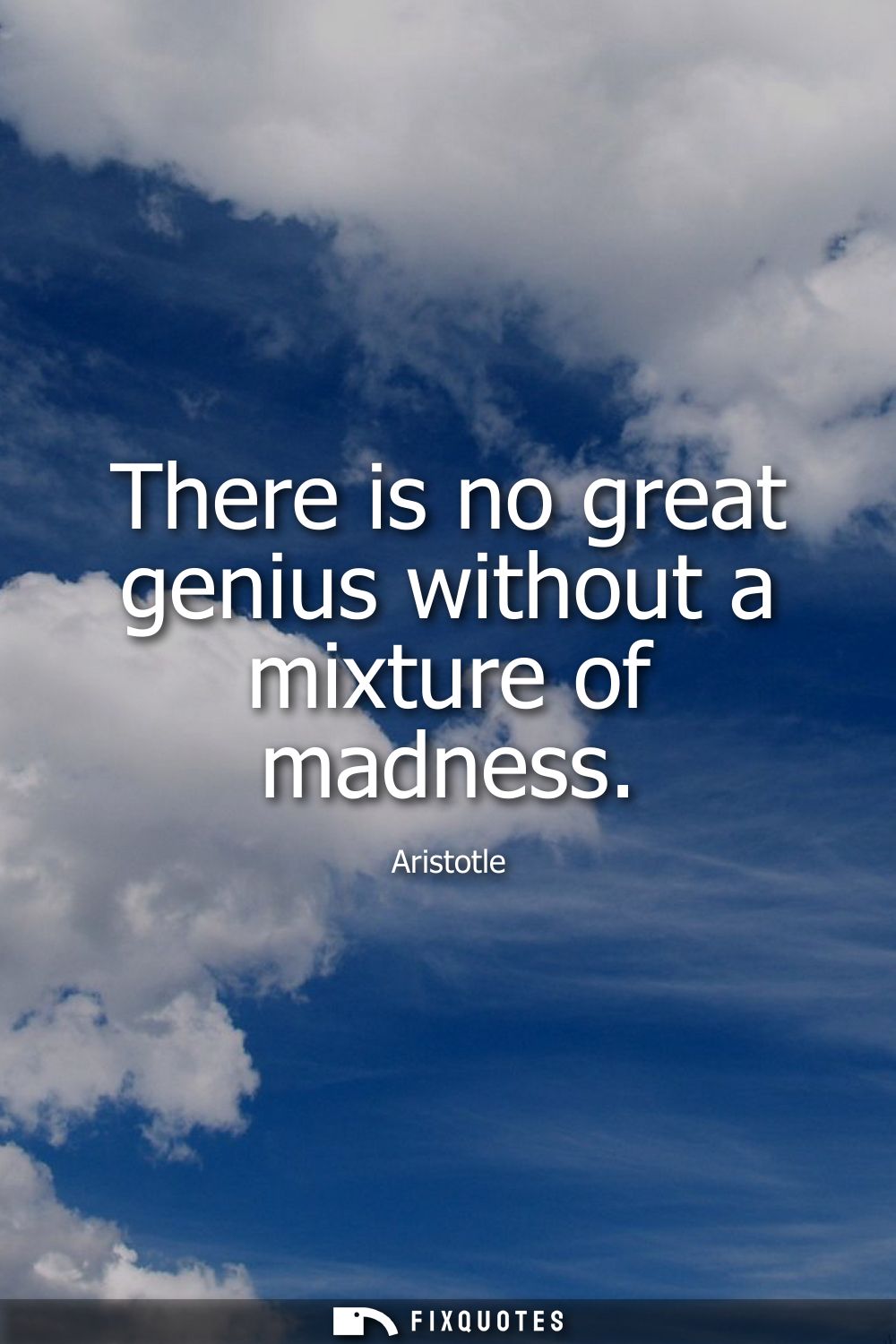
"There is no great genius without a mixture of madness"
About this Quote
Aristotle drops this line like a calming warning label on the idea of excellence: greatness is rarely tidy. Coming from the philosopher who built systems for classifying everything from animals to arguments, the admission lands with extra bite. He’s not romanticizing chaos; he’s trying to account for a stubborn pattern his neat categories can’t fully domesticate. “Mixture” is the tell. This isn’t a celebration of losing control so much as a claim that the exceptional mind runs hot enough to flirt with the edge.
The intent is diagnostic, almost clinical. Aristotle is interested in causes: why certain people produce the work that reorganizes a field, and why those people so often appear socially difficult, emotionally volatile, or obsessively singular. The subtext is that genius requires a tolerance for dissonance. To see what others miss, you have to be willing to look foolish, to fixate, to keep pressing after the sensible person stops. That persistence can resemble “madness” to a community that values steadiness over discovery.
Context matters: in the Greek tradition, “madness” isn’t only pathology; it’s also mania, a heightened state associated with prophecy, poetry, and the gods. Aristotle, more sober than Plato but still shaped by that cultural vocabulary, splits the difference. He secularizes the myth: not divine possession, but a temperament that destabilizes the ordinary.
The line also doubles as a social defense. If brilliance and instability travel together, the community can both admire the product and quarantine the producer. Genius becomes legible, even forgivable, as an exception that proves the rule of normalcy.
The intent is diagnostic, almost clinical. Aristotle is interested in causes: why certain people produce the work that reorganizes a field, and why those people so often appear socially difficult, emotionally volatile, or obsessively singular. The subtext is that genius requires a tolerance for dissonance. To see what others miss, you have to be willing to look foolish, to fixate, to keep pressing after the sensible person stops. That persistence can resemble “madness” to a community that values steadiness over discovery.
Context matters: in the Greek tradition, “madness” isn’t only pathology; it’s also mania, a heightened state associated with prophecy, poetry, and the gods. Aristotle, more sober than Plato but still shaped by that cultural vocabulary, splits the difference. He secularizes the myth: not divine possession, but a temperament that destabilizes the ordinary.
The line also doubles as a social defense. If brilliance and instability travel together, the community can both admire the product and quarantine the producer. Genius becomes legible, even forgivable, as an exception that proves the rule of normalcy.
Quote Details
| Topic | Wisdom |
|---|---|
| Source | Help us find the source |
| Cite |
Citation Formats
APA Style (7th ed.)
Aristotle. (2026, January 15). There is no great genius without a mixture of madness. FixQuotes. https://fixquotes.com/quotes/there-is-no-great-genius-without-a-mixture-of-34189/
Chicago Style
Aristotle. "There is no great genius without a mixture of madness." FixQuotes. January 15, 2026. https://fixquotes.com/quotes/there-is-no-great-genius-without-a-mixture-of-34189/.
MLA Style (9th ed.)
"There is no great genius without a mixture of madness." FixQuotes, 15 Jan. 2026, https://fixquotes.com/quotes/there-is-no-great-genius-without-a-mixture-of-34189/. Accessed 3 Apr. 2026.
More Quotes by Aristotle
Add to List