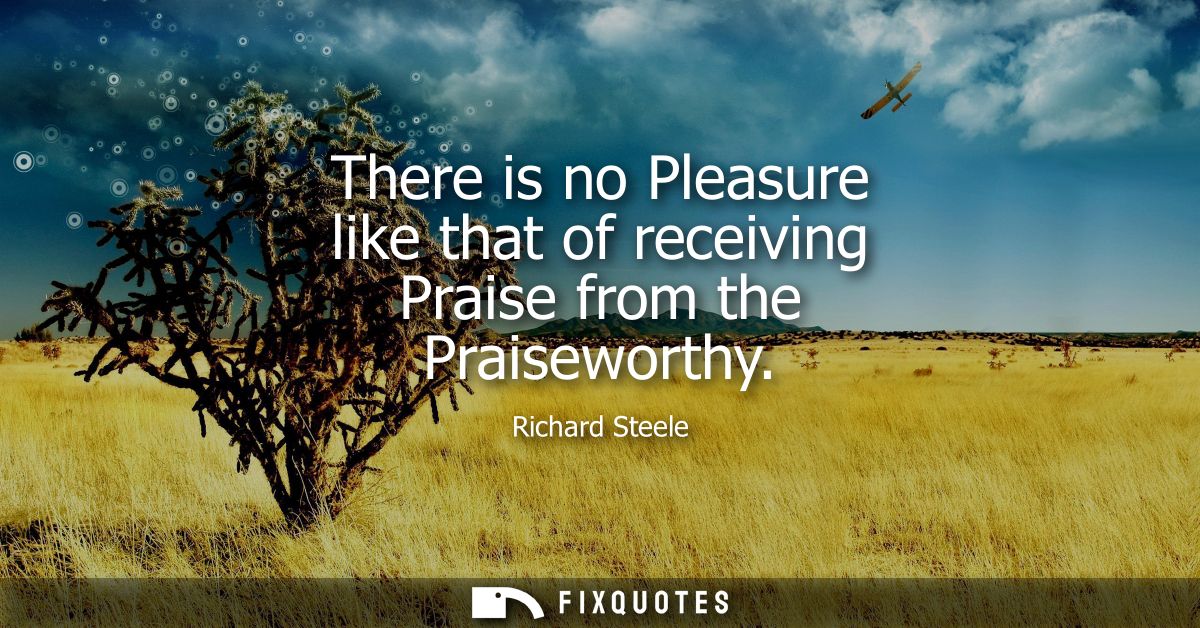
"There is no Pleasure like that of receiving Praise from the Praiseworthy"
About this Quote
The key word is “Praiseworthy,” which does double duty. It sets a standard for the person giving praise (they must be virtuous, discerning) while quietly implying a standard for the person receiving it (you must have done something that survives serious scrutiny). Steele is moralizing, yes, but he’s also managing status. “There is no Pleasure like...” frames approval as the highest indulgence, then launders that indulgence through ethics: it’s fine to enjoy praise, provided it comes from the right people. Vanity gets rebranded as good taste.
In early 18th-century Britain - a society increasingly shaped by periodicals, polite sociability, and anxieties about hypocrisy - this is a neat antidote to cheap clout. Steele, as a dramatist and essayist, knew how easily public applause could be bought, faked, or simply given by a crowd that wanted spectacle. He proposes a hierarchy of audiences: the worthiest spectator is the one who can’t be easily impressed. The subtext is disciplinary: seek out harder judges, and you’ll behave better.
Quote Details
| Topic | Respect |
|---|---|
| Source | Help us find the source |
| Cite |
Citation Formats
APA Style (7th ed.)
Steele, Richard. (2026, January 15). There is no Pleasure like that of receiving Praise from the Praiseworthy. FixQuotes. https://fixquotes.com/quotes/there-is-no-pleasure-like-that-of-receiving-163771/
Chicago Style
Steele, Richard. "There is no Pleasure like that of receiving Praise from the Praiseworthy." FixQuotes. January 15, 2026. https://fixquotes.com/quotes/there-is-no-pleasure-like-that-of-receiving-163771/.
MLA Style (9th ed.)
"There is no Pleasure like that of receiving Praise from the Praiseworthy." FixQuotes, 15 Jan. 2026, https://fixquotes.com/quotes/there-is-no-pleasure-like-that-of-receiving-163771/. Accessed 27 Mar. 2026.