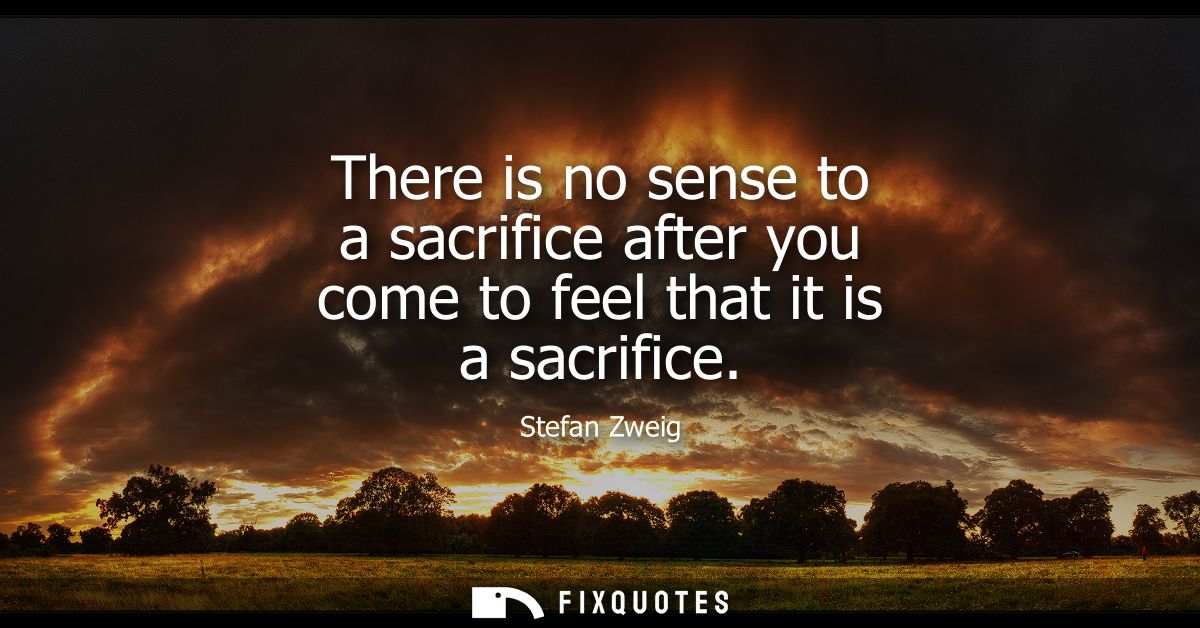
"There is no sense to a sacrifice after you come to feel that it is a sacrifice"
About this Quote
The subtext is a warning about martyrdom’s secret hunger. Once sacrifice becomes self-aware, it starts demanding recognition, gratitude, history’s applause. That demand may stay polite, even silent, but it reorganizes the relationship: the giver becomes creditor, the loved one becomes debtor, the cause becomes employer. Zweig, a writer of emotional precision and social masks, is diagnosing how quickly virtue can become resentment dressed as principle.
Context sharpens the blade. An Austrian Jewish intellectual formed by fin-de-siecle Vienna and undone by Europe’s collapse, Zweig saw ideals invoked to justify war, nationalism, and exile. He also understood private sacrifice: the compromises of marriage, the etiquette of bourgeois life, the slow surrender of comfort to crisis. In that world, “sacrifice” is a word people use to flatter themselves while they grind down others.
What makes the line work is its refusal to romanticize suffering. It doesn’t say sacrifice is bad; it says sacrifice that needs to be felt as sacrifice is already contaminated by ego. The purest giving, Zweig implies, is indistinguishable from choice.
Quote Details
| Topic | Letting Go |
|---|---|
| Source | Help us find the source |
| Cite |
Citation Formats
APA Style (7th ed.)
Zweig, Stefan. (2026, January 16). There is no sense to a sacrifice after you come to feel that it is a sacrifice. FixQuotes. https://fixquotes.com/quotes/there-is-no-sense-to-a-sacrifice-after-you-come-126858/
Chicago Style
Zweig, Stefan. "There is no sense to a sacrifice after you come to feel that it is a sacrifice." FixQuotes. January 16, 2026. https://fixquotes.com/quotes/there-is-no-sense-to-a-sacrifice-after-you-come-126858/.
MLA Style (9th ed.)
"There is no sense to a sacrifice after you come to feel that it is a sacrifice." FixQuotes, 16 Jan. 2026, https://fixquotes.com/quotes/there-is-no-sense-to-a-sacrifice-after-you-come-126858/. Accessed 28 Mar. 2026.