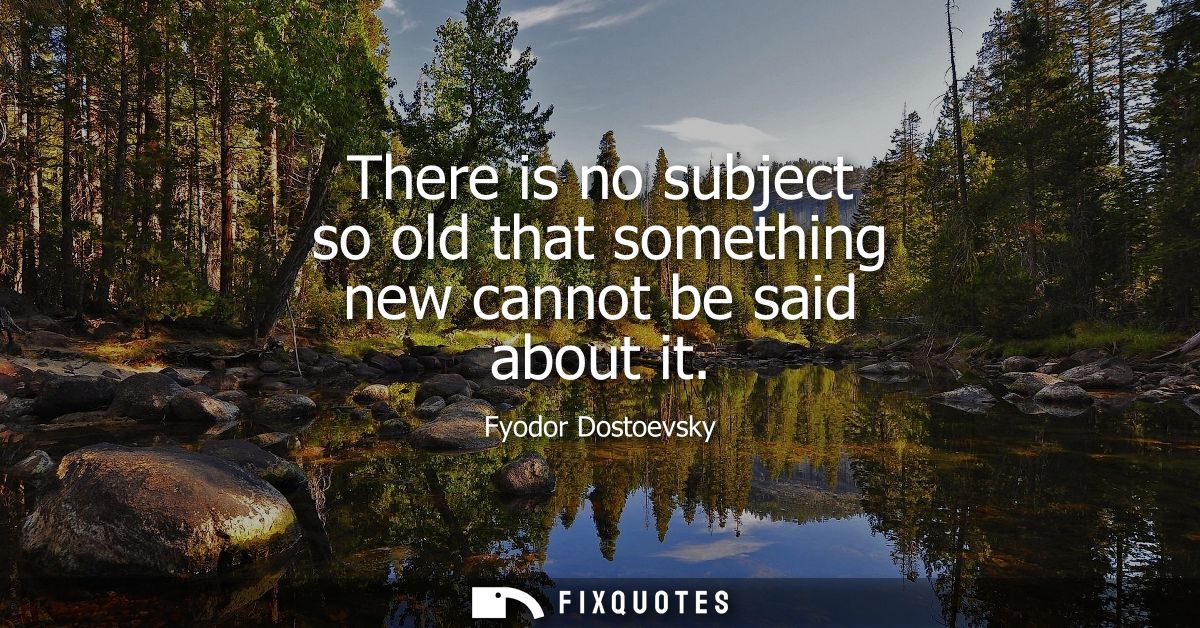
"There is no subject so old that something new cannot be said about it"
About this Quote
The intent is partly craft advice, partly philosophy. As a novelist obsessed with recurrence - guilt, faith, freedom, humiliation, pride - Dostoevsky knew repetition isn’t redundancy. His books circle the same themes because human beings circle. What’s “new” isn’t a gimmick; it’s the unnerving specificity of a consciousness rendered honestly. In that sense the line defends the novel as an engine for fresh meaning: put an ancient dilemma inside a particular room, with particular debts, particular wounds, and it becomes contemporary again.
The subtext also takes aim at cynicism. Saying “nothing new” is often a way to avoid attention, effort, or vulnerability. Dostoevsky suggests the opposite: if you can’t find something new to say, the limitation may be your seeing, not the subject. Coming from a writer forged by imprisonment, political repression, and spiritual crisis, the claim carries context: history doesn’t retire its questions. It just forces new answers out of them.
Quote Details
| Topic | Knowledge |
|---|---|
| Source | Verified source: Quote Junkie: Philosophy Edition (Hagopian Institute, 2008)ISBN: 9781434896834 · ID: bvWI-Qku-IcC
Evidence:
... Fyodor Dostoevsky The greatest happiness is to know the source of unhappiness . Fyodor Dostoevsky The soul is healed by being with children Fyodor Dostoevsky There is no subject so old that something new cannot be said about it ... |
| Cite |
Citation Formats
APA Style (7th ed.)
Dostoevsky, Fyodor. (2026, February 18). There is no subject so old that something new cannot be said about it. FixQuotes. https://fixquotes.com/quotes/there-is-no-subject-so-old-that-something-new-7150/
Chicago Style
Dostoevsky, Fyodor. "There is no subject so old that something new cannot be said about it." FixQuotes. February 18, 2026. https://fixquotes.com/quotes/there-is-no-subject-so-old-that-something-new-7150/.
MLA Style (9th ed.)
"There is no subject so old that something new cannot be said about it." FixQuotes, 18 Feb. 2026, https://fixquotes.com/quotes/there-is-no-subject-so-old-that-something-new-7150/. Accessed 26 Mar. 2026.