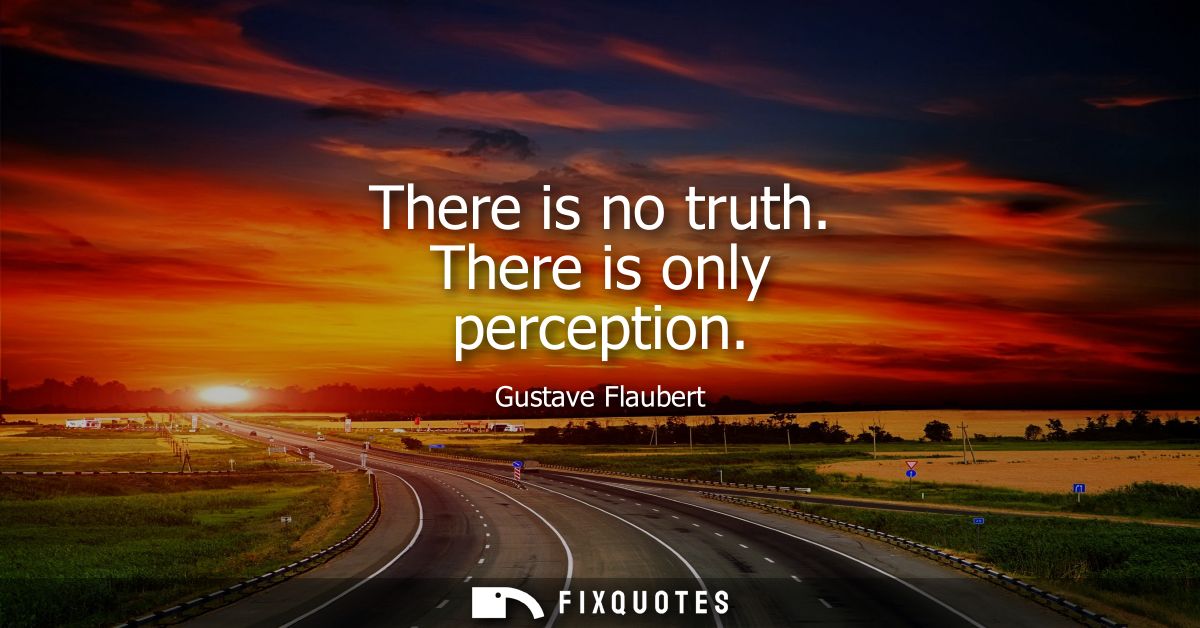
"There is no truth. There is only perception"
About this Quote
Flaubert’s “There is no truth. There is only perception” isn’t a warm, relativist shrug; it’s a cold tool for seeing how reality gets manufactured in the mind and then sold back to us as fact. Coming from a novelist obsessed with precision and allergic to bourgeois self-deception, the line reads less like philosophy and more like a warning label: people don’t encounter “truth” directly, they curate it through desire, vanity, fear, and whatever story they’re already living inside.
That’s the subtext of Flaubert’s realism, especially in a world like Madame Bovary’s, where Emma doesn’t merely misunderstand her life; she experiences it through borrowed scripts. Romance novels, social expectations, consumer fantasies: perception isn’t passive here, it’s a regime. The terrifying implication is that perception can be trained, monetized, and aestheticized until it feels inevitable. Flaubert’s genius is to dramatize this without sermonizing. He writes with such clinical clarity that the characters’ delusions indict themselves.
The line also hints at his famous pursuit of le mot juste. If there’s “no truth,” language can’t be a transparent window onto reality; it’s a lens that bends. Flaubert’s fixations on style become ethical: to write accurately is to resist the cheap perceptions culture hands you. In 19th-century France, with its rising mass media, consumer culture, and moral pieties, that resistance mattered. The statement lands as both skepticism and discipline: you may not reach truth, but you can expose the machinery of seeing.
That’s the subtext of Flaubert’s realism, especially in a world like Madame Bovary’s, where Emma doesn’t merely misunderstand her life; she experiences it through borrowed scripts. Romance novels, social expectations, consumer fantasies: perception isn’t passive here, it’s a regime. The terrifying implication is that perception can be trained, monetized, and aestheticized until it feels inevitable. Flaubert’s genius is to dramatize this without sermonizing. He writes with such clinical clarity that the characters’ delusions indict themselves.
The line also hints at his famous pursuit of le mot juste. If there’s “no truth,” language can’t be a transparent window onto reality; it’s a lens that bends. Flaubert’s fixations on style become ethical: to write accurately is to resist the cheap perceptions culture hands you. In 19th-century France, with its rising mass media, consumer culture, and moral pieties, that resistance mattered. The statement lands as both skepticism and discipline: you may not reach truth, but you can expose the machinery of seeing.
Quote Details
| Topic | Truth |
|---|---|
| Source | Help us find the source |
| Cite |
Citation Formats
APA Style (7th ed.)
Flaubert, Gustave. (2026, January 14). There is no truth. There is only perception. FixQuotes. https://fixquotes.com/quotes/there-is-no-truth-there-is-only-perception-11742/
Chicago Style
Flaubert, Gustave. "There is no truth. There is only perception." FixQuotes. January 14, 2026. https://fixquotes.com/quotes/there-is-no-truth-there-is-only-perception-11742/.
MLA Style (9th ed.)
"There is no truth. There is only perception." FixQuotes, 14 Jan. 2026, https://fixquotes.com/quotes/there-is-no-truth-there-is-only-perception-11742/. Accessed 27 Mar. 2026.
More Quotes by Gustave
Add to List