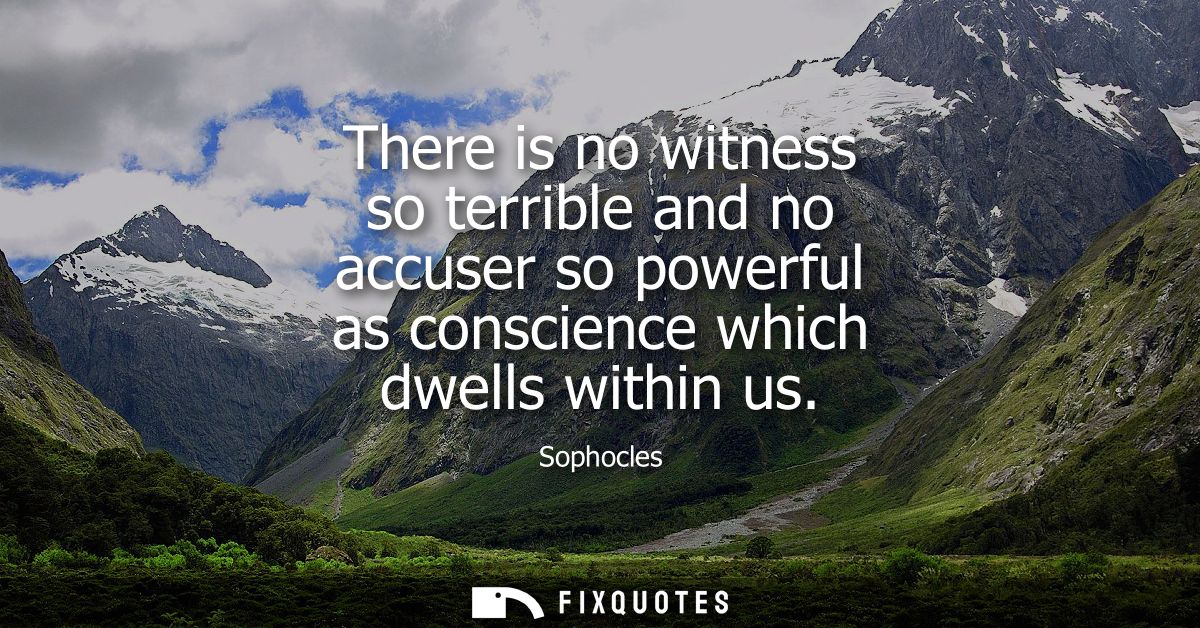
"There is no witness so terrible and no accuser so powerful as conscience which dwells within us"
About this Quote
The subtext is bleakly practical. External authority can be evaded; evidence can be buried; gods can be bargained with (or at least pleaded to). Conscience, though, "dwells within us" like a permanent resident. That verb matters. It suggests not a fleeting pang but an occupancy. You're never alone, and your privacy is a myth. Sophoclean tragedy thrives on exactly this pressure: characters who can outrun soldiers, prophets, and kings but cannot outrun what they know about themselves. The horror isn't just punishment; it's recognition.
Contextually, the quote sits comfortably beside the moral architecture of Greek tragedy, where wrongdoing triggers not only legal consequences but pollution, shame, and cosmic imbalance. Sophocles is less interested in preaching virtue than in exposing the mechanism by which humans self-destruct: they try to manage appearances while their inner testimony keeps taking the stand. The line anticipates a modern insight with ancient severity: the fiercest surveillance is self-surveillance, and it doesn't need cameras.
Quote Details
| Topic | Ethics & Morality |
|---|---|
| Source | Help us find the source |
| Cite |
Citation Formats
APA Style (7th ed.)
Sophocles. (2026, January 15). There is no witness so terrible and no accuser so powerful as conscience which dwells within us. FixQuotes. https://fixquotes.com/quotes/there-is-no-witness-so-terrible-and-no-accuser-so-34387/
Chicago Style
Sophocles. "There is no witness so terrible and no accuser so powerful as conscience which dwells within us." FixQuotes. January 15, 2026. https://fixquotes.com/quotes/there-is-no-witness-so-terrible-and-no-accuser-so-34387/.
MLA Style (9th ed.)
"There is no witness so terrible and no accuser so powerful as conscience which dwells within us." FixQuotes, 15 Jan. 2026, https://fixquotes.com/quotes/there-is-no-witness-so-terrible-and-no-accuser-so-34387/. Accessed 30 Mar. 2026.