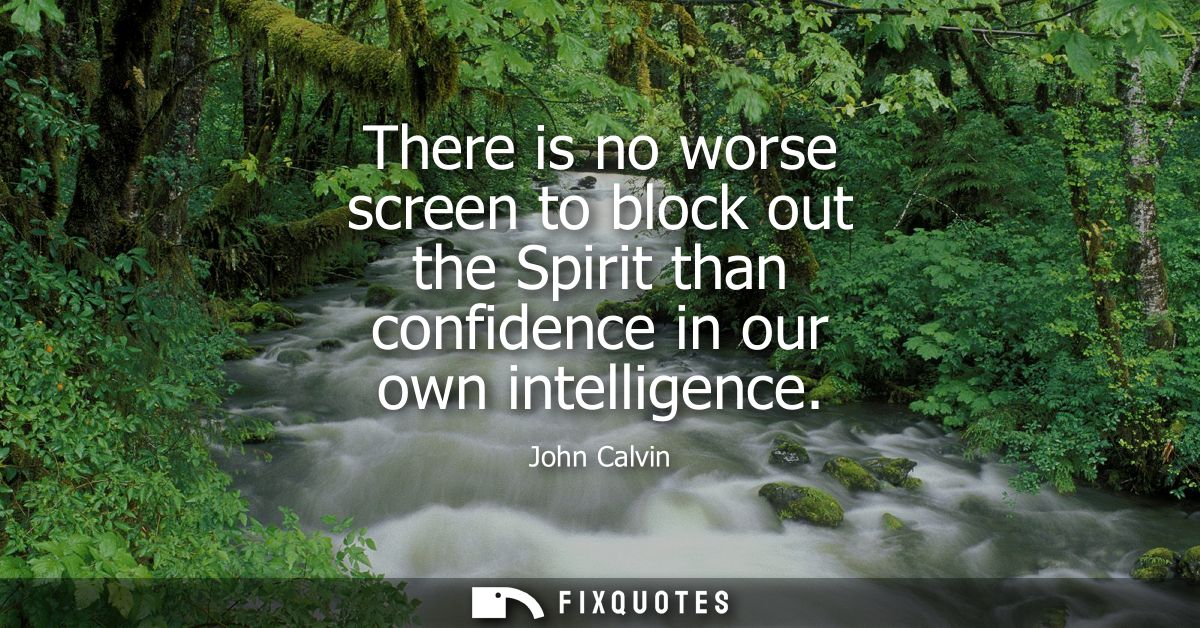
"There is no worse screen to block out the Spirit than confidence in our own intelligence"
About this Quote
The intent is pastoral and polemical at once. Pastoral, because he’s diagnosing a familiar psychological move: the ego recruiting “reason” as its bodyguard. Polemical, because it draws a boundary against any theology that treats God as an object to be mastered by technique, debate, or scholastic prowess. Calvin’s Reformation project leans hard on the doctrine that human faculties are compromised - not useless, but bent. Intelligence becomes dangerous not because thinking is bad, but because thinking can become a substitute for dependence.
The subtext is a warning about control. “Spirit” here is not a vague mood; it’s the Holy Spirit, whose work Calvin imagines as disruptive, humbling, and un-purchasable. Confidence in intelligence is “worse” than ignorance because it feels like sight. It creates the illusion that you’re already oriented, already qualified, already safe from surprise. That’s the screen: not darkness, but glare.
Context matters: a 16th-century Europe arguing over authority - Church, scripture, conscience, learning. Calvin’s jab lands on anyone tempted to treat theology as intellectual property. He’s not anti-mind; he’s anti-self-sufficiency. The mind, in his frame, is meant to be an instrument. The moment it starts crowning itself, it stops listening.
Quote Details
| Topic | Humility |
|---|---|
| Source | Help us find the source |
| Cite |
Citation Formats
APA Style (7th ed.)
Calvin, John. (2026, January 15). There is no worse screen to block out the Spirit than confidence in our own intelligence. FixQuotes. https://fixquotes.com/quotes/there-is-no-worse-screen-to-block-out-the-spirit-9459/
Chicago Style
Calvin, John. "There is no worse screen to block out the Spirit than confidence in our own intelligence." FixQuotes. January 15, 2026. https://fixquotes.com/quotes/there-is-no-worse-screen-to-block-out-the-spirit-9459/.
MLA Style (9th ed.)
"There is no worse screen to block out the Spirit than confidence in our own intelligence." FixQuotes, 15 Jan. 2026, https://fixquotes.com/quotes/there-is-no-worse-screen-to-block-out-the-spirit-9459/. Accessed 5 Apr. 2026.