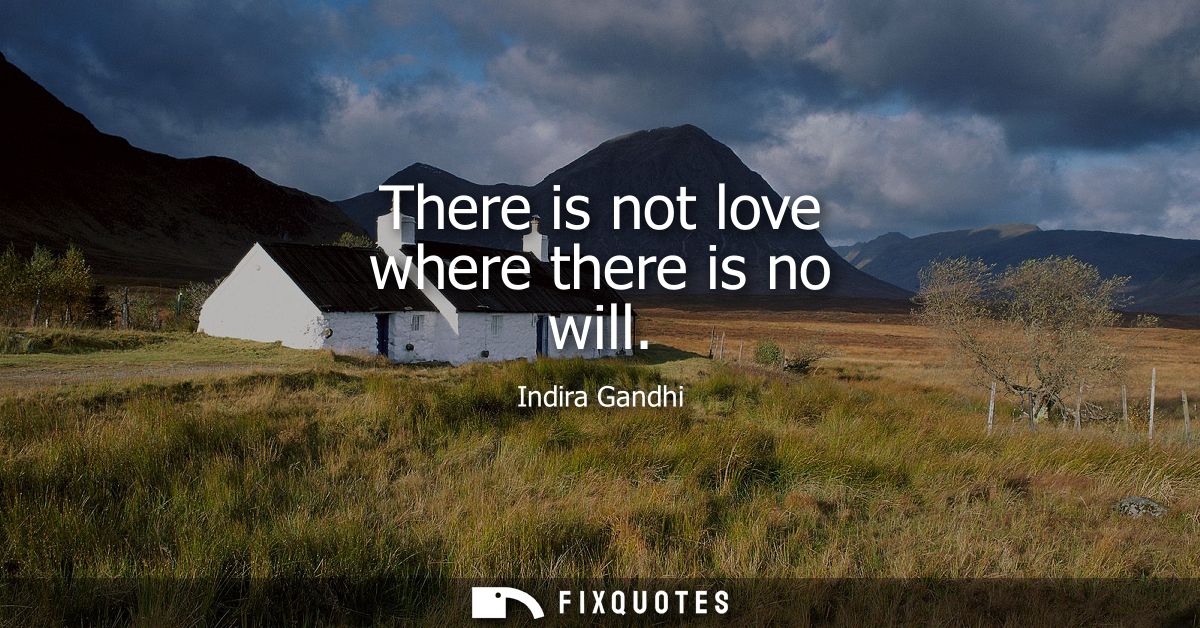
"There is not love where there is no will"
About this Quote
Love, in Indira Gandhi's framing, is not a mood you stumble into; it is a discipline you choose. "There is not love where there is no will" turns a sentimental noun into a political verb. Coming from a statesman who governed through crisis, factionalism, and the high-stakes theater of postcolonial nation-building, the line reads less like romance and more like governance advice: affection without agency is theatrics; commitment without resolve is noise.
The intent is bluntly corrective. Gandhi rejects the idea that love is something that "happens" to people and replaces it with willpower - the capacity to decide, endure, and act. The subtext carries a hard edge: if you say you love - a person, a cause, a country - but you won't shoulder the cost of that claim, then you don't love. You prefer the identity of a lover to the labor of love.
Context sharpens the stakes. In a democracy repeatedly tested by poverty, communal tension, and geopolitical pressure, public devotion is cheap currency. Politicians declare love for "the people" while avoiding the unpopular work of building institutions, distributing resources, or restraining their own power. Gandhi's line exposes that fraud by making will the proof. It's also self-implicating: will can justify sacrifice, but it can also rationalize coercion. When leaders equate love with will, they flirt with the dangerous idea that force is just commitment with muscle. The sentence is small, but it presses on the central problem of modern politics: how easily passion becomes propaganda unless it's tethered to accountable choice.
The intent is bluntly corrective. Gandhi rejects the idea that love is something that "happens" to people and replaces it with willpower - the capacity to decide, endure, and act. The subtext carries a hard edge: if you say you love - a person, a cause, a country - but you won't shoulder the cost of that claim, then you don't love. You prefer the identity of a lover to the labor of love.
Context sharpens the stakes. In a democracy repeatedly tested by poverty, communal tension, and geopolitical pressure, public devotion is cheap currency. Politicians declare love for "the people" while avoiding the unpopular work of building institutions, distributing resources, or restraining their own power. Gandhi's line exposes that fraud by making will the proof. It's also self-implicating: will can justify sacrifice, but it can also rationalize coercion. When leaders equate love with will, they flirt with the dangerous idea that force is just commitment with muscle. The sentence is small, but it presses on the central problem of modern politics: how easily passion becomes propaganda unless it's tethered to accountable choice.
Quote Details
| Topic | Love |
|---|---|
| Source | Help us find the source |
| Cite |
Citation Formats
APA Style (7th ed.)
Gandhi, Indira. (2026, January 15). There is not love where there is no will. FixQuotes. https://fixquotes.com/quotes/there-is-not-love-where-there-is-no-will-144412/
Chicago Style
Gandhi, Indira. "There is not love where there is no will." FixQuotes. January 15, 2026. https://fixquotes.com/quotes/there-is-not-love-where-there-is-no-will-144412/.
MLA Style (9th ed.)
"There is not love where there is no will." FixQuotes, 15 Jan. 2026, https://fixquotes.com/quotes/there-is-not-love-where-there-is-no-will-144412/. Accessed 12 Feb. 2026.
More Quotes by Indira
Add to List