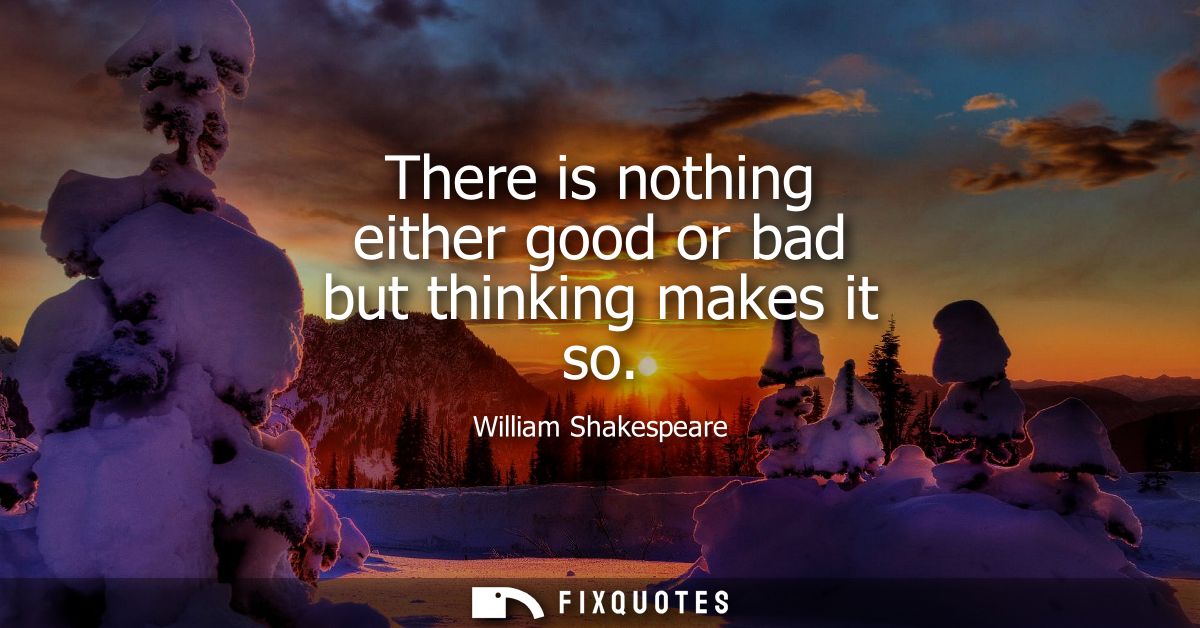
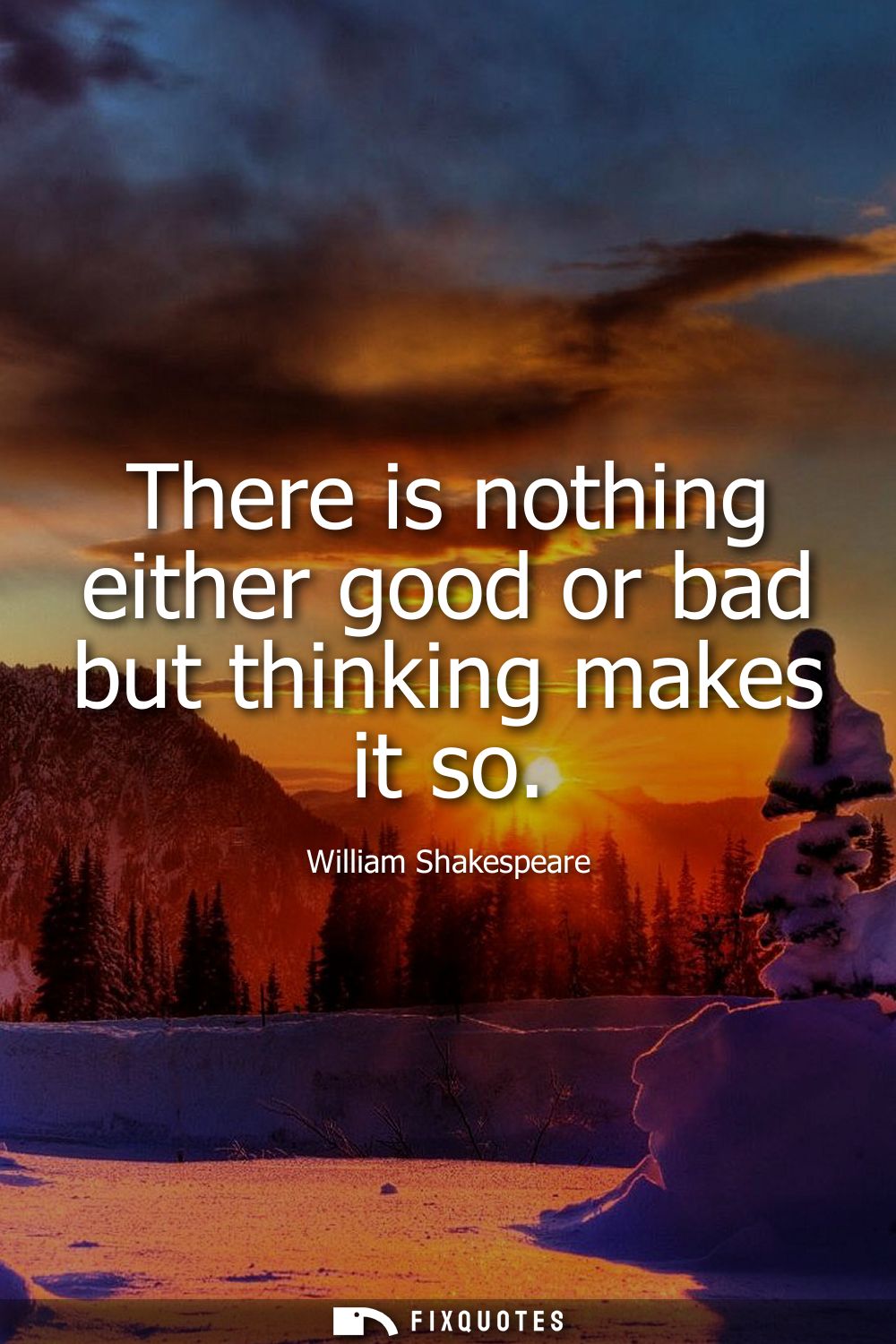
"There is nothing either good or bad, but thinking makes it so"
About this Quote
Morality, in Hamlet, isn’t a property of the world; it’s a mood that latches onto the world and won’t let go. “There is nothing either good or bad but thinking makes it so” lands with the sly provocation of a mind trying to out-argue its own despair. Shakespeare gives the line to Hamlet while he’s being surveilled and managed, a prince treated like a problem to be solved. So the claim isn’t a serene philosophy-of-mind seminar. It’s a defense mechanism: if good and bad are constructions, then grief, humiliation, even Denmark’s rot can be reclassified, rendered optional. That’s the seduction.
The subtext is more cutting. Hamlet’s insight is also an alibi. If judgment is just “thinking,” then responsibility can be deferred, action postponed, revenge endlessly litigated. Shakespeare makes the idea feel true in the moment and dangerous in the long run, because it mirrors Hamlet’s most corrosive habit: turning experience into interpretation until interpretation replaces living.
What makes the line work is its double edge. It sounds like radical freedom, but it also hints at captivity inside one’s own skull. Hamlet is brilliant enough to relativize anything, including his own suffering, yet he can’t think his way out of paralysis. The sentence is clean, balanced, almost aphoristic - a neat little courtroom argument - which is precisely the point: elegance becomes a kind of self-enchantment. Shakespeare lets us hear how intellect can both illuminate reality and anesthetize it, and how quickly “perspective” can turn into a trap.
The subtext is more cutting. Hamlet’s insight is also an alibi. If judgment is just “thinking,” then responsibility can be deferred, action postponed, revenge endlessly litigated. Shakespeare makes the idea feel true in the moment and dangerous in the long run, because it mirrors Hamlet’s most corrosive habit: turning experience into interpretation until interpretation replaces living.
What makes the line work is its double edge. It sounds like radical freedom, but it also hints at captivity inside one’s own skull. Hamlet is brilliant enough to relativize anything, including his own suffering, yet he can’t think his way out of paralysis. The sentence is clean, balanced, almost aphoristic - a neat little courtroom argument - which is precisely the point: elegance becomes a kind of self-enchantment. Shakespeare lets us hear how intellect can both illuminate reality and anesthetize it, and how quickly “perspective” can turn into a trap.
Quote Details
| Topic | Ethics & Morality |
|---|---|
| Source | Hamlet (William Shakespeare), Act 2, Scene 2 — line from the play text (Act II, Sc. II); found in standard editions and online texts. |
| Cite |
Citation Formats
APA Style (7th ed.)
Shakespeare, William. (2026, February 16). There is nothing either good or bad, but thinking makes it so. FixQuotes. https://fixquotes.com/quotes/there-is-nothing-either-good-or-bad-but-thinking-27592/
Chicago Style
Shakespeare, William. "There is nothing either good or bad, but thinking makes it so." FixQuotes. February 16, 2026. https://fixquotes.com/quotes/there-is-nothing-either-good-or-bad-but-thinking-27592/.
MLA Style (9th ed.)
"There is nothing either good or bad, but thinking makes it so." FixQuotes, 16 Feb. 2026, https://fixquotes.com/quotes/there-is-nothing-either-good-or-bad-but-thinking-27592/. Accessed 12 Mar. 2026.
More Quotes by William
Add to List