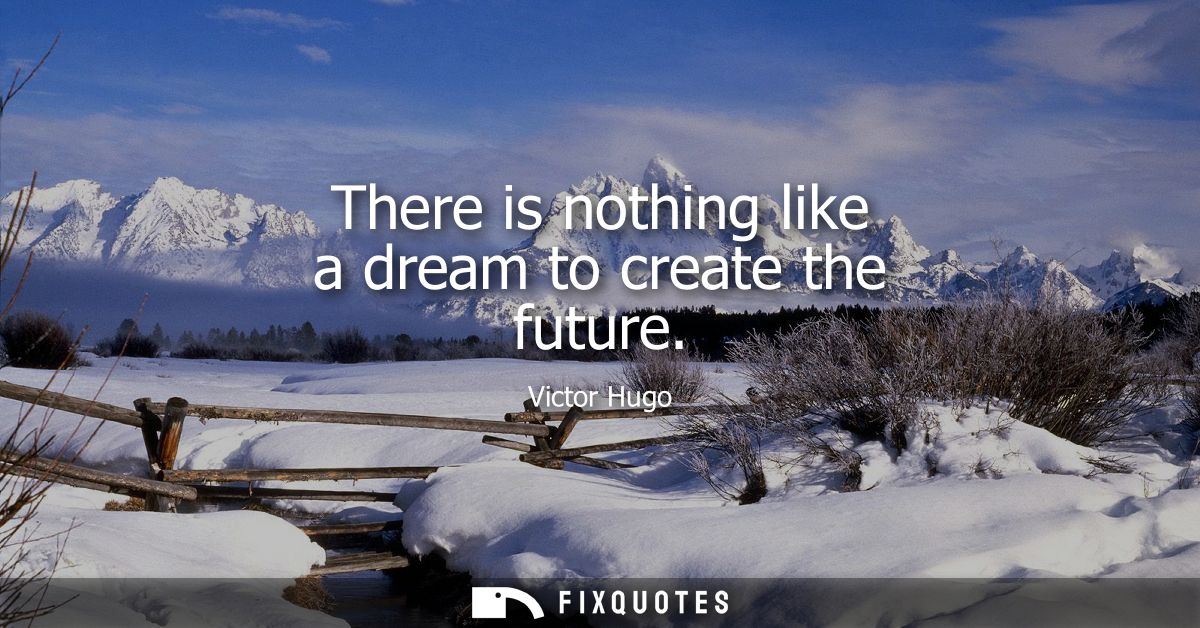
"There is nothing like a dream to create the future"
About this Quote
Hugo’s line is a romantic provocation dressed up as common sense: the future isn’t engineered solely by policy, industry, or “realism,” but by the kinds of private visions that polite society likes to dismiss as impractical. “Nothing like a dream” is doing double duty. It flatters imagination as the first draft of history, and it needles the reader who equates seriousness with cynicism. The phrasing makes the claim feel inevitable, almost physical: dreams aren’t airy distractions from reality; they’re the mechanism by which reality gets revised.
The subtext is political. Hugo lived through whiplash regimes in 19th-century France, a century of revolutions, restorations, empires, and crackdowns where the official story changed faster than the street names. In that climate, “the future” isn’t a neutral horizon; it’s contested territory. A dream becomes a quiet act of defiance, a way to keep an alternative order alive when the present is insisting it’s permanent. That’s why Hugo, who spent years in exile for opposing Napoleon III, treats imagination as a civic force. The dream is not escapism; it’s rehearsal.
What makes the sentence work is its compact reversal of cause and effect. We assume the future produces dreams (aspirations shaped by what seems possible). Hugo flips it: dreams produce the future, expanding the boundaries of the possible by insisting on a world that does not yet exist. It’s romanticism as strategy, not perfume.
The subtext is political. Hugo lived through whiplash regimes in 19th-century France, a century of revolutions, restorations, empires, and crackdowns where the official story changed faster than the street names. In that climate, “the future” isn’t a neutral horizon; it’s contested territory. A dream becomes a quiet act of defiance, a way to keep an alternative order alive when the present is insisting it’s permanent. That’s why Hugo, who spent years in exile for opposing Napoleon III, treats imagination as a civic force. The dream is not escapism; it’s rehearsal.
What makes the sentence work is its compact reversal of cause and effect. We assume the future produces dreams (aspirations shaped by what seems possible). Hugo flips it: dreams produce the future, expanding the boundaries of the possible by insisting on a world that does not yet exist. It’s romanticism as strategy, not perfume.
Quote Details
| Topic | Motivational |
|---|---|
| Source | Les Misérables (1862) — often quoted line rendered as "There is nothing like a dream to create the future" (see Victor Hugo entry/Wikiquote). |
| Cite |
Citation Formats
APA Style (7th ed.)
Hugo, Victor. (2026, January 15). There is nothing like a dream to create the future. FixQuotes. https://fixquotes.com/quotes/there-is-nothing-like-a-dream-to-create-the-future-10575/
Chicago Style
Hugo, Victor. "There is nothing like a dream to create the future." FixQuotes. January 15, 2026. https://fixquotes.com/quotes/there-is-nothing-like-a-dream-to-create-the-future-10575/.
MLA Style (9th ed.)
"There is nothing like a dream to create the future." FixQuotes, 15 Jan. 2026, https://fixquotes.com/quotes/there-is-nothing-like-a-dream-to-create-the-future-10575/. Accessed 13 Feb. 2026.
More Quotes by Victor
Add to List