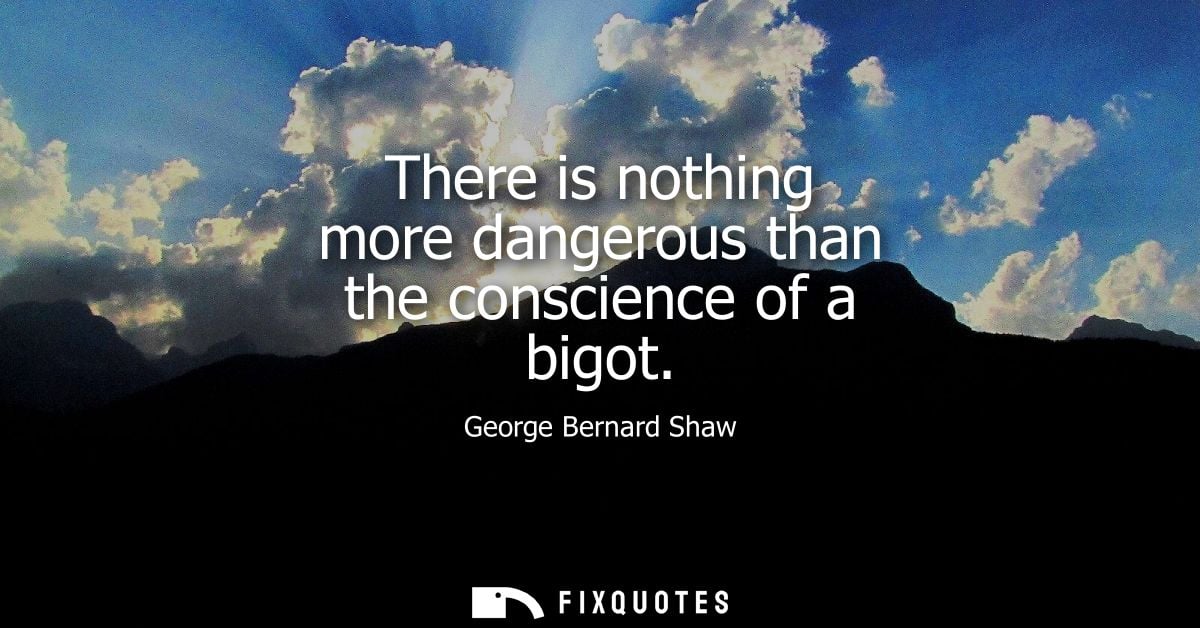
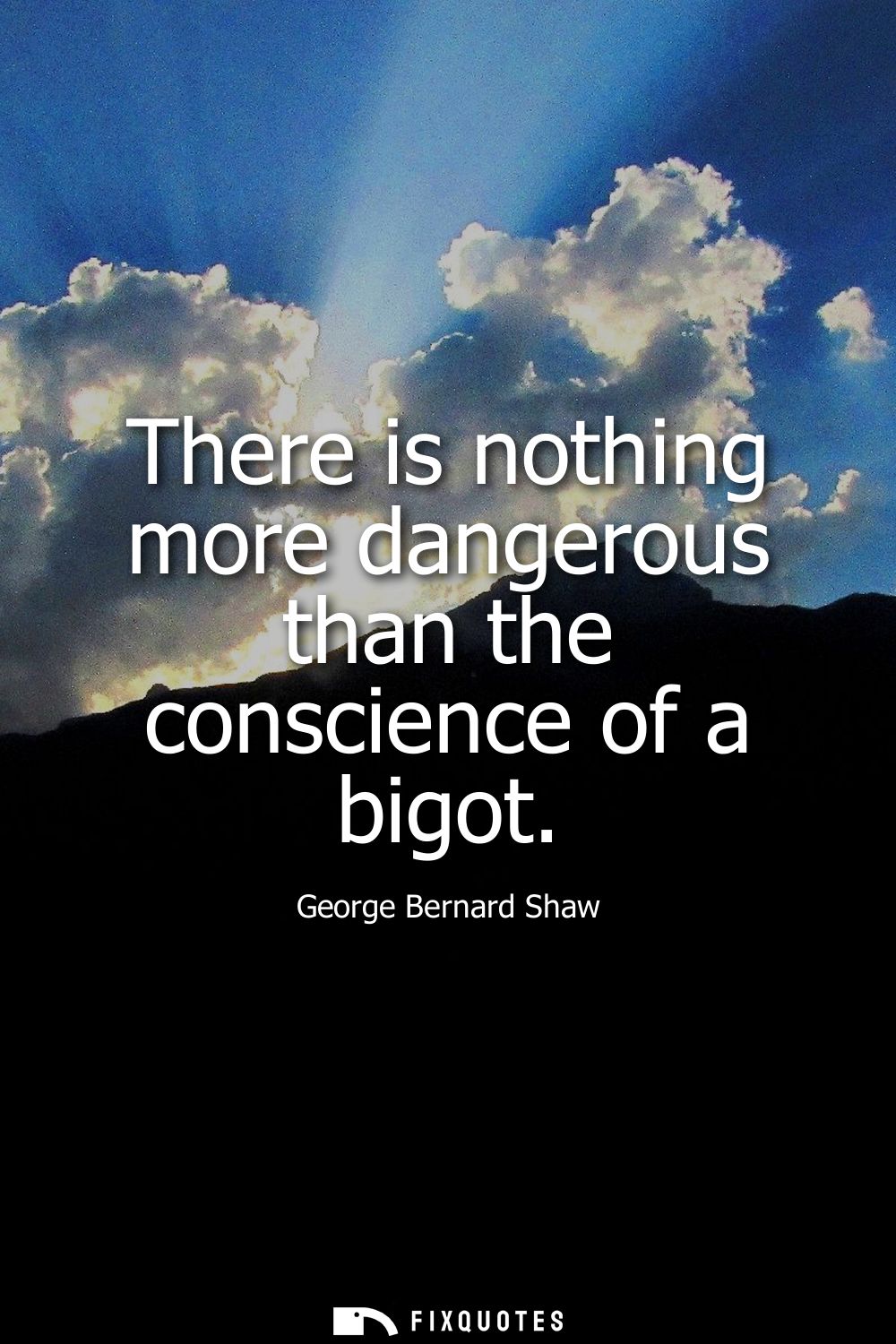
"There is nothing more dangerous than the conscience of a bigot"
About this Quote
Shaw’s line lands like a thrown glass: not because it’s loud, but because it’s aimed at the tidy moral self-image that lets intolerance dress itself up as virtue. “Bigot” is obvious enough; the sting comes from “conscience.” Shaw isn’t warning about the openly cruel villain who knows he’s doing wrong. He’s pointing at the more modern menace: the person who believes, sincerely, that their prejudice is an ethical duty.
That’s the subtext that makes the quote work. Conscience is usually treated as a brake on harm, an inner tribunal that restrains our worst impulses. Shaw flips it into an accelerant. A bigot with doubts can be argued with, shamed, slowed. A bigot with a conscience has already laundered desire into principle. He doesn’t hate; he “protects.” He doesn’t exclude; he “preserves standards.” Every action becomes righteous, and righteousness is famously hard to negotiate with.
The context is Shaw’s broader project as a dramatist and public intellectual: dismantling respectable hypocrisy. Writing in an era of empire, rigid class hierarchy, and moralizing social policy, he watched prejudice become institutional by passing through the language of decency and duty. The line is less about a lone crank than about systems built by people who can sleep at night.
Shaw’s cynicism isn’t nihilistic; it’s diagnostic. He’s warning that the most dangerous violence isn’t always fueled by passion. Sometimes it’s fueled by a calm, well-scrubbed certainty that God, nation, nature, or “common sense” is on your side.
That’s the subtext that makes the quote work. Conscience is usually treated as a brake on harm, an inner tribunal that restrains our worst impulses. Shaw flips it into an accelerant. A bigot with doubts can be argued with, shamed, slowed. A bigot with a conscience has already laundered desire into principle. He doesn’t hate; he “protects.” He doesn’t exclude; he “preserves standards.” Every action becomes righteous, and righteousness is famously hard to negotiate with.
The context is Shaw’s broader project as a dramatist and public intellectual: dismantling respectable hypocrisy. Writing in an era of empire, rigid class hierarchy, and moralizing social policy, he watched prejudice become institutional by passing through the language of decency and duty. The line is less about a lone crank than about systems built by people who can sleep at night.
Shaw’s cynicism isn’t nihilistic; it’s diagnostic. He’s warning that the most dangerous violence isn’t always fueled by passion. Sometimes it’s fueled by a calm, well-scrubbed certainty that God, nation, nature, or “common sense” is on your side.
Quote Details
| Topic | Ethics & Morality |
|---|---|
| Source | Help us find the source |
| Cite |
Citation Formats
APA Style (7th ed.)
Shaw, George Bernard. (2026, January 15). There is nothing more dangerous than the conscience of a bigot. FixQuotes. https://fixquotes.com/quotes/there-is-nothing-more-dangerous-than-the-29186/
Chicago Style
Shaw, George Bernard. "There is nothing more dangerous than the conscience of a bigot." FixQuotes. January 15, 2026. https://fixquotes.com/quotes/there-is-nothing-more-dangerous-than-the-29186/.
MLA Style (9th ed.)
"There is nothing more dangerous than the conscience of a bigot." FixQuotes, 15 Jan. 2026, https://fixquotes.com/quotes/there-is-nothing-more-dangerous-than-the-29186/. Accessed 30 Mar. 2026.
More Quotes by George
Add to List