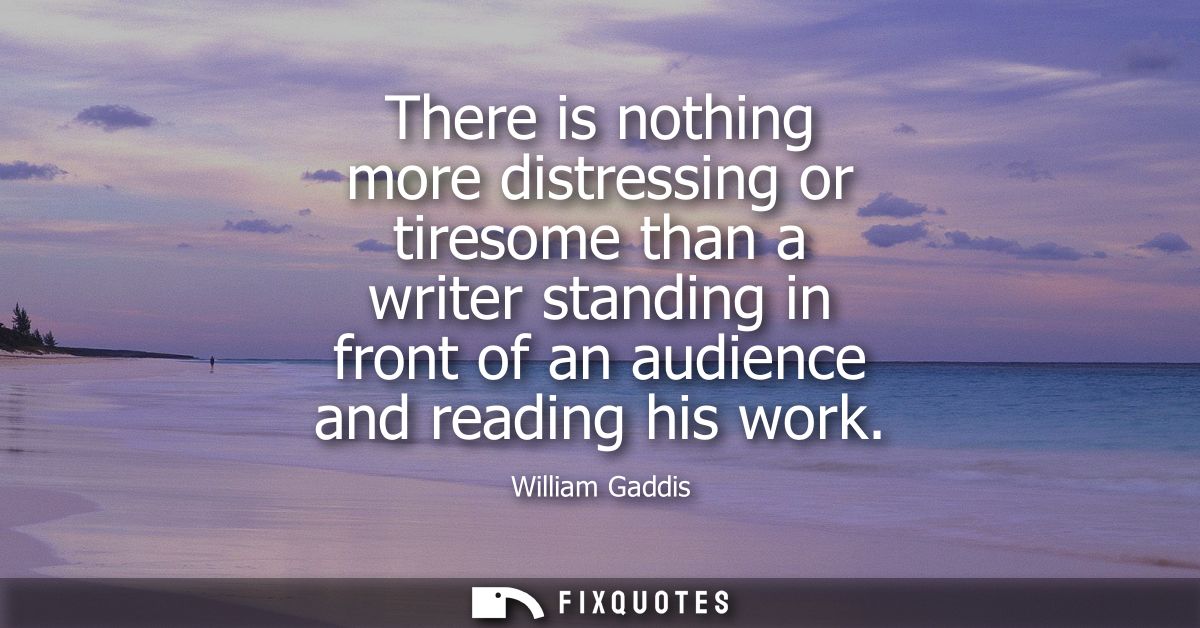
"There is nothing more distressing or tiresome than a writer standing in front of an audience and reading his work"
About this Quote
The phrasing is telling. “Distressing” points to embarrassment, not mere annoyance: the writer, stripped of the page’s authority, is suddenly just a person asking to be liked. “Tiresome” is the sharper blade. It implies not a failed event but an intrinsically wearying ritual, a cultural habit that mistakes proximity for meaning. Gaddis’s cynicism lands because it targets the modern literary economy as much as the format itself: readings as promotional labor, authorship as a kind of touring.
Contextually, Gaddis is a fitting messenger. His books are dense, polyphonic, resistant to easy consumption; they demand the solitary concentration a reading event can’t provide. A public excerpt offers the illusion of access while dodging what the work actually requires. Underneath the complaint is a moral claim: literature shouldn’t need the author’s body to authenticate it. If the prose can’t stand on the page, no microphone will save it.
Quote Details
| Topic | Writing |
|---|---|
| Source | Help us find the source |
| Cite |
Citation Formats
APA Style (7th ed.)
Gaddis, William. (2026, January 16). There is nothing more distressing or tiresome than a writer standing in front of an audience and reading his work. FixQuotes. https://fixquotes.com/quotes/there-is-nothing-more-distressing-or-tiresome-126972/
Chicago Style
Gaddis, William. "There is nothing more distressing or tiresome than a writer standing in front of an audience and reading his work." FixQuotes. January 16, 2026. https://fixquotes.com/quotes/there-is-nothing-more-distressing-or-tiresome-126972/.
MLA Style (9th ed.)
"There is nothing more distressing or tiresome than a writer standing in front of an audience and reading his work." FixQuotes, 16 Jan. 2026, https://fixquotes.com/quotes/there-is-nothing-more-distressing-or-tiresome-126972/. Accessed 27 Mar. 2026.