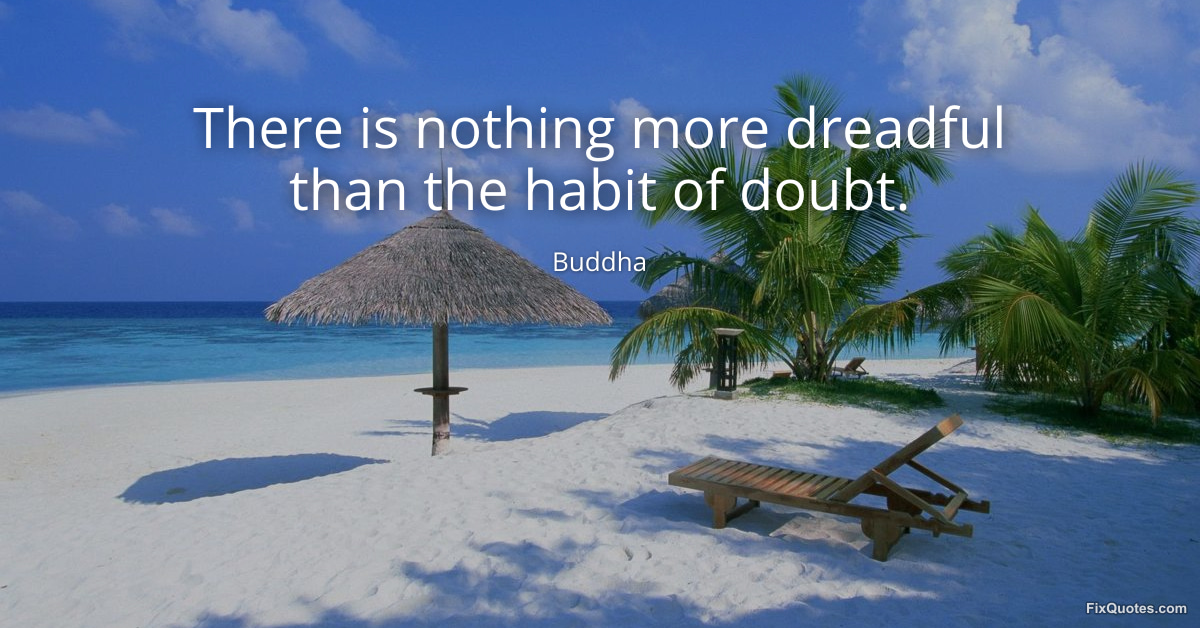
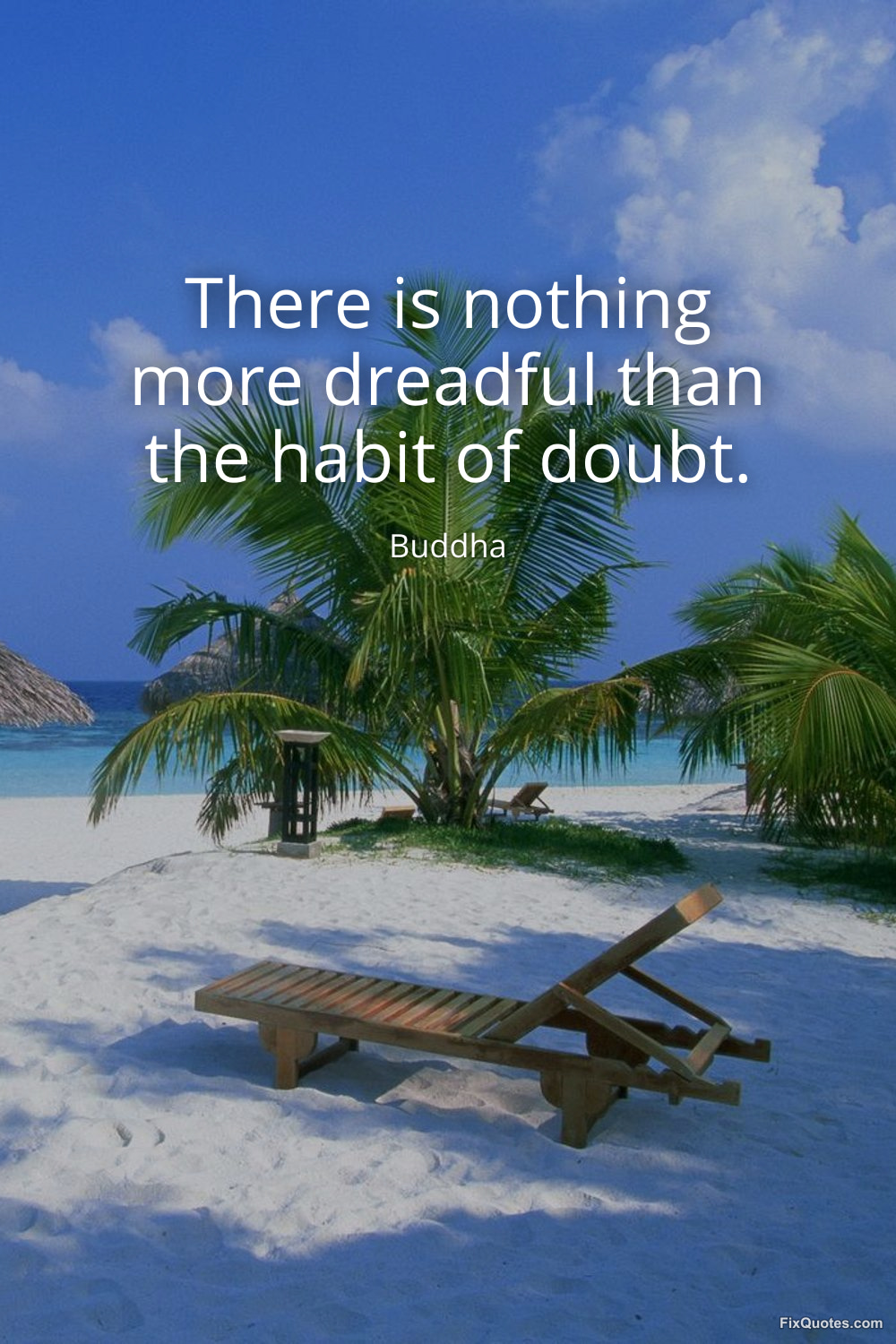
"There is nothing more dreadful than the habit of doubt"
About this Quote
Doubt, in this formulation, is not a virtue but a trap. That matters because the Buddha is often flattened into a mascot for serene open-mindedness, when much of his teaching is actually concerned with discipline: the training of attention, conduct, and insight. "Habit" is the key word here. He is not condemning honest questioning or intellectual rigor. He is warning against a mind that becomes attached to hesitation itself, a mind that circles every choice, every perception, every commitment until clarity is impossible.
The line carries the authority of a leader, not just a mystic. Buddha was founding a path, a community, and a way of life that asked for sustained practice. In that context, chronic doubt is corrosive. It erodes trust in teacher, method, and self; it turns spiritual inquiry into permanent deferral. You can hear the practical concern beneath the aphorism: a person who doubts as a reflex never quite begins.
Its force also comes from how psychologically modern it feels. The problem is not uncertainty; uncertainty is part of being alive. The problem is when skepticism hardens into identity, when withholding belief starts to feel smarter than risking conviction. That posture can masquerade as sophistication. Buddha cuts through it with unusual severity. "Dreadful" is a strong word because the cost is strong: doubt, repeated often enough, splinters the will.
The subtext is almost paradoxical. Liberation requires seeing through illusion, but you cannot see clearly if your mind is addicted to second-guessing. At a certain point, wisdom demands commitment.
The line carries the authority of a leader, not just a mystic. Buddha was founding a path, a community, and a way of life that asked for sustained practice. In that context, chronic doubt is corrosive. It erodes trust in teacher, method, and self; it turns spiritual inquiry into permanent deferral. You can hear the practical concern beneath the aphorism: a person who doubts as a reflex never quite begins.
Its force also comes from how psychologically modern it feels. The problem is not uncertainty; uncertainty is part of being alive. The problem is when skepticism hardens into identity, when withholding belief starts to feel smarter than risking conviction. That posture can masquerade as sophistication. Buddha cuts through it with unusual severity. "Dreadful" is a strong word because the cost is strong: doubt, repeated often enough, splinters the will.
The subtext is almost paradoxical. Liberation requires seeing through illusion, but you cannot see clearly if your mind is addicted to second-guessing. At a certain point, wisdom demands commitment.
Quote Details
| Topic | Wisdom |
|---|---|
| Source | Later attribution: I Can't Believe It's Not Buddha! (Bodhipaksa, 2018) modern compilationISBN: 9781946764362 · ID: LYpLDwAAQBAJ
Evidence: What Fake Buddha Quotes Can Teach Us About Buddhism Bodhipaksa. earlier , going as far back as the 1500s , was ... There is nothing more dreadful than the habit of doubt . " This was sent to me as part of a longer quote : There is ... Other candidates (1) Buddha, Truth and Brotherhood (Buddha, 1934)50.0% Indeed, there is nothing more dreadful than the habit of doubt. Faith draws people together, but doubt separates them... |
| Cite |
Citation Formats
APA Style (7th ed.)
Buddha. (2026, March 17). There is nothing more dreadful than the habit of doubt. FixQuotes. https://fixquotes.com/quotes/there-is-nothing-more-dreadful-than-the-habit-of-185949/
Chicago Style
Buddha. "There is nothing more dreadful than the habit of doubt." FixQuotes. March 17, 2026. https://fixquotes.com/quotes/there-is-nothing-more-dreadful-than-the-habit-of-185949/.
MLA Style (9th ed.)
"There is nothing more dreadful than the habit of doubt." FixQuotes, 17 Mar. 2026, https://fixquotes.com/quotes/there-is-nothing-more-dreadful-than-the-habit-of-185949/. Accessed 3 Apr. 2026.
More Quotes by Buddha
Add to List