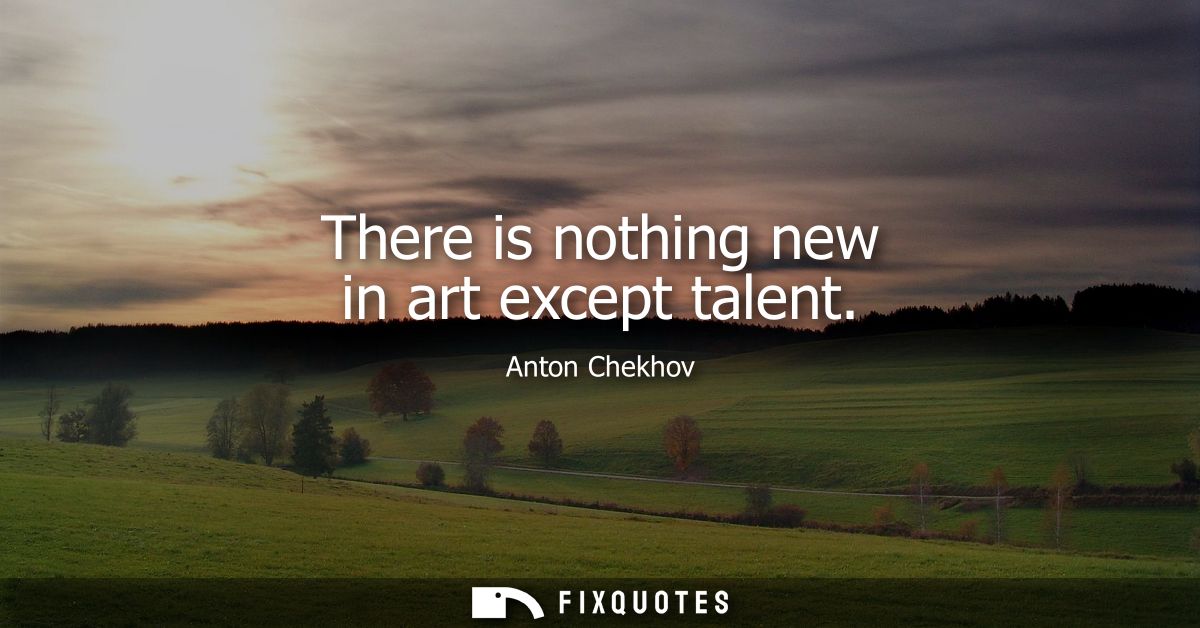
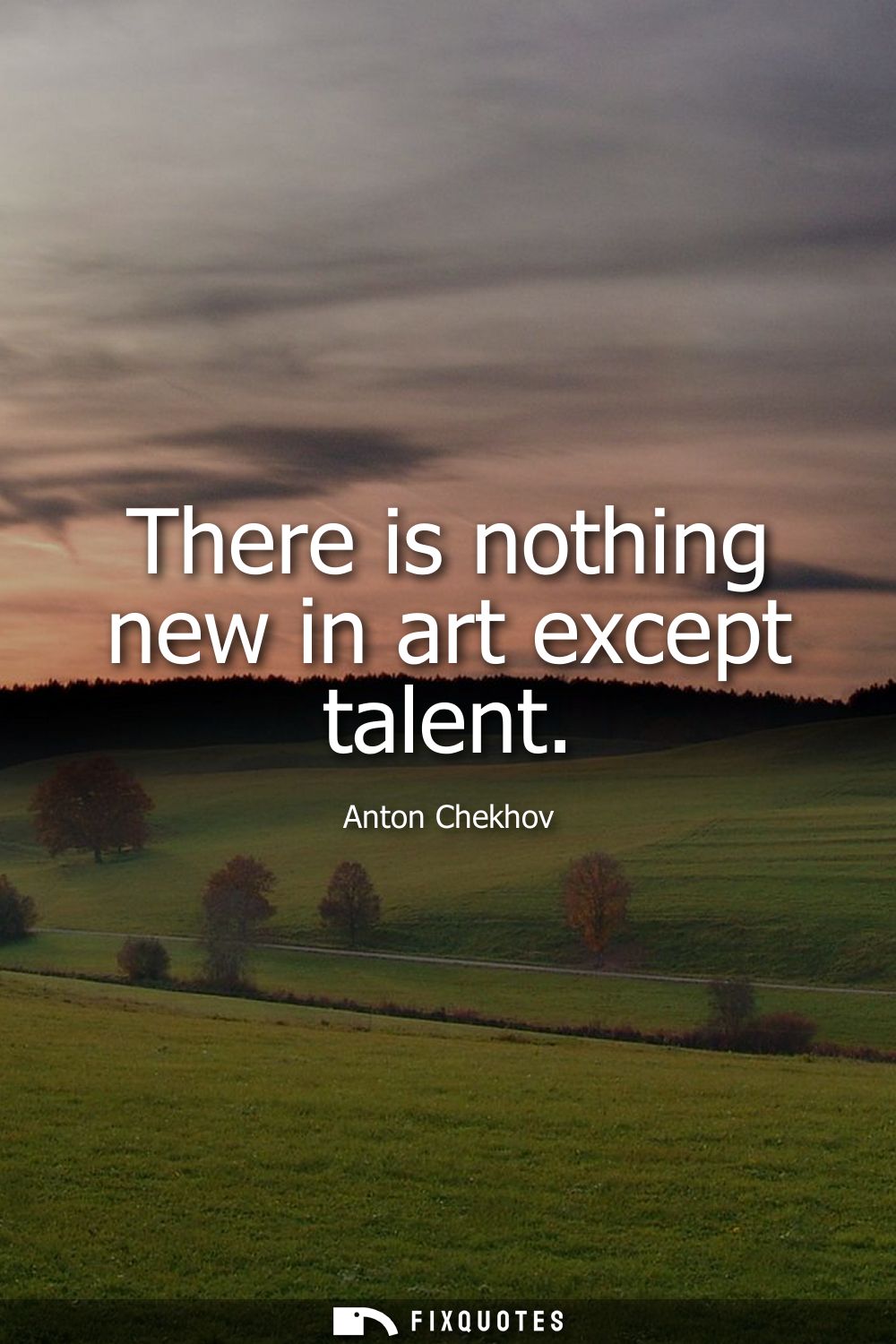
"There is nothing new in art except talent"
About this Quote
Chekhov’s line lands like a shrug with a scalpel hidden in it: the obsession with novelty is mostly a marketing fantasy, and art doesn’t advance by inventing never-before-seen content so much as by finding the one mind capable of making old materials feel unavoidable. Coming from a dramatist who rebuilt theater by stripping away theatricality, it’s also a quiet flex. Chekhov wrote about the most familiar subjects imaginable - money, boredom, missed chances, family cruelty - then made them ring with a new frequency. “Nothing new” is less a complaint than a corrective aimed at critics and audiences who mistake surface gimmicks for significance.
The subtext is anti-romantic and anti-bohemian. It punctures the cult of the “original idea” and relocates value where Chekhov believed it belonged: perception, selection, restraint. Talent, in this formulation, isn’t raw genius; it’s the capacity to notice what everyone else overlooks, to calibrate tone, to let subtext do the heavy lifting. That’s why the sentence works: it’s paradoxical but practical. It denies novelty as an end while describing the only kind of novelty that matters - the kind produced by craft.
Context sharpens the edge. Late-19th-century Russian culture was crowded with manifestos, movements, and literary camps arguing about what art should do. Chekhov sidesteps ideology. He implies that “newness” is cheap, but a new sensibility is rare. The provocation isn’t that art repeats itself; it’s that repetition is inevitable, and only talent makes it worth repeating.
The subtext is anti-romantic and anti-bohemian. It punctures the cult of the “original idea” and relocates value where Chekhov believed it belonged: perception, selection, restraint. Talent, in this formulation, isn’t raw genius; it’s the capacity to notice what everyone else overlooks, to calibrate tone, to let subtext do the heavy lifting. That’s why the sentence works: it’s paradoxical but practical. It denies novelty as an end while describing the only kind of novelty that matters - the kind produced by craft.
Context sharpens the edge. Late-19th-century Russian culture was crowded with manifestos, movements, and literary camps arguing about what art should do. Chekhov sidesteps ideology. He implies that “newness” is cheap, but a new sensibility is rare. The provocation isn’t that art repeats itself; it’s that repetition is inevitable, and only talent makes it worth repeating.
Quote Details
| Topic | Art |
|---|
More Quotes by Anton
Add to List