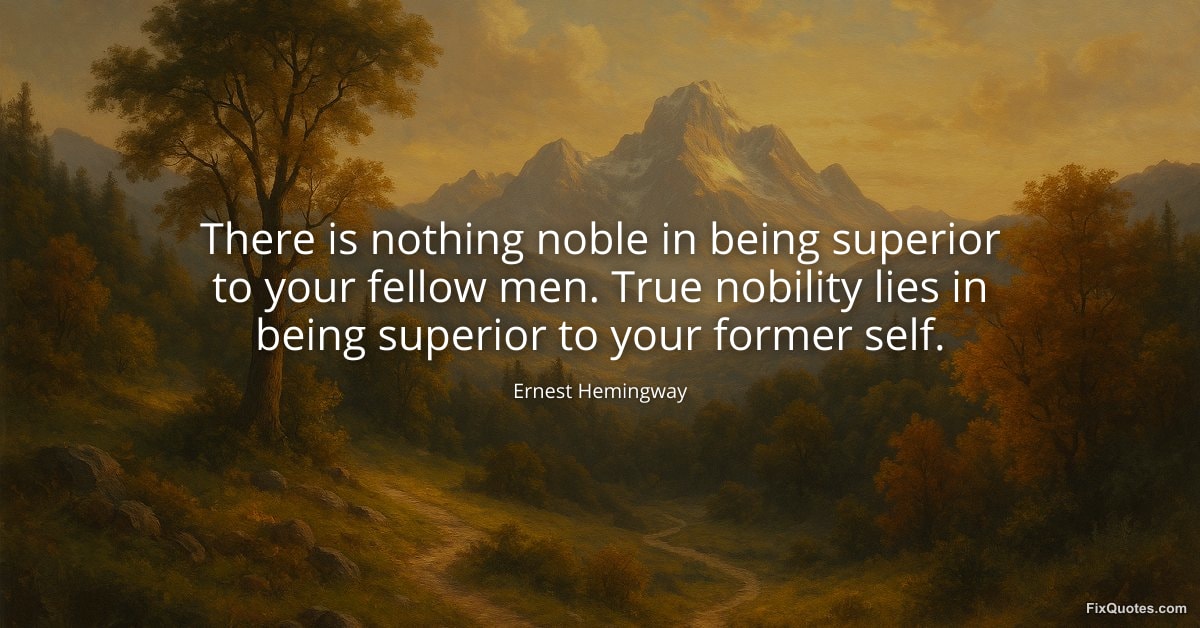
"There is nothing noble in being superior to your fellow men. True nobility lies in being superior to your former self"
About this Quote
The subtext is a rebuke to status as character. Social superiority depends on someone else losing, and that’s why Hemingway calls it “nothing noble”: it’s hierarchy dressed up as virtue. By contrast, “former self” suggests a fight with weakness, fear, complacency, or self-deception - the enemies that populate his fiction more than any villain does. It’s also a way of preserving pride without requiring domination. You can be hard on yourself without turning that hardness into cruelty toward others.
Context matters: Hemingway came of age amid World War I disillusionment, where old ideas of honor were exposed as propaganda, and later wrote in a culture obsessed with toughness, winning, and masculine proof. This sentence offers a quieter code. It keeps the Hemingway myth of grit but redirects it inward, toward discipline and integrity rather than swagger. Nobility, here, is not a public performance; it’s the unseen work of becoming less compromised than you were yesterday.
Quote Details
| Topic | Self-Improvement |
|---|---|
| Source | Later attribution: Vol 2 - Your Duality Within (Anderson Silver, 2019) modern compilationISBN: 9781999527327 · ID: Oj-4DwAAQBAJ
Evidence: A Study of Your Two Distinct & Inner Voices Anderson Silver. " There is nothing noble in being superior to your fellow men . True nobility lies in being superior to your former self . " Ernest Hemingway The first and most crucial point I ... Other candidates (1) Ernest Hemingway (Ernest Hemingway) compilation34.5% d not deserve to live in the world if we did not see it ch 9 in africa a thing is true at first light and a lie by no... |
| Video | Watch Video Quote |
| Featured | This quote was our Quote of the Day on December 17, 2025 |
| Cite |
Citation Formats
APA Style (7th ed.)
Hemingway, Ernest. (2026, January 11). There is nothing noble in being superior to your fellow men. True nobility lies in being superior to your former self. FixQuotes. https://fixquotes.com/quotes/there-is-nothing-noble-in-being-superior-to-your-111909/
Chicago Style
Hemingway, Ernest. "There is nothing noble in being superior to your fellow men. True nobility lies in being superior to your former self." FixQuotes. January 11, 2026. https://fixquotes.com/quotes/there-is-nothing-noble-in-being-superior-to-your-111909/.
MLA Style (9th ed.)
"There is nothing noble in being superior to your fellow men. True nobility lies in being superior to your former self." FixQuotes, 11 Jan. 2026, https://fixquotes.com/quotes/there-is-nothing-noble-in-being-superior-to-your-111909/. Accessed 12 Feb. 2026.