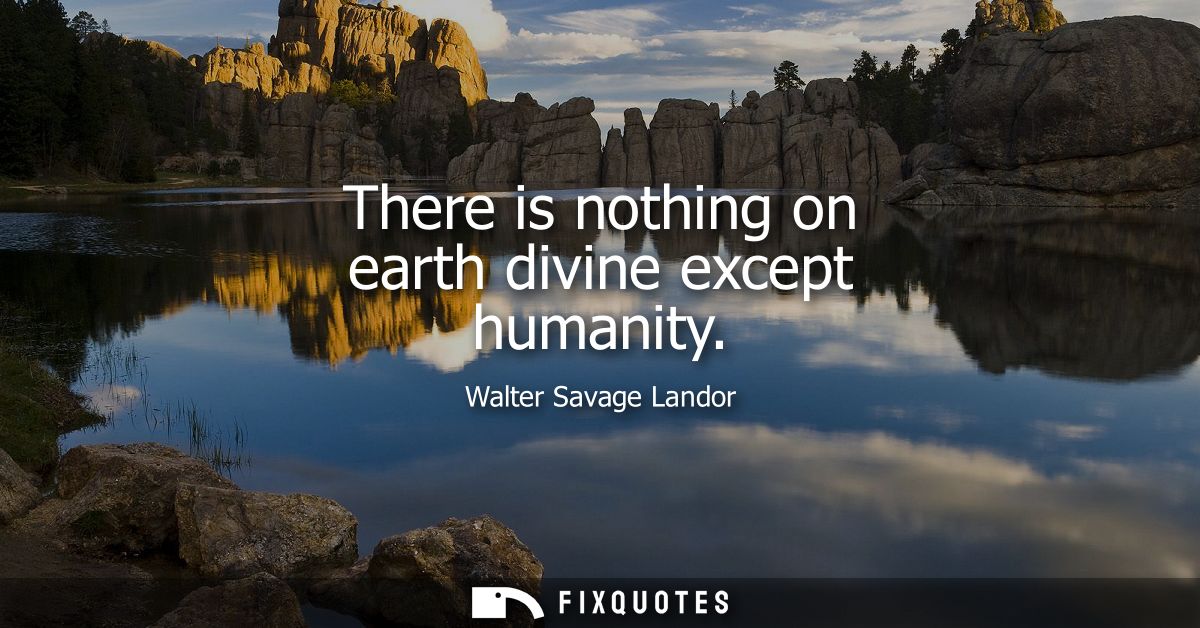
"There is nothing on earth divine except humanity"
About this Quote
Landor’s line is a devotional sentence with its altar deliberately overturned. “Nothing on earth divine” sounds like a hymn opening, the kind that cues reverence and submission, then it swivels: the only thing worthy of that reverence is not heaven, not kings, not creeds, but people. The provocation isn’t atheism so much as a reallocation of the sacred. He keeps the emotional voltage of religious language while stripping it of its usual object, insisting that divinity is a human property we can choose to recognize.
The phrasing matters. “On earth” quietly concedes the metaphysical debate without joining it; Landor doesn’t have to disprove God to make his point. He’s arguing about what should command our moral attention here, in the realm of laws, hunger, war, charity. “Except humanity” lands like a verdict: if you’re looking for holiness, stop outsourcing it to institutions and start measuring society by how it treats bodies and minds.
Context sharpens the edge. Landor wrote out of a long 19th-century collision between Enlightenment humanism and inherited religious authority, with revolutions abroad and reform movements at home. The quote carries the era’s impatience with sanctified hierarchy and its hope that moral legitimacy can be grounded in human dignity instead of divine right.
Subtext: holiness is not a halo; it’s an obligation. If humanity is the only divinity available, then cruelty is not just a sin - it’s a kind of blasphemy against the only sacred thing we can actually reach.
The phrasing matters. “On earth” quietly concedes the metaphysical debate without joining it; Landor doesn’t have to disprove God to make his point. He’s arguing about what should command our moral attention here, in the realm of laws, hunger, war, charity. “Except humanity” lands like a verdict: if you’re looking for holiness, stop outsourcing it to institutions and start measuring society by how it treats bodies and minds.
Context sharpens the edge. Landor wrote out of a long 19th-century collision between Enlightenment humanism and inherited religious authority, with revolutions abroad and reform movements at home. The quote carries the era’s impatience with sanctified hierarchy and its hope that moral legitimacy can be grounded in human dignity instead of divine right.
Subtext: holiness is not a halo; it’s an obligation. If humanity is the only divinity available, then cruelty is not just a sin - it’s a kind of blasphemy against the only sacred thing we can actually reach.
Quote Details
| Topic | Ethics & Morality |
|---|---|
| Source | Help us find the source |
| Cite |
Citation Formats
APA Style (7th ed.)
Landor, Walter Savage. (2026, January 16). There is nothing on earth divine except humanity. FixQuotes. https://fixquotes.com/quotes/there-is-nothing-on-earth-divine-except-humanity-85035/
Chicago Style
Landor, Walter Savage. "There is nothing on earth divine except humanity." FixQuotes. January 16, 2026. https://fixquotes.com/quotes/there-is-nothing-on-earth-divine-except-humanity-85035/.
MLA Style (9th ed.)
"There is nothing on earth divine except humanity." FixQuotes, 16 Jan. 2026, https://fixquotes.com/quotes/there-is-nothing-on-earth-divine-except-humanity-85035/. Accessed 26 Mar. 2026.
More Quotes by Walter
Add to List