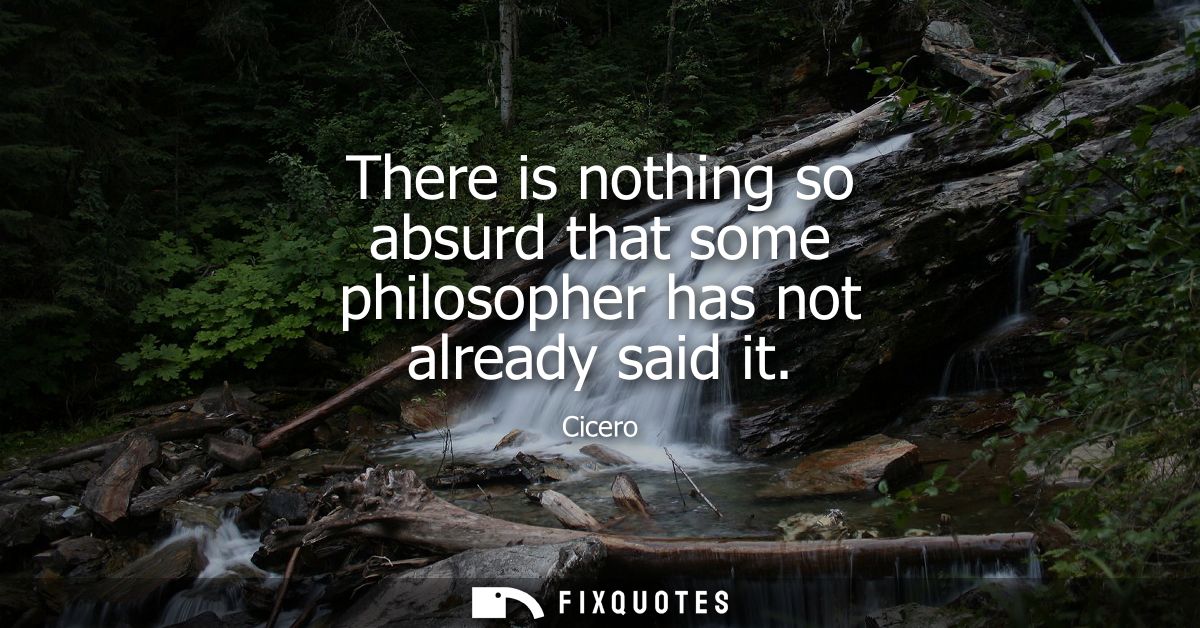
"There is nothing so absurd that some philosopher has not already said it"
About this Quote
Cicero’s line lands like a well-aimed eye-roll from a man who knew too many clever people. It’s not an anti-intellectual tantrum; it’s a warning about what happens when brilliance becomes untethered from judgment. “Nothing so absurd” is deliberately absolute, a rhetorical trapdoor: if philosophers have already said every absurdity, then novelty isn’t proof of truth, and complexity isn’t evidence of wisdom. The joke is barbed because it hits a real temptation in elite culture - the prestige of sounding deep.
The subtext is political. Cicero lived in a late Roman Republic where rhetoric, law, and philosophy weren’t seminar-room hobbies; they were tools in factional conflict and public persuasion. In a world of collapsing norms, arguments could be weaponized, and philosophical schools (Stoics, Epicureans, Skeptics) offered not just ideas but identities. Cicero, a statesman-orator who admired Greek philosophy while translating it for Roman life, is policing the boundary between useful thought and self-indulgent speculation. He’s telling his audience: don’t let a polished argument smuggle nonsense past your common sense.
It also reveals Cicero’s own anxiety about the marketplace of ideas: once you accept that a trained mind can rationalize anything, you’re forced to ask what checks remain. His punchline is a demand for civic responsibility in thinking - philosophy as a discipline, not a license.
The subtext is political. Cicero lived in a late Roman Republic where rhetoric, law, and philosophy weren’t seminar-room hobbies; they were tools in factional conflict and public persuasion. In a world of collapsing norms, arguments could be weaponized, and philosophical schools (Stoics, Epicureans, Skeptics) offered not just ideas but identities. Cicero, a statesman-orator who admired Greek philosophy while translating it for Roman life, is policing the boundary between useful thought and self-indulgent speculation. He’s telling his audience: don’t let a polished argument smuggle nonsense past your common sense.
It also reveals Cicero’s own anxiety about the marketplace of ideas: once you accept that a trained mind can rationalize anything, you’re forced to ask what checks remain. His punchline is a demand for civic responsibility in thinking - philosophy as a discipline, not a license.
Quote Details
| Topic | Witty One-Liners |
|---|---|
| Source | Help us find the source |
| Cite |
Citation Formats
APA Style (7th ed.)
Cicero. (2026, January 14). There is nothing so absurd that some philosopher has not already said it. FixQuotes. https://fixquotes.com/quotes/there-is-nothing-so-absurd-that-some-philosopher-9054/
Chicago Style
Cicero. "There is nothing so absurd that some philosopher has not already said it." FixQuotes. January 14, 2026. https://fixquotes.com/quotes/there-is-nothing-so-absurd-that-some-philosopher-9054/.
MLA Style (9th ed.)
"There is nothing so absurd that some philosopher has not already said it." FixQuotes, 14 Jan. 2026, https://fixquotes.com/quotes/there-is-nothing-so-absurd-that-some-philosopher-9054/. Accessed 27 Mar. 2026.
More Quotes by Cicero
Add to List