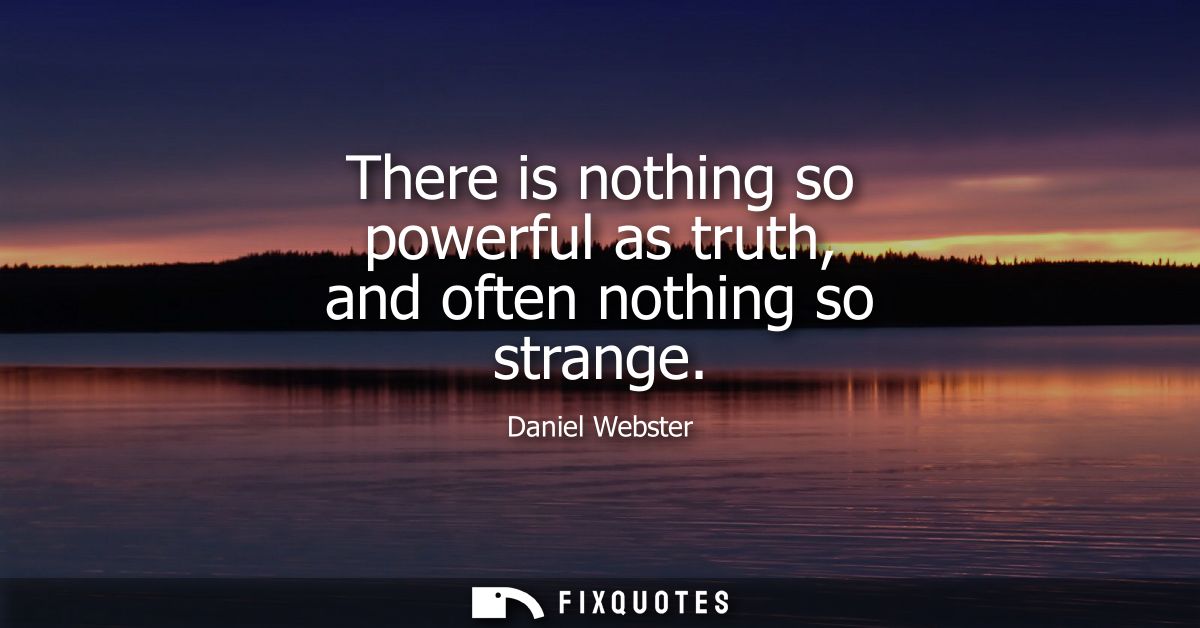
"There is nothing so powerful as truth, and often nothing so strange"
About this Quote
Truth is framed here less as a moral ideal than as a political force: blunt, inevitable, and frequently inconvenient. Daniel Webster, a statesman who made his name in courtrooms and the Senate, isn’t praising honesty for its purity. He’s advertising truth as leverage. In a culture of rhetoric, compromise, and partisan theater, “nothing so powerful” reads like a reminder that facts, once exposed, can rearrange alliances, topple reputations, and force institutions to respond. It’s a claim about consequence, not virtue.
The second clause is where Webster shows his seasoned cynicism. “Often nothing so strange” admits what every political operator knows but rarely dignifies: truth doesn’t arrive neatly packaged for speeches. It can be absurd, contradictory, or emotionally hard to metabolize. Real events rarely respect the storylines leaders want to sell. That “strange” also gestures toward the courtroom feel of Webster’s world, where a single unexpected detail can crack a case open, and where the most persuasive narrative may still be wrong.
The intent is double-edged. On one hand, it elevates truth as the ultimate authority over mere eloquence, a subtle flex from an orator famous for eloquence. On the other, it warns audiences that if they truly want truth, they should be prepared for it to look alien, even embarrassing. The subtext: you can manage optics; you can’t finally manage reality.
The second clause is where Webster shows his seasoned cynicism. “Often nothing so strange” admits what every political operator knows but rarely dignifies: truth doesn’t arrive neatly packaged for speeches. It can be absurd, contradictory, or emotionally hard to metabolize. Real events rarely respect the storylines leaders want to sell. That “strange” also gestures toward the courtroom feel of Webster’s world, where a single unexpected detail can crack a case open, and where the most persuasive narrative may still be wrong.
The intent is double-edged. On one hand, it elevates truth as the ultimate authority over mere eloquence, a subtle flex from an orator famous for eloquence. On the other, it warns audiences that if they truly want truth, they should be prepared for it to look alien, even embarrassing. The subtext: you can manage optics; you can’t finally manage reality.
Quote Details
| Topic | Truth |
|---|---|
| Source | Help us find the source |
| Cite |
Citation Formats
APA Style (7th ed.)
Webster, Daniel. (2026, January 17). There is nothing so powerful as truth, and often nothing so strange. FixQuotes. https://fixquotes.com/quotes/there-is-nothing-so-powerful-as-truth-and-often-34683/
Chicago Style
Webster, Daniel. "There is nothing so powerful as truth, and often nothing so strange." FixQuotes. January 17, 2026. https://fixquotes.com/quotes/there-is-nothing-so-powerful-as-truth-and-often-34683/.
MLA Style (9th ed.)
"There is nothing so powerful as truth, and often nothing so strange." FixQuotes, 17 Jan. 2026, https://fixquotes.com/quotes/there-is-nothing-so-powerful-as-truth-and-often-34683/. Accessed 12 Feb. 2026.
More Quotes by Daniel
Add to List