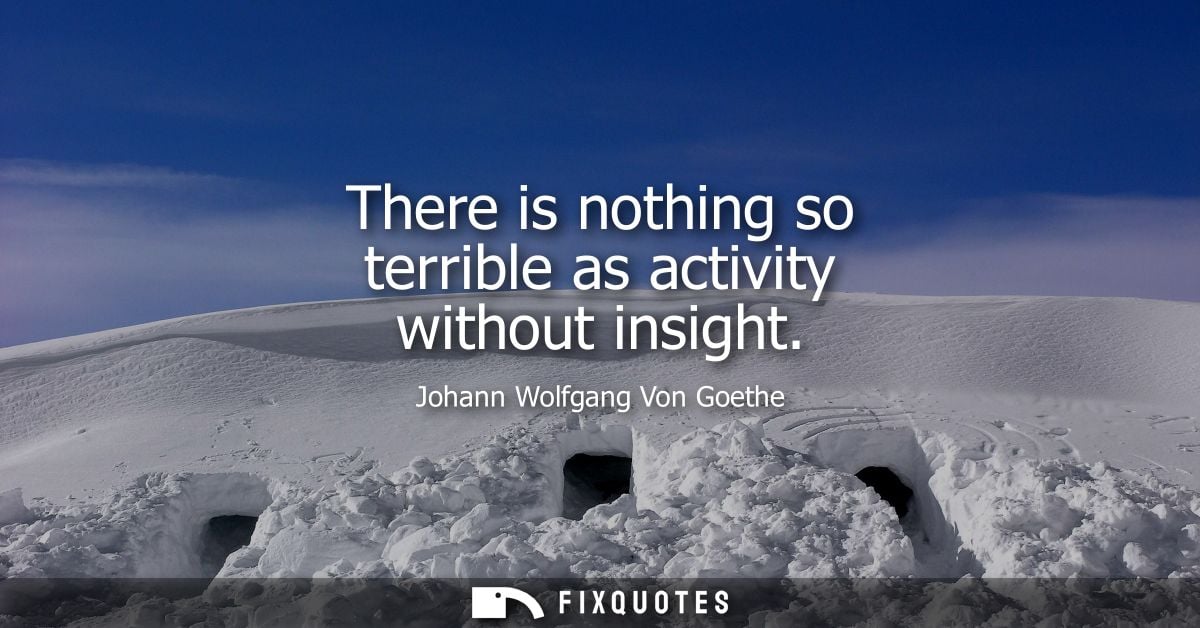
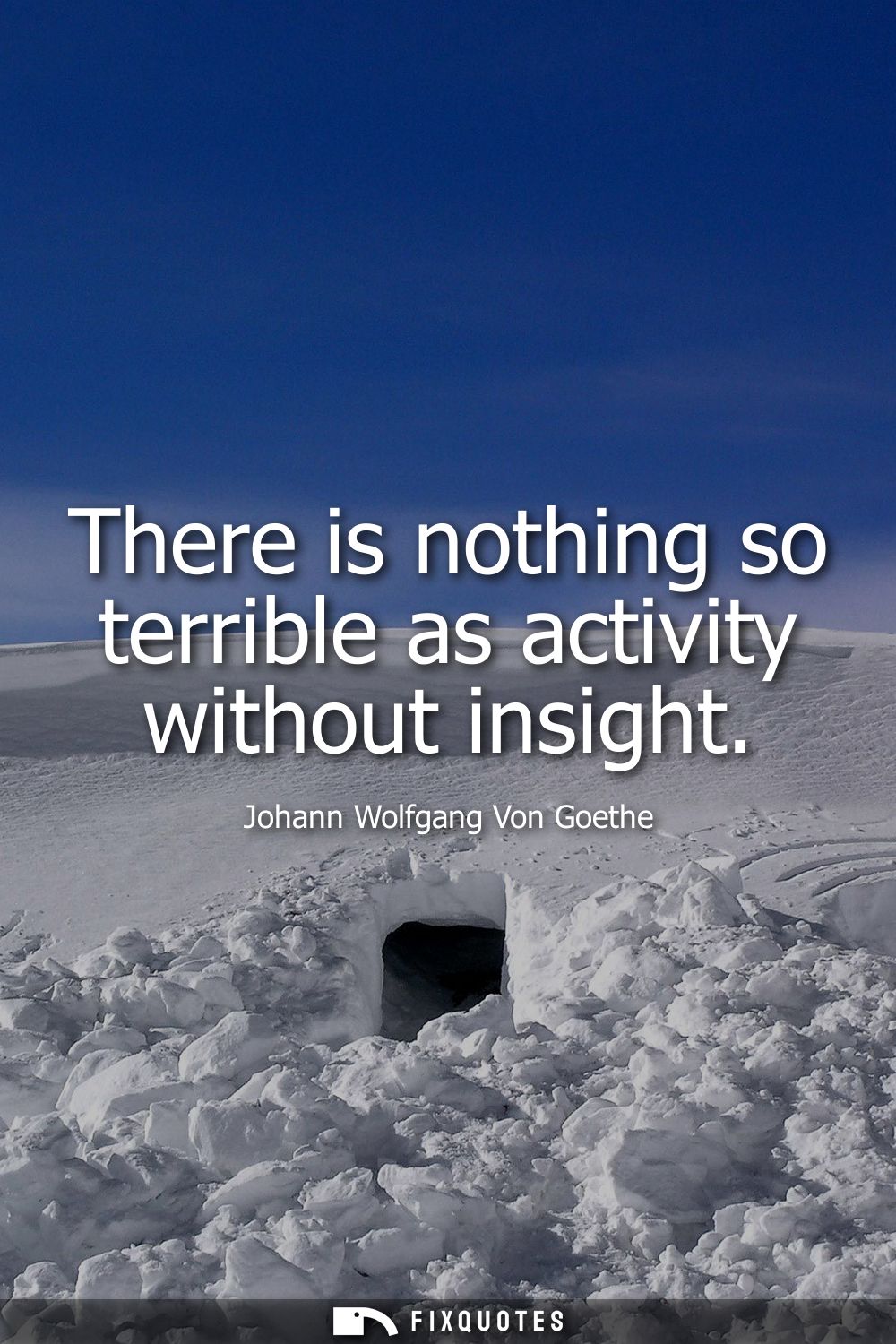
"There is nothing so terrible as activity without insight"
About this Quote
Goethe’s warning lands like a slap at the cult of hustle: motion isn’t automatically progress, and busyness can be its own kind of calamity. “Activity” here isn’t heroic labor; it’s the feverish impulse to do something, anything, to prove we’re useful or righteous. The terror comes from the mismatch between energy and understanding: when insight is absent, action stops being a tool and becomes a weapon pointed in random directions.
The phrasing is deliberately absolute - “nothing so terrible” - because Goethe is aiming at a moral and cultural pathology, not a minor personal flaw. The line carries the subtext of an age accelerating into modernity. Goethe lived through the Enlightenment’s confidence, the French Revolution’s upheaval, and the early churn of industrial change. He saw what happens when ideals, reforms, and innovations sprint ahead of wisdom: revolutions that devour their own aims, systems built faster than they can be ethically understood, people mistaking intensity for clarity.
As a writer steeped in both scientific curiosity and humanist skepticism, Goethe distrusted one-track rationalism and one-track passion alike. Insight, for him, isn’t mere information; it’s perception shaped by experience, patience, and an ability to see consequences. The quote works because it refuses to flatter the reader. It doesn’t condemn laziness; it condemns the far more socially rewarded vice: frantic competence unmoored from reflection. Read now, it skewers performance culture, reactive politics, and “move fast” ideologies - a reminder that the most efficient way to cause damage is to be highly motivated and poorly informed.
The phrasing is deliberately absolute - “nothing so terrible” - because Goethe is aiming at a moral and cultural pathology, not a minor personal flaw. The line carries the subtext of an age accelerating into modernity. Goethe lived through the Enlightenment’s confidence, the French Revolution’s upheaval, and the early churn of industrial change. He saw what happens when ideals, reforms, and innovations sprint ahead of wisdom: revolutions that devour their own aims, systems built faster than they can be ethically understood, people mistaking intensity for clarity.
As a writer steeped in both scientific curiosity and humanist skepticism, Goethe distrusted one-track rationalism and one-track passion alike. Insight, for him, isn’t mere information; it’s perception shaped by experience, patience, and an ability to see consequences. The quote works because it refuses to flatter the reader. It doesn’t condemn laziness; it condemns the far more socially rewarded vice: frantic competence unmoored from reflection. Read now, it skewers performance culture, reactive politics, and “move fast” ideologies - a reminder that the most efficient way to cause damage is to be highly motivated and poorly informed.
Quote Details
| Topic | Wisdom |
|---|---|
| Source | Help us find the source |
| Cite |
Citation Formats
APA Style (7th ed.)
Goethe, Johann Wolfgang Von. (2026, January 15). There is nothing so terrible as activity without insight. FixQuotes. https://fixquotes.com/quotes/there-is-nothing-so-terrible-as-activity-without-7956/
Chicago Style
Goethe, Johann Wolfgang Von. "There is nothing so terrible as activity without insight." FixQuotes. January 15, 2026. https://fixquotes.com/quotes/there-is-nothing-so-terrible-as-activity-without-7956/.
MLA Style (9th ed.)
"There is nothing so terrible as activity without insight." FixQuotes, 15 Jan. 2026, https://fixquotes.com/quotes/there-is-nothing-so-terrible-as-activity-without-7956/. Accessed 6 Mar. 2026.
More Quotes by Johann
Add to List