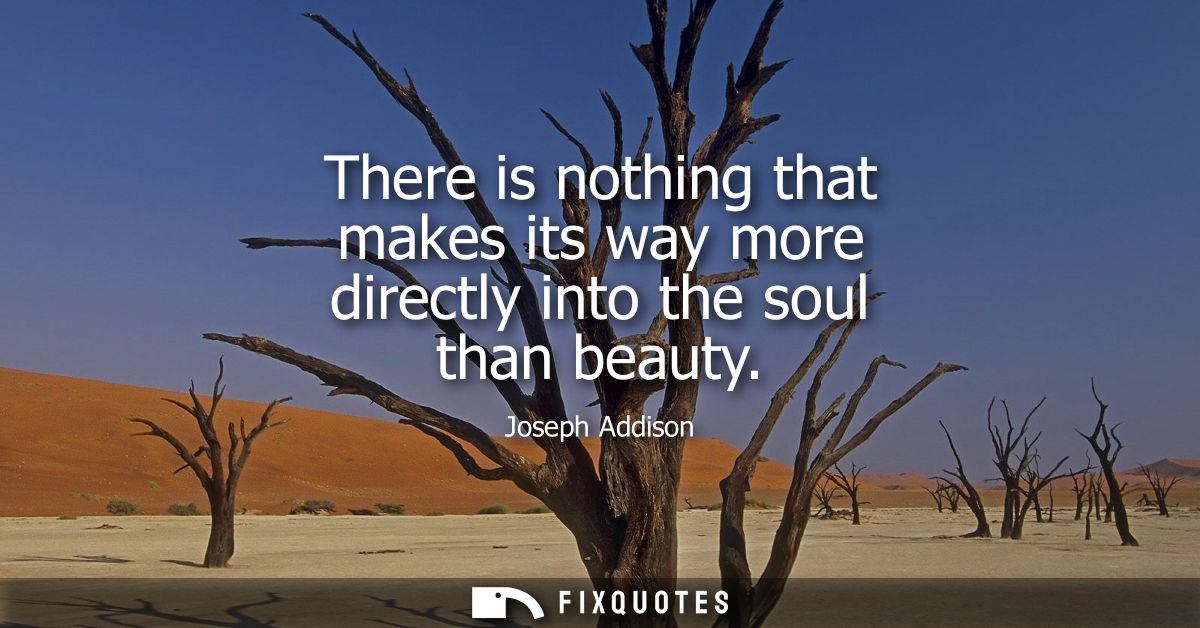
"There is nothing that makes its way more directly into the soul than beauty"
About this Quote
The line works because it flatters the reader while quietly disciplining them. If beauty goes “directly into the soul,” then the soul is porous, impressionable, and trainable. That’s the subtext of the period’s moral psychology: cultivate aesthetic sensibility and you cultivate virtue. In an age anxious about commerce, urban noise, and partisan heat, beauty becomes a soft technology of social order. It civilizes without commanding.
“Nothing” is doing rhetorical heavy lifting. Addison is making an exclusivity claim: not reason, not fear, not self-interest penetrates like beauty does. That absolutism invites agreement because most people recognize the experience: the sudden hush at a landscape, the involuntary pull of music, the way a sentence can land before you’ve decided you believe it.
There’s also a mild warning tucked inside the praise. If beauty enters the soul most directly, it can be used. Addison’s confidence in refinement assumes a benevolent curator. The modern reader hears the second note: whoever controls “beauty” can shape interior life.
Quote Details
| Topic | Art |
|---|---|
| Source | Help us find the source |
| Cite |
Citation Formats
APA Style (7th ed.)
Addison, Joseph. (2026, January 17). There is nothing that makes its way more directly into the soul than beauty. FixQuotes. https://fixquotes.com/quotes/there-is-nothing-that-makes-its-way-more-directly-71699/
Chicago Style
Addison, Joseph. "There is nothing that makes its way more directly into the soul than beauty." FixQuotes. January 17, 2026. https://fixquotes.com/quotes/there-is-nothing-that-makes-its-way-more-directly-71699/.
MLA Style (9th ed.)
"There is nothing that makes its way more directly into the soul than beauty." FixQuotes, 17 Jan. 2026, https://fixquotes.com/quotes/there-is-nothing-that-makes-its-way-more-directly-71699/. Accessed 23 Mar. 2026.