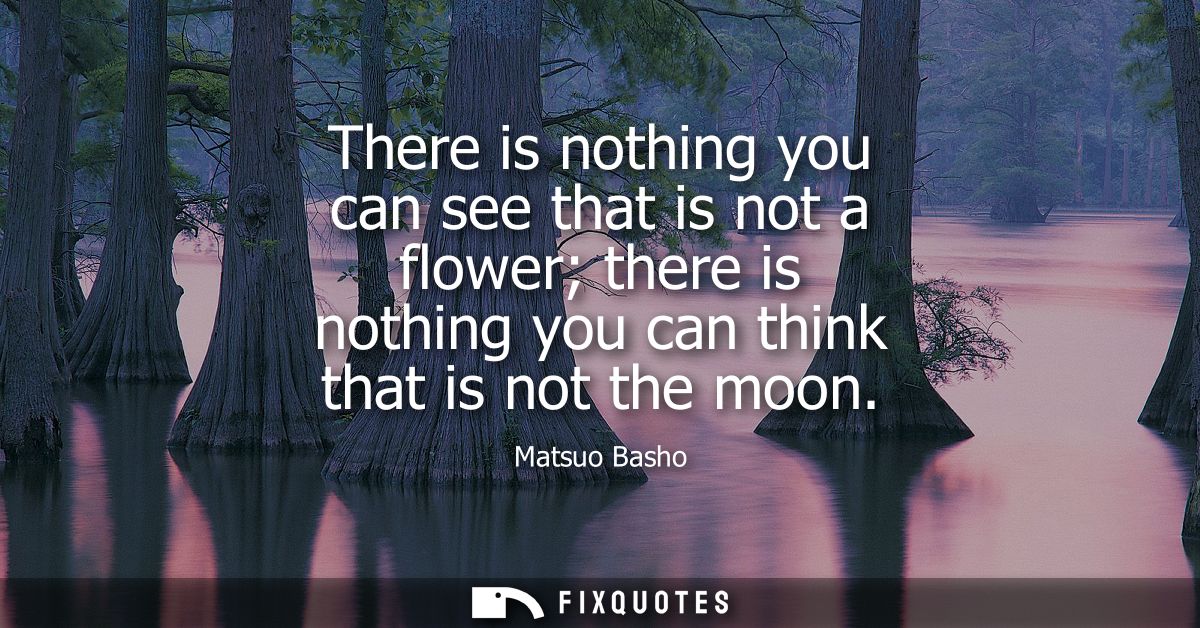
"There is nothing you can see that is not a flower; there is nothing you can think that is not the moon"
About this Quote
The subtext is Zen-adjacent without turning preachy. “Nothing you can see” is an assault on the ego’s habit of sorting reality into useful versus useless, beautiful versus plain. To see a bucket, a crow, a roadside weed as “flower” is to refuse the deadening utilitarian gaze. “Nothing you can think” does the same to the mind’s chatter: even your cleverest idea is still moonlight, not the sun. It’s illumination, not possession.
Context matters: Basho is writing in the haikai/haiku orbit, where compression is ethics. The form trains you to honor surfaces, to distrust grand explanation, to let a single image do the heavy lifting. The intent isn’t to escape the world but to make it vivid again - to insist that perception itself can be devotional, and that thought, for all its swagger, remains borrowed light.
Quote Details
| Topic | Poetry |
|---|---|
| Source | Verified source: Oi no Kobumi (The Knapsack Notebook) (Matsuo Basho, 1694)
Evidence: 見る處花にあらずといふ事なし。おもふ所月にあらずといふ事なし。 (Preface / opening section (序)). The English quote commonly attributed to Bashō (“There is nothing you can see that is not a flower; there is nothing you can think that is not the moon”) is a translation/paraphrase of this line in Bashō’s travel prose work『笈の小文』(Oi no Kobumi), in the opening/preface passage. A University of Virginia Japanese Text Initiative record identifies the work and provides the Japanese text (the page was blocked to fetch in my tool session with a 403, but the bibliographic record snippet and the exact Japanese line are visible in the search result). ([jti.lib.virginia.edu](https://jti.lib.virginia.edu/japanese/basho/oi/MatOino.html?utm_source=openai)). About “first published/spoken”: Bashō died in 1694, and『笈の小文』circulated in manuscript before later printings; pinning a single modern ‘first publication’ date depends on the edition history. What can be verified confidently as the PRIMARY SOURCE is that the wording originates in『笈の小文』, preface. The 1694 date is commonly associated with the work’s composition/late-life compilation (not a modern quote compilation). ([jti.lib.virginia.edu](https://jti.lib.virginia.edu/japanese/basho/oi/MatOino.html?utm_source=openai)). Other candidates (1) The Witches' Almanac: Issue 32, Spring 2013 to Spring 2014 (Theitic, 2012) compilation95.0% ... There is nothing you can see that is not a flower; there is nothing you can think that is not the moon. – Matsuo ... |
| Cite |
Citation Formats
APA Style (7th ed.)
Basho, Matsuo. (2026, February 10). There is nothing you can see that is not a flower; there is nothing you can think that is not the moon. FixQuotes. https://fixquotes.com/quotes/there-is-nothing-you-can-see-that-is-not-a-flower-122985/
Chicago Style
Basho, Matsuo. "There is nothing you can see that is not a flower; there is nothing you can think that is not the moon." FixQuotes. February 10, 2026. https://fixquotes.com/quotes/there-is-nothing-you-can-see-that-is-not-a-flower-122985/.
MLA Style (9th ed.)
"There is nothing you can see that is not a flower; there is nothing you can think that is not the moon." FixQuotes, 10 Feb. 2026, https://fixquotes.com/quotes/there-is-nothing-you-can-see-that-is-not-a-flower-122985/. Accessed 10 Feb. 2026.