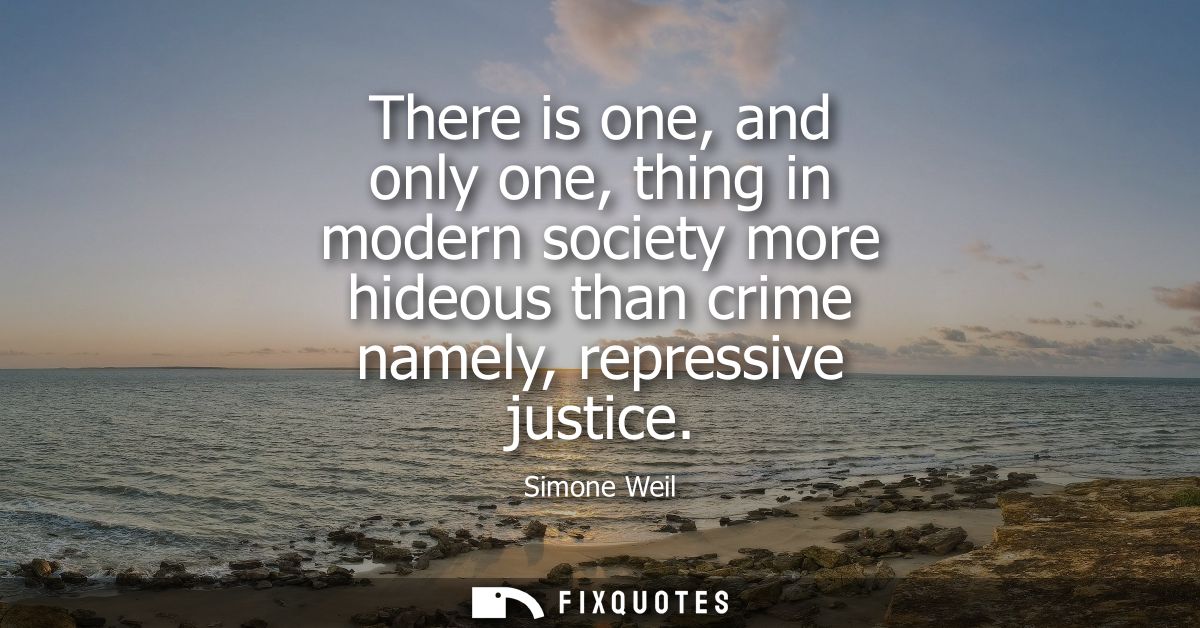
"There is one, and only one, thing in modern society more hideous than crime namely, repressive justice"
About this Quote
Weil’s line is engineered to offend polite instincts: of course crime is hideous, we’re trained to say, and justice is the antidote. She detonates that reflex by specifying not justice as such, but “repressive justice” - the kind that masquerades as moral hygiene while functioning as social control. The phrasing “one, and only one” is a deliberate trapdoor. It mimics the certainty of courtroom language, then flips the verdict onto the court itself.
The intent isn’t to romanticize criminals. It’s to expose how modern states sanitize violence when it’s administered in the name of order. “Repressive” points past individual punishment toward systems: police power, prisons, labor discipline, and the bureaucratic habit of converting human beings into cases. Weil’s deeper target is the moral alchemy that turns suffering into policy and calls it virtue. Crime is ugly because it ruptures the social fabric; repressive justice is uglier because it repairs that rupture by hardening cruelty into an institution, then demanding gratitude for it.
Context matters: Weil writes in a Europe where the machinery of the state is expanding, ideologies are competing to monopolize “law,” and punishment is increasingly rationalized as efficiency. Her politics never settle comfortably into a party line; she distrusts both revolutionary vengeance and conservative sanctimony. The subtext is Christian and anti-idolatrous: when society worships security, justice becomes a ritual sacrifice. The line works because it turns the reader’s appetite for punishment into the object under indictment, asking whether our horror at crime is sincere - or just a pretext to indulge a more orderly brutality.
The intent isn’t to romanticize criminals. It’s to expose how modern states sanitize violence when it’s administered in the name of order. “Repressive” points past individual punishment toward systems: police power, prisons, labor discipline, and the bureaucratic habit of converting human beings into cases. Weil’s deeper target is the moral alchemy that turns suffering into policy and calls it virtue. Crime is ugly because it ruptures the social fabric; repressive justice is uglier because it repairs that rupture by hardening cruelty into an institution, then demanding gratitude for it.
Context matters: Weil writes in a Europe where the machinery of the state is expanding, ideologies are competing to monopolize “law,” and punishment is increasingly rationalized as efficiency. Her politics never settle comfortably into a party line; she distrusts both revolutionary vengeance and conservative sanctimony. The subtext is Christian and anti-idolatrous: when society worships security, justice becomes a ritual sacrifice. The line works because it turns the reader’s appetite for punishment into the object under indictment, asking whether our horror at crime is sincere - or just a pretext to indulge a more orderly brutality.
Quote Details
| Topic | Justice |
|---|---|
| Source | Help us find the source |
More Quotes by Simone
Add to List