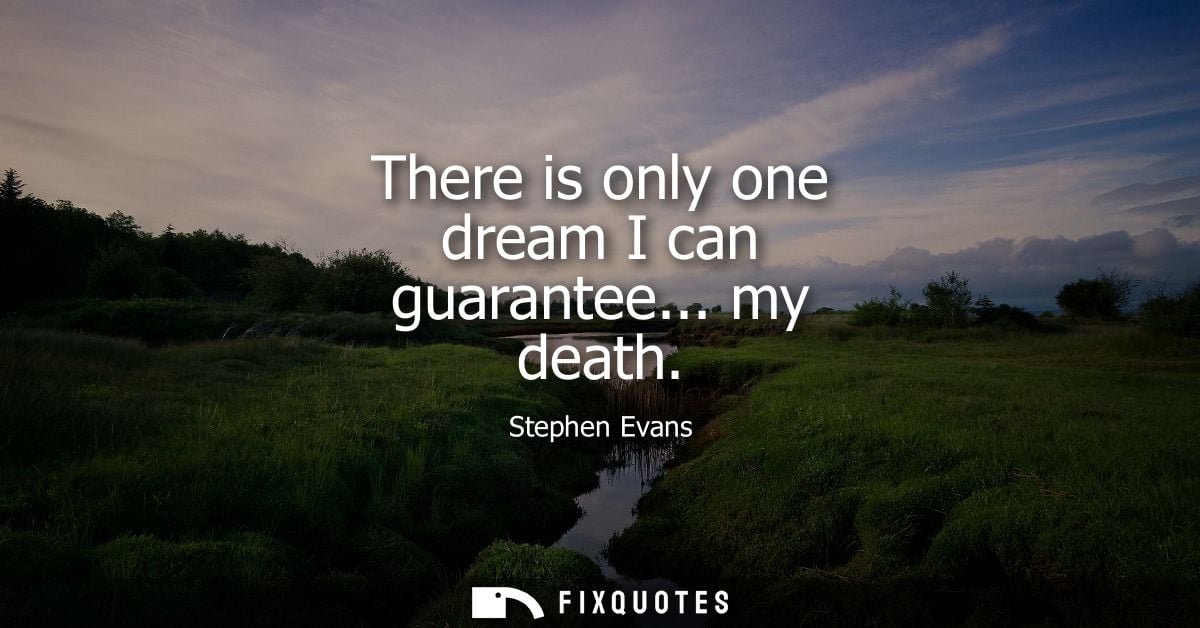
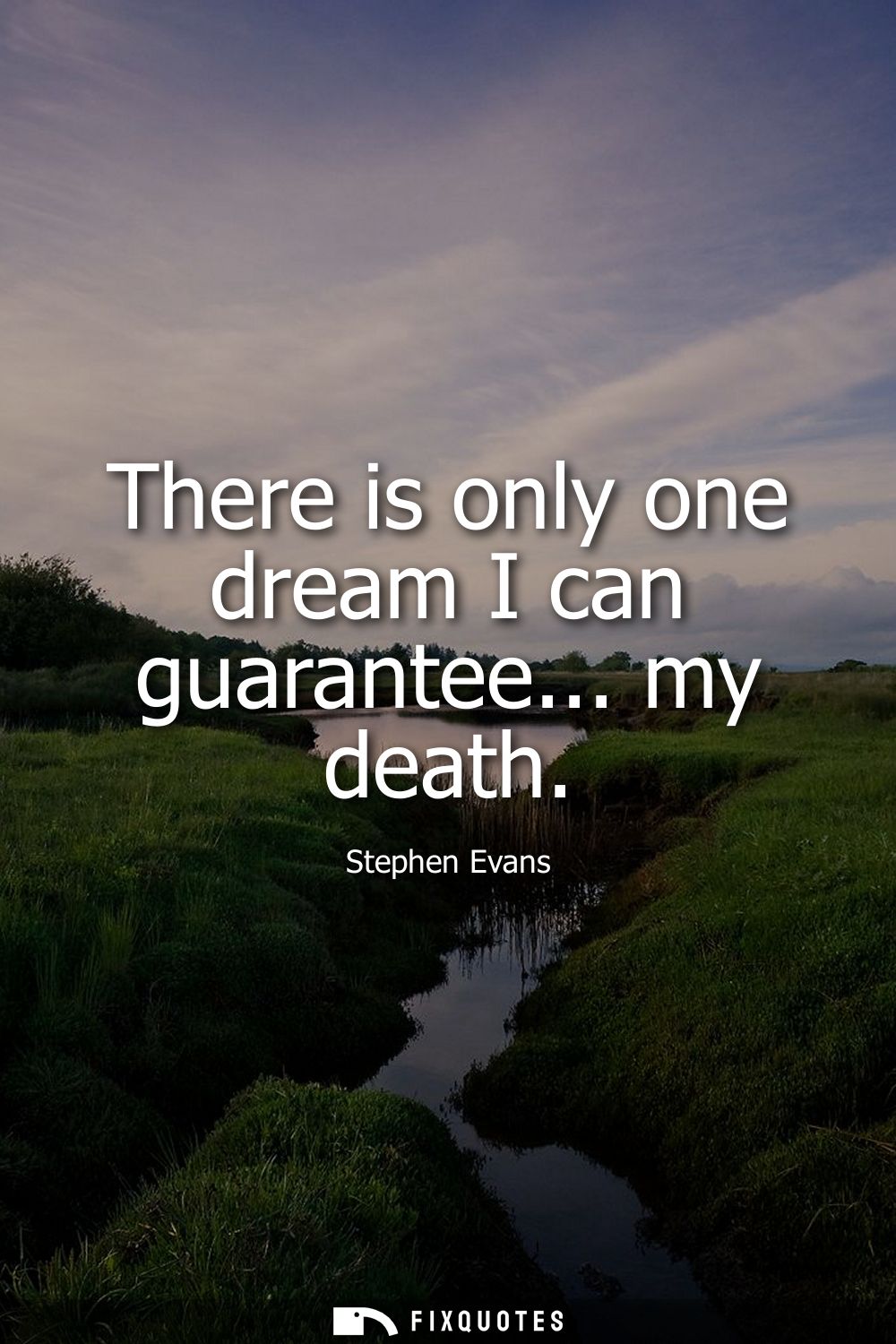
"There is only one dream I can guarantee... my death"
About this Quote
A guarantee is usually a comfort, a warranty stamped on uncertainty. Stephen Evans flips that instinct into a chill punchline: the only dream he can promise is his own death. The line works because it hijacks the language of aspiration. We’re trained to hear “dream” as career, love, legacy - the glossy fuel of self-help culture. Evans drags the word back to its oldest, darker meaning: the private movie we can’t control, the nightly rehearsal for endings.
The ellipsis is doing quiet violence here. “There is only one dream I can guarantee...” sets up the reader for a motivational turn - perseverance, destiny, maybe a hard-won lesson. Instead, the pause becomes a trapdoor. When “my death” lands, it’s not just morbid; it’s corrective. It refuses the modern marketplace of promises, where everyone is selling certainty: productivity hacks, life plans, brand-building. Evans offers the only certainty that can’t be monetized, negotiated, or “manifested.”
Subtextually, it’s also a declaration of authorship limits. A writer can invent worlds, but cannot write an ending that exempts him from being human. That’s the sting: imagination is expansive, mortality is not. Read in a contemporary context - climate anxiety, political instability, burnout culture - the quote feels less like goth theatrics and more like deadpan realism. It’s a bleak joke with an ethical edge: stop confusing desire with destiny, and stop letting other people sell you guarantees they can’t honor.
The ellipsis is doing quiet violence here. “There is only one dream I can guarantee...” sets up the reader for a motivational turn - perseverance, destiny, maybe a hard-won lesson. Instead, the pause becomes a trapdoor. When “my death” lands, it’s not just morbid; it’s corrective. It refuses the modern marketplace of promises, where everyone is selling certainty: productivity hacks, life plans, brand-building. Evans offers the only certainty that can’t be monetized, negotiated, or “manifested.”
Subtextually, it’s also a declaration of authorship limits. A writer can invent worlds, but cannot write an ending that exempts him from being human. That’s the sting: imagination is expansive, mortality is not. Read in a contemporary context - climate anxiety, political instability, burnout culture - the quote feels less like goth theatrics and more like deadpan realism. It’s a bleak joke with an ethical edge: stop confusing desire with destiny, and stop letting other people sell you guarantees they can’t honor.
Quote Details
| Topic | Mortality |
|---|---|
| Source | Help us find the source |
| Cite |
Citation Formats
APA Style (7th ed.)
Evans, Stephen. (2026, January 16). There is only one dream I can guarantee... my death. FixQuotes. https://fixquotes.com/quotes/there-is-only-one-dream-i-can-guarantee-my-death-123460/
Chicago Style
Evans, Stephen. "There is only one dream I can guarantee... my death." FixQuotes. January 16, 2026. https://fixquotes.com/quotes/there-is-only-one-dream-i-can-guarantee-my-death-123460/.
MLA Style (9th ed.)
"There is only one dream I can guarantee... my death." FixQuotes, 16 Jan. 2026, https://fixquotes.com/quotes/there-is-only-one-dream-i-can-guarantee-my-death-123460/. Accessed 16 Feb. 2026.
More Quotes by Stephen
Add to List