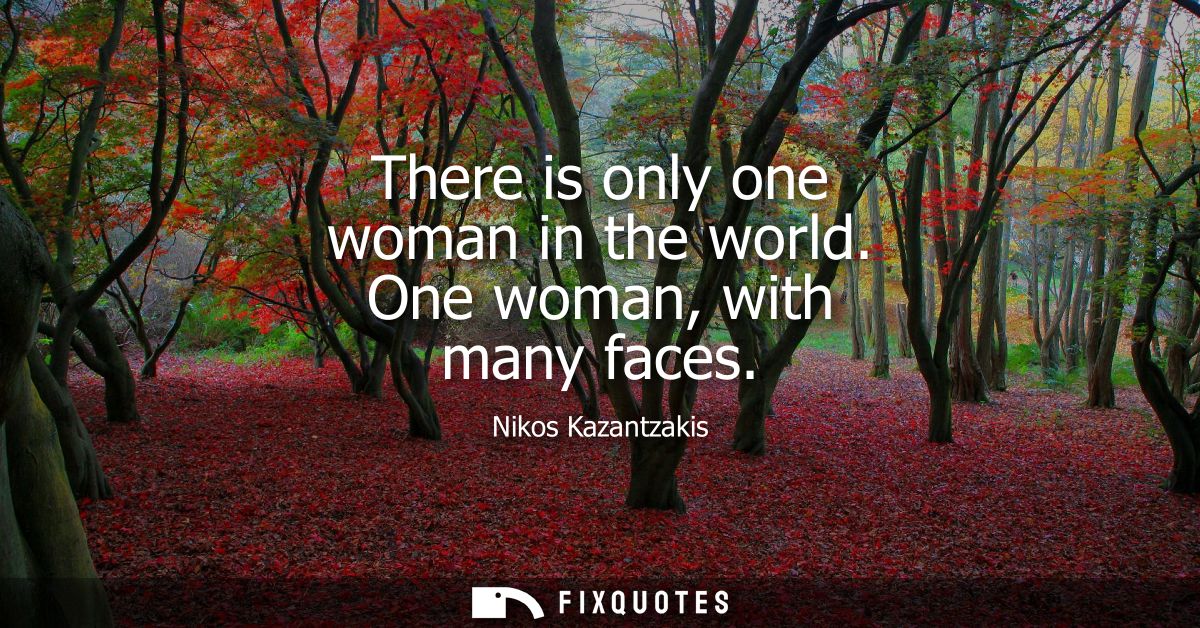
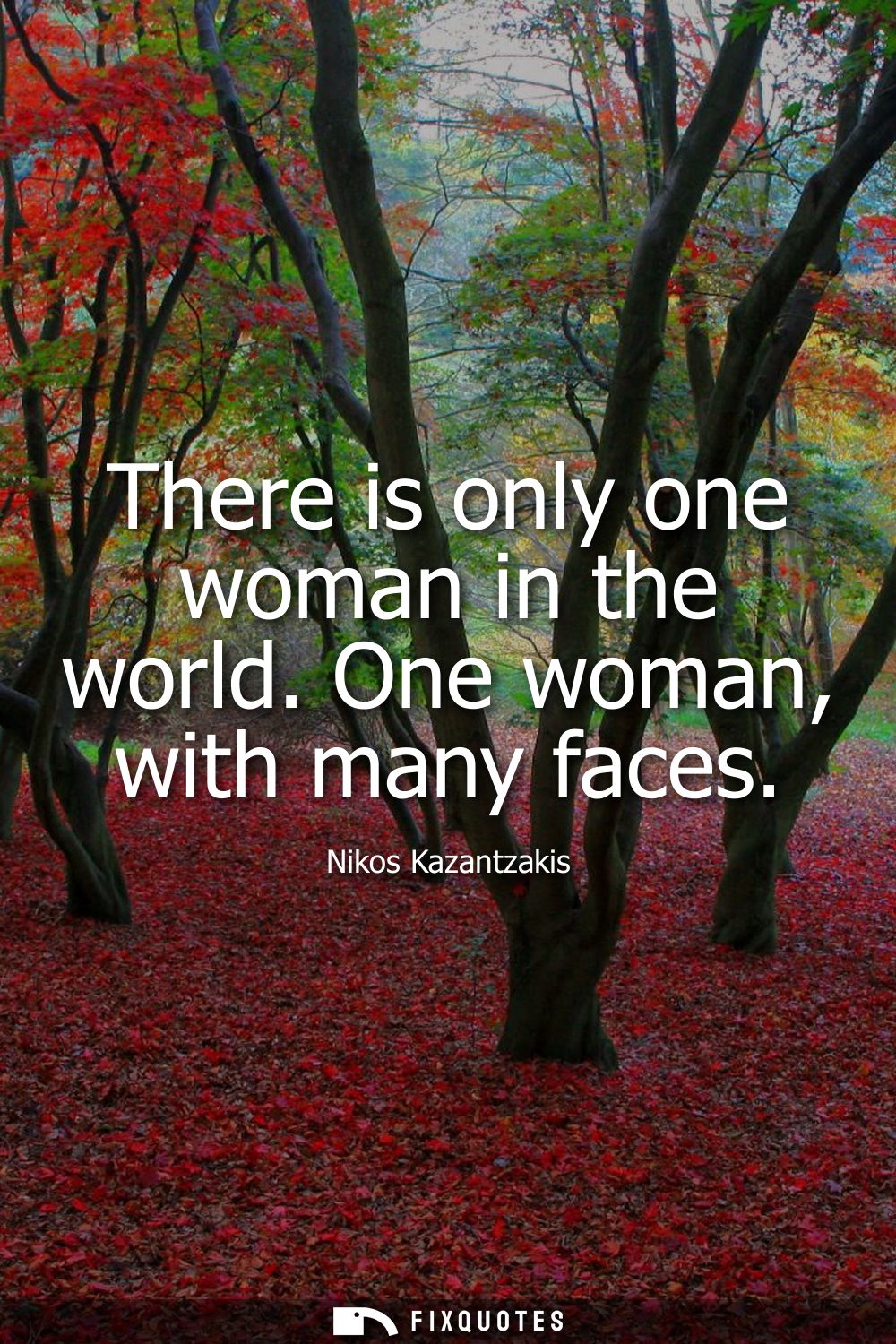
"There is only one woman in the world. One woman, with many faces"
About this Quote
Monogamy gets smuggled in here as metaphysics, and that’s exactly the point. Kazantzakis isn’t offering a sentimental valentine; he’s staging a provocation: the beloved as archetype, the individual as mask. “Only one woman” lands like a dare to ordinary realism, then the second sentence swivels the meaning—“many faces” loosens possession into multiplicity. The line wants you to feel the tension between devotion and the roaming hunger of the imagination.
Kazantzakis wrote in the long wake of Greek modernism, when writers were wrestling with inherited myths and the new psychology of desire. Read against that backdrop, the woman becomes less a person than a vessel for recurrence: mother, lover, saint, temptress, homeland, muse. It’s an idea with ancient Greek pedigree (the many epithets of a single goddess) updated for a 20th-century novelist obsessed with spiritual striving and bodily appetite. The rhetoric is spare, almost biblical in its repetition, which gives it the authority of revelation while hiding its volatility.
Subtext: this isn’t about knowing women; it’s about how men narrate them. “One woman” flatters the speaker’s fidelity, but “many faces” admits that fidelity may be to a fantasy that keeps changing costumes. It’s romantic, yes, but also quietly self-incriminating: the beloved multiplied into types, the self refusing to settle, love recast as an endless act of interpretation.
Kazantzakis wrote in the long wake of Greek modernism, when writers were wrestling with inherited myths and the new psychology of desire. Read against that backdrop, the woman becomes less a person than a vessel for recurrence: mother, lover, saint, temptress, homeland, muse. It’s an idea with ancient Greek pedigree (the many epithets of a single goddess) updated for a 20th-century novelist obsessed with spiritual striving and bodily appetite. The rhetoric is spare, almost biblical in its repetition, which gives it the authority of revelation while hiding its volatility.
Subtext: this isn’t about knowing women; it’s about how men narrate them. “One woman” flatters the speaker’s fidelity, but “many faces” admits that fidelity may be to a fantasy that keeps changing costumes. It’s romantic, yes, but also quietly self-incriminating: the beloved multiplied into types, the self refusing to settle, love recast as an endless act of interpretation.
Quote Details
| Topic | Soulmate |
|---|---|
| Source | Help us find the source |
| Cite |
Citation Formats
APA Style (7th ed.)
Kazantzakis, Nikos. (2026, January 14). There is only one woman in the world. One woman, with many faces. FixQuotes. https://fixquotes.com/quotes/there-is-only-one-woman-in-the-world-one-woman-70358/
Chicago Style
Kazantzakis, Nikos. "There is only one woman in the world. One woman, with many faces." FixQuotes. January 14, 2026. https://fixquotes.com/quotes/there-is-only-one-woman-in-the-world-one-woman-70358/.
MLA Style (9th ed.)
"There is only one woman in the world. One woman, with many faces." FixQuotes, 14 Jan. 2026, https://fixquotes.com/quotes/there-is-only-one-woman-in-the-world-one-woman-70358/. Accessed 5 Feb. 2026.
More Quotes by Nikos
Add to List