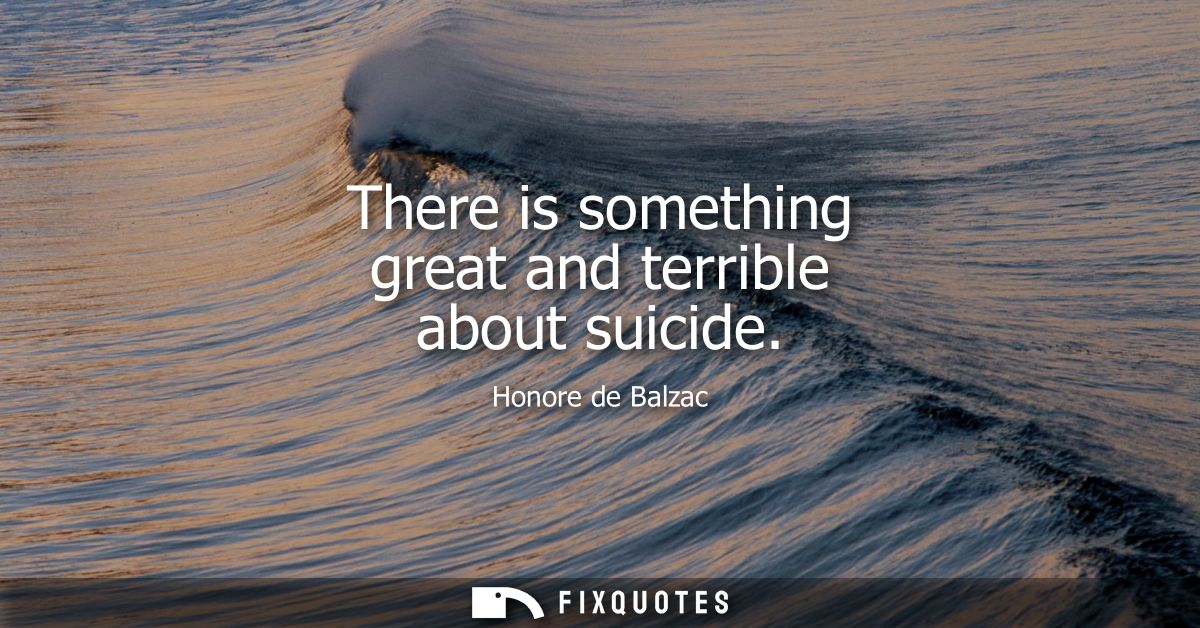
"There is something great and terrible about suicide"
About this Quote
Balzac’s line has the blunt symmetry of a guillotine: “great” paired with “terrible,” grandeur welded to horror. It works because it refuses the reader the comfort of a single moral label. Suicide isn’t framed as sin, weakness, or heroism; it’s framed as an event with scale. “Great” gestures at the terrifying magnitude of the decision, the way it concentrates a whole life’s conflict into one irreversible act. “Terrible” reminds you that magnitude doesn’t equal nobility; the same act can be both a claim of agency and a catastrophic absence.
Coming from a 19th-century realist who anatomized money, ambition, reputation, and social claustrophobia, the subtext is less romantic than it sounds. Balzac understood how people get cornered by institutions that don’t look like villains: debt, status, family obligation, the grinding theater of respectability. In that world, suicide becomes the final veto against a system that keeps extracting. Calling it “great” is a bitter acknowledgment that opting out can feel like the only moment of control left. Calling it “terrible” admits the cost: not just death, but the collapse of relational webs, the brutal silence it leaves behind, the violence done to the self.
The sentence also smuggles in a critique of melodrama. Balzac isn’t aestheticizing suicide; he’s deflating easy stories about it. Greatness here isn’t glamor. It’s the awful recognition that some choices are so absolute they resemble power, even when they’re born from despair.
Coming from a 19th-century realist who anatomized money, ambition, reputation, and social claustrophobia, the subtext is less romantic than it sounds. Balzac understood how people get cornered by institutions that don’t look like villains: debt, status, family obligation, the grinding theater of respectability. In that world, suicide becomes the final veto against a system that keeps extracting. Calling it “great” is a bitter acknowledgment that opting out can feel like the only moment of control left. Calling it “terrible” admits the cost: not just death, but the collapse of relational webs, the brutal silence it leaves behind, the violence done to the self.
The sentence also smuggles in a critique of melodrama. Balzac isn’t aestheticizing suicide; he’s deflating easy stories about it. Greatness here isn’t glamor. It’s the awful recognition that some choices are so absolute they resemble power, even when they’re born from despair.
Quote Details
| Topic | Mortality |
|---|
More Quotes by Honore
Add to List