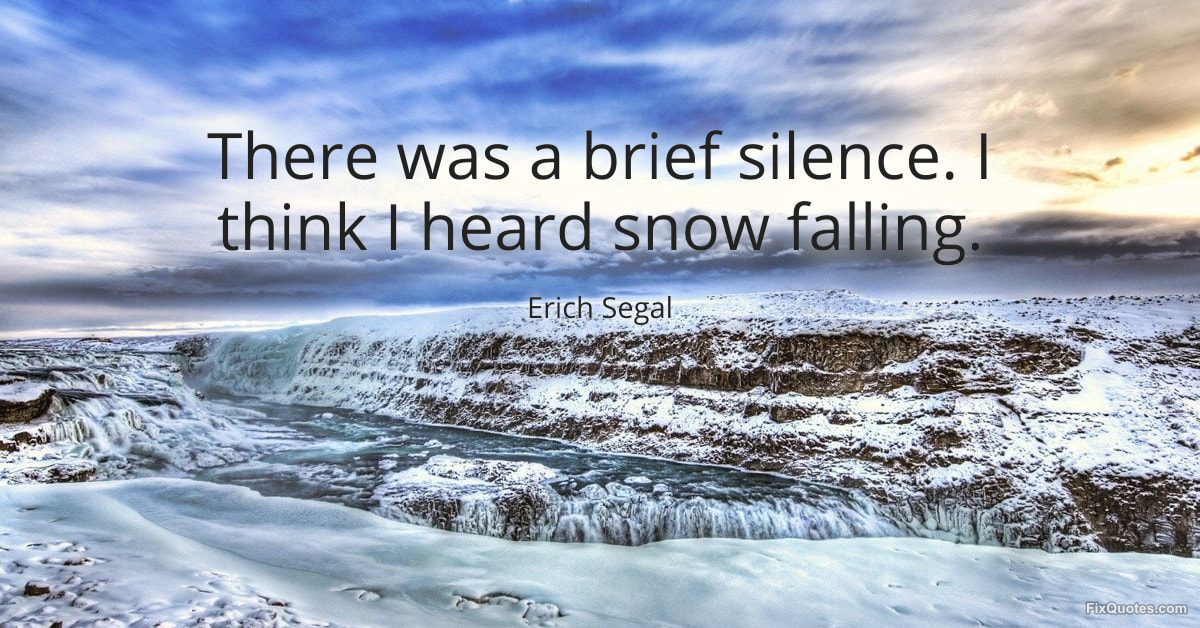
"There was a brief silence. I think I heard snow falling"
About this Quote
Silence is easy to write; making it audible is the trick. Segal’s line lands because it turns an absence of dialogue into a presence in the room, then pushes it one notch further: not just quiet, but the kind of hush so complete you can almost hear the world rearranging itself. “I think” matters. It keeps the moment human-scaled, slightly uncertain, as if the narrator is startled by their own sensitivity. That small hedge also invites us to share the sensation rather than be instructed to feel it.
The snow is doing double work. On the surface, it’s a sensory detail that cools the scene and slows time. Subtextually, snow is cover: it muffles sound, softens edges, and makes everything look temporarily clean. In a Segal novel, that’s rarely innocent. Snow can read like emotional anesthesia, a natural sedative that lets characters survive what they can’t quite say aloud. It also suggests distance and isolation; snowfall separates people even when they’re standing close, creating a thin, cold layer between what’s spoken and what’s true.
Contextually, Segal’s fiction is built on romantic compression: big feelings delivered in clean sentences, drama conveyed through restraint rather than decoration. This line is a writer’s shortcut to intimacy. It implies that something consequential has just been said, or refused, and the aftermath is so charged the narrator starts listening to the weather. The silence isn’t empty; it’s crowded.
The snow is doing double work. On the surface, it’s a sensory detail that cools the scene and slows time. Subtextually, snow is cover: it muffles sound, softens edges, and makes everything look temporarily clean. In a Segal novel, that’s rarely innocent. Snow can read like emotional anesthesia, a natural sedative that lets characters survive what they can’t quite say aloud. It also suggests distance and isolation; snowfall separates people even when they’re standing close, creating a thin, cold layer between what’s spoken and what’s true.
Contextually, Segal’s fiction is built on romantic compression: big feelings delivered in clean sentences, drama conveyed through restraint rather than decoration. This line is a writer’s shortcut to intimacy. It implies that something consequential has just been said, or refused, and the aftermath is so charged the narrator starts listening to the weather. The silence isn’t empty; it’s crowded.
Quote Details
| Topic | Winter |
|---|
More Quotes by Erich
Add to List