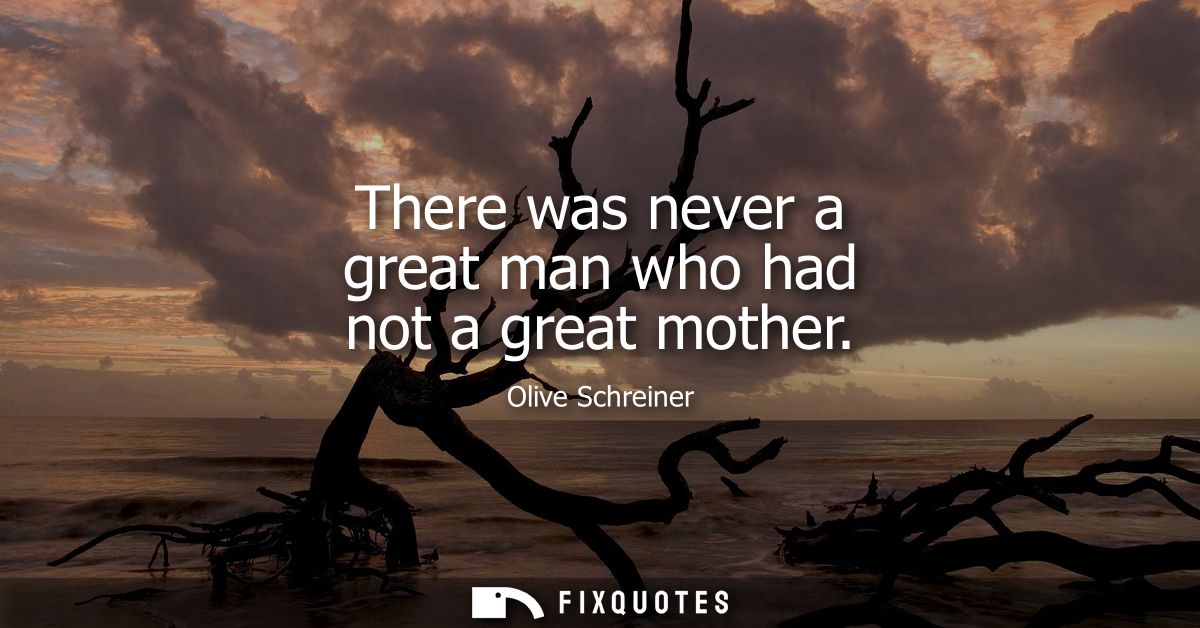
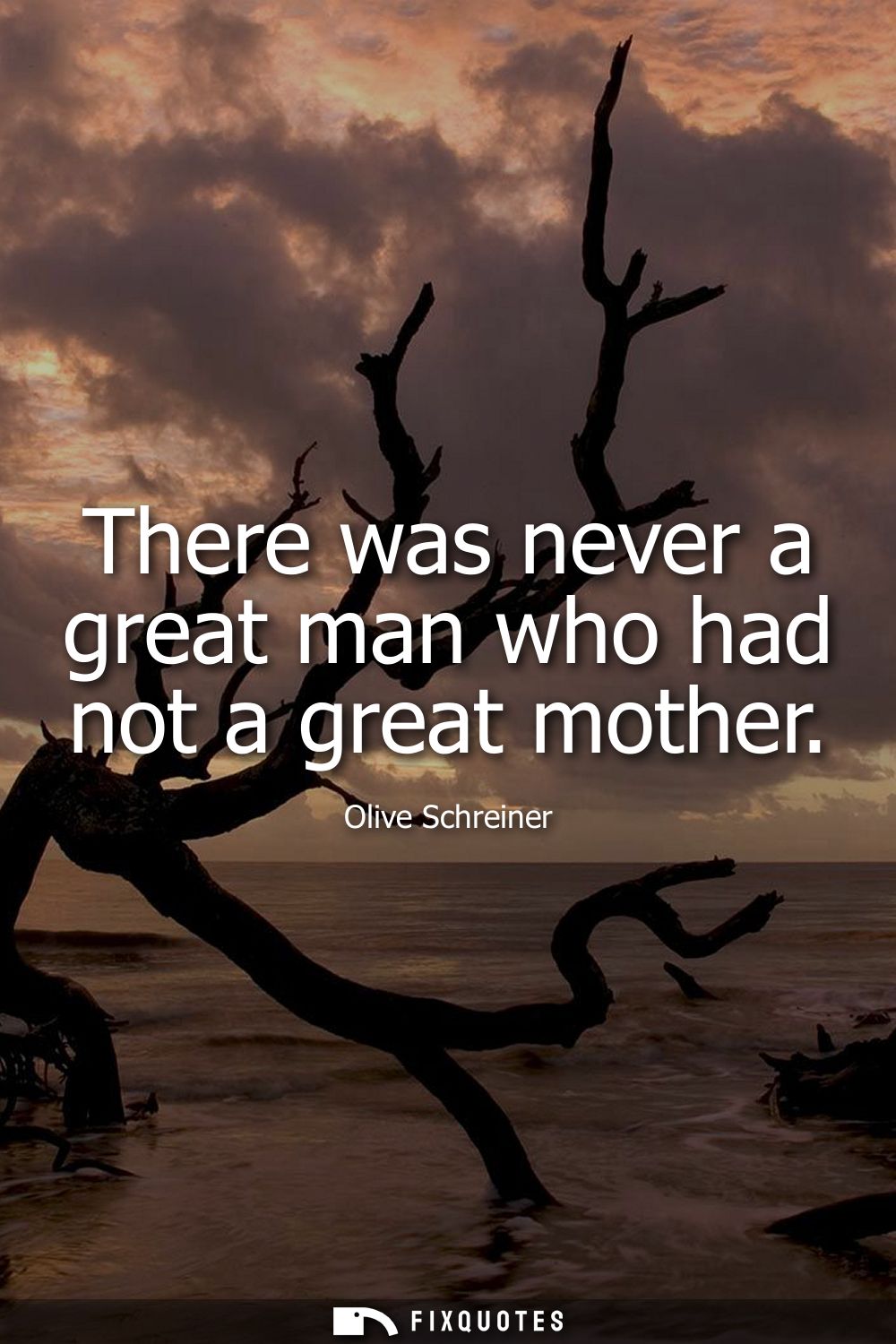
"There was never a great man who had not a great mother"
About this Quote
Schreiner’s line flatters mothers while quietly indicting the cultures that pretend greatness is self-made. “Never” is doing the bullying work here: it’s not a sentimental nod to Mom, it’s a totalizing claim meant to puncture the mythology of the lone male genius. In late-Victorian public life, men were crowned “great” for conquest, governance, and authorship, while women’s labor was filed under nature, duty, or mere background. Schreiner drags that hidden infrastructure into the foreground and dares you to call it incidental.
The phrase “great mother” is also a strategic provocation. It refuses the era’s preferred image of feminine influence as passive moral perfume; it implies skill, force, and formation. Mothers don’t just nurture, they produce citizens, leaders, and thinkers. If the “great man” is the visible peak, the mother is the mountain range beneath him: education before school, discipline before institutions, values before ideology. Schreiner is arguing about power without using the language of parliaments.
There’s subversive irony in the quote’s apparent conservatism. It sounds like domestic praise, but it weaponizes the domestic sphere against male supremacy: if women are essential to “greatness,” then excluding them from rights, education, and public authority isn’t just unjust, it’s self-sabotage. Schreiner, a feminist novelist and essayist, makes the private political with one neat reversal: greatness isn’t an individual trait; it’s an economy of care someone else paid into.
The phrase “great mother” is also a strategic provocation. It refuses the era’s preferred image of feminine influence as passive moral perfume; it implies skill, force, and formation. Mothers don’t just nurture, they produce citizens, leaders, and thinkers. If the “great man” is the visible peak, the mother is the mountain range beneath him: education before school, discipline before institutions, values before ideology. Schreiner is arguing about power without using the language of parliaments.
There’s subversive irony in the quote’s apparent conservatism. It sounds like domestic praise, but it weaponizes the domestic sphere against male supremacy: if women are essential to “greatness,” then excluding them from rights, education, and public authority isn’t just unjust, it’s self-sabotage. Schreiner, a feminist novelist and essayist, makes the private political with one neat reversal: greatness isn’t an individual trait; it’s an economy of care someone else paid into.
Quote Details
| Topic | Mother |
|---|---|
| Source | Evidence:
A Novel Olive Schreiner. them , and they do it ill . -That is true ; they do it exe- crably . It is the work ... There was never a great man who had not a great mother - it is hardly an exaggera- tion . The first six years of our ... |
| Cite |
Citation Formats
APA Style (7th ed.)
Schreiner, Olive. (2026, March 27). There was never a great man who had not a great mother. FixQuotes. https://fixquotes.com/quotes/there-was-never-a-great-man-who-had-not-a-great-93953/
Chicago Style
Schreiner, Olive. "There was never a great man who had not a great mother." FixQuotes. March 27, 2026. https://fixquotes.com/quotes/there-was-never-a-great-man-who-had-not-a-great-93953/.
MLA Style (9th ed.)
"There was never a great man who had not a great mother." FixQuotes, 27 Mar. 2026, https://fixquotes.com/quotes/there-was-never-a-great-man-who-had-not-a-great-93953/. Accessed 3 Apr. 2026.
More Quotes by Olive
Add to List